

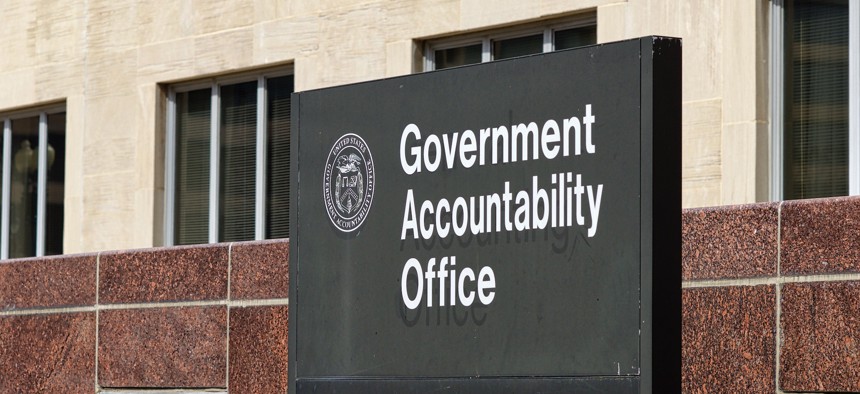
The Government Accountability Office found that an inspector general oversight panel missed certain timeline requirements in 76% of cases. John M. Chase / Getty Images



Who watches the watchdogs? GAO finds flaws in inspector general oversight system
President Donald Trump has fired nearly 20 IGs, and his administration last year put a hold on funding for the Council of the Inspectors General on Integrity and Efficiency.

The Government Accountability Office on Monday released a report finding that the Council of the Inspectors General on Integrity and Efficiency frequently fell short of its own process requirements when investigating misconduct allegations against agency watchdogs.
The central IG group houses the Integrity Committee, which reviews ethics complaints against IGs and other senior OIG personnel. The panel is composed of select IGs as well as representatives from the Office of Government Ethics and FBI. Between 2020 and 2025, it received more than 16,200 complaints and completed 15 investigations.
GAO investigators flagged that a CIGIE staffer is currently disregarding complaints they deem as “frivolous” despite internal policy that such decisions are required to be reviewed by the entity’s legal counsel.
“Without a process for secondary review of the [program manager’s] decisions on what constitutes a frivolous complaint, actions taken by a single individual determine whether to pursue the complaint, even if the determination is not accurate,” they wrote. “Further, it increases the risk that the IC is not reviewing relevant complaints that it should have had an opportunity to consider.”
When the program manager determines that a complaint is significant, they refer it to a group composed of the IC legal counsel and representatives from the Office of Special Counsel and Justice Department to resolve any jurisdictional issues. This group reviewed 460 cases between fiscal 2021 and 2025.
Based on a generalizable sample of 79 cases, however, GAO found that this group missed at least one timeline requirement 76% of the time. As an example, for 49% of complaints, either the DOJ or OSC did not decide whether to forward it to the broader IC within seven business days.
When the IC decides to take on a case, it identifies an IG to investigate the complaint. But GAO reported that the IC conducts "limited oversight” of such investigations.
Notably, investigators found that IGs, when requesting reimbursement from CIGIE for undertaking these investigations, provided supporting documentation that was inconsistent and incomplete in the five cases they reviewed.
“Controls are not in place to ensure that reimbursement requests are properly reviewed for accuracy and to ensure that all costs are necessary and allowable. Rather, payments are made as requested,” they wrote. “This increases the risk that the IC may pay assisting OIGs for unnecessary or unallowable costs in conducting an investigation.”
CIGIE “concurred in principle” with all eight recommendations that GAO made in the report, including to require the IC legal counsel to examine potentially frivolous complaints, improve timelines for reviewing complaints and mandate more information from IGs for investigation reimbursement requests.
While agreeing with the recommendations, CIGIE Chair Cheryl Mason, who is also the Veterans Affairs Department IG, argued that the IC’s effectiveness is undermined by structural problems, namely regular leadership changes and a reliance on other IGs for investigations.
“This decentralized model has contributed in part to timeliness issues and inconsistencies in IC investigations,” she wrote in a letter attached to the report. “Oversight of this model is complicated by the IC’s rotating membership. The six IC members — who serve in these roles as required by the statute — all hold critical, full-time positions elsewhere.”
Good government groups and congressional Democrats have questioned Mason’s ability to operate independently as CIGIE chair because, prior to her confirmation as VA IG, she served as a senior adviser to VA Secretary Doug Collins.
Along with firing nearly 20 IGs, the Trump administration in 2025 blocked CIGIE from receiving funding for more than a month.
If you have a tip that can contribute to our reporting, Sean Michael Newhouse can be reached securely at seanthenewsboy.45 on Signal.
NEXT STORY: Anti-fraud overhaul clears House despite Democratic concerns over privacy and IG independence