

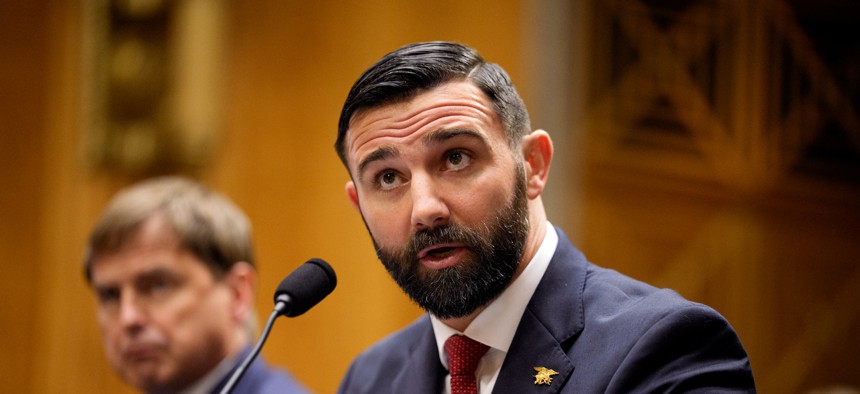
Cameron Hamilton, nominee to be administrator of the Federal Emergency Management Agency, speaks during a hearing on Wednesday. He had previously been fired from serving as acting FEMA chief due to a policy disagreement with President Donald Trump. Andrew Harnik / Getty Images





FEMA, OMB noms grilled on alleged political sway in government assistance
Democratic senators pointed to disparities between what states are approved to receive disaster funding as well as a proposal to require that political appointees approve grant awards to ensure they advance the president’s priorities.

In a hearing on Wednesday that featured nominees to lead a wide range of federal agencies, Senate Democrats on the Homeland Security and Government Affairs Committee focused their questioning on differences in politics possibly preventing individuals and groups from receiving government services.
Cameron Hamilton, the nominee to head the Federal Emergency Management Agency, was asked repeatedly about a March analysis from E&E News that found President Donald Trump approved 23% of disaster funding requests from Democratic-led states compared with 89% for Republican-run states.
“This is unacceptable,” said Sen. Maggie Hassan, D-N.H. “The idea that Americans who need help in the wake of a tornado, or a flood or a hurricane should be treated differently based upon politics is shameful. It is un-American.”
Hamilton agreed that partisanship should not play a role in approving disaster assistance and expressed doubt that the president would reject aid to a state solely because it leans Democrat.
The nominee was also pressed about whether FEMA should increase staffing levels after the Trump administration pushed out thousands of employees.
“They are an exceptional group of public servants, but there needs to be enough of them on the ground,” said Sen. Richard Blumenthal, D-Conn. “And you will lose more of them unless you are adequately staffed.”
Hamilton didn’t directly answer the question, but he did back Homeland Security Secretary Markwayne Mullin’s recent decision to bring back several hundred workers who had been let go.
Last year, Trump fired Hamilton from serving as the acting chief of FEMA after he testified against the elimination of the agency, which contravened the president’s position at the time. In May, however, an administration-backed review panel recommended preserving FEMA but urged state and local governments to take on a larger share of disaster response and recovery.
Hamilton also told the senators that he wants to do a “significant IT overhaul” of the agency and, if confirmed, would release a 30-day report on areas where FEMA can reform.
Trump’s Office of Management and Budget deputy director nominee, Hal Duncan, was also asked about political influence on funding decisions. Sen. Elissa Slotkin, D-Mich., said that a proposed rule from the agency to overhaul the federal grantmaking process, including by requiring political appointees to approve awards to ensure they advance the president’s priorities, was creating a “climate of fear.”
She questioned if a university would lose federal research funding if it allowed a peaceful protest against the war in Iran. Duncan didn’t directly answer the question but said “this administration is committed to gold standard science.”
Duncan currently serves as a senior official at OMB.
Ranking member Gary Peters, D-Mich., said during the hearing that OMB is not cooperating with at least 14 audits from the Government Accountability Office, an independent and nonpartisan watchdog agency in the legislative branch. Likewise, Sen. Joni Ernst, R-Iowa, said that “OMB has been very slow to respond to some of [GAO’s] investigations.”
In response, Duncan said that he would review the audits in question.
“At one point, we had 50 open inquiries from GAO mid-last year,” he said. “We try to respond to GAO inquiries in a responsible time, while still maintaining our ability to carry out our duties in support of the administration.”
OMB Director Russell Vought has previously characterized GAO as “typically wrong and very partisan.” On several occasions, the agency has determined that the administration violated rules around impoundments, which is when the executive branch delays or withholds congressional approved spending.
In addition, Peters criticized the hearing’s “overcrowded lineup” with 11 nominees testifying — five in the first half and the other six in the second half. The ranking member also said that several of the nominees haven’t completed Office of Government Ethics financial disclosures or FBI background checks.
“It certainly looks like this committee's Republican majority is simply rubber stamping the president,” he said.
Chairman Rand Paul, R-Ky., responded that the committee would not vote on a nominee until all ethics reports and background investigations are complete.
Charles Baldis – the nominee to lead the Office of Special Counsel, which protects federal whistleblowers from retaliation – was not asked a specific question throughout the nearly 90-minute hearing.
If you have a tip that can contribute to our reporting, Sean Michael Newhouse can be reached securely at seanthenewsboy.45 on Signal.
NEXT STORY: Who watches the watchdogs? GAO finds flaws in inspector general oversight system