

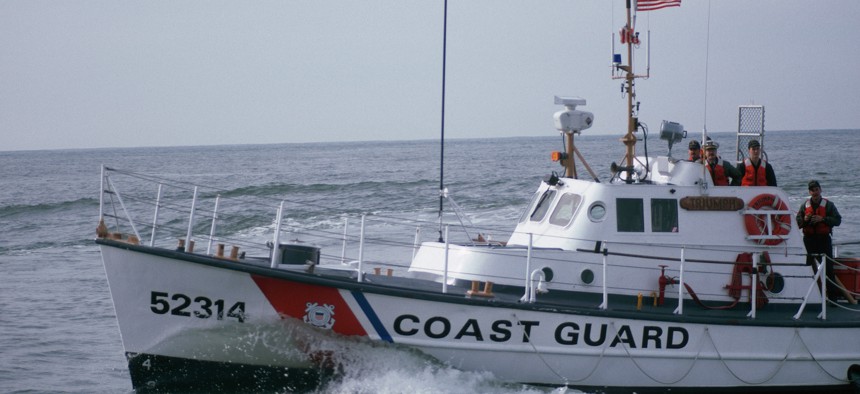
The Government Accountability Office reported there were 112 reported social climate incidents reported to the Coast Guard between fiscal 1998 and 2024. Joel W. Rogers / Getty Images





Watchdog flags gaps in Coast Guard’s handling of discrimination complaints
More than half of the incidents analyzed in the report, which looked back to fiscal 1998, occurred between fiscal 2019 and 2024.

The Government Accountability Office on Wednesday issued a report examining how the Coast Guard handles discrimination against service members, flagging issues with how officials define, collect information about and promote awareness of such incidents.
Specifically, the report addressed social climate incidents, which is when a member of the community commits an act against a Coast Guard member or their family that is "perceived as hostile, harassing or discriminatory in nature, and that is based on unlawful discrimination.”
For example, one incident featured in the report involved a restaurant that allegedly refused to serve a member because of their race.
GAO, however, reported that Coast Guard officials relied on different interpretations for what a social climate incident is and used different standards of proof to substantiate allegations. Investigators blamed this on the service branch’s definition for such an incident, which they wrote is “not clear as to whether it is limited to protected classes only — i.e., race, color, national origin, sex, religion and disability.”
“This could mean service members receive different response options depending on how their local command interprets and applies the policy,” according to the report.
In all, GAO found that there were 112 such reported incidents between fiscal 1998 and 2024, of which 79% dealt with race or ethnicity. More than half of the total incidents occurred between fiscal 2019 and 2024.
Coast Guard officials told investigators that they couldn’t necessarily explain the increase but reasoned that it could be due to members feeling more comfortable reporting incidents of discrimination following the 2020 anti-racism protests.
Investigators also reported that Coast Guard officials “generally implemented policies to address and oversee social climate incidents” but were unable to find any documentation for six reported incidents. Additionally, several commanders said they did not know the service branch published data about such incidents on an internal website.
GAO recommended that the Coast Guard clarify its definition of social climate incident, implement a standard process to collect and retain information about such incidents and ensure commanders are aware of associated tracking tools.
The Homeland Security Department, the Coast Guard’s parent agency, concurred with all three recommendations and said that it would implement them by the end of fiscal 2026.
A Coast Guard spokesperson said in a statement to Government Executive that: “Discrimination against our service members is unacceptable and inconsistent with our core values. We are committed to addressing GAO’s recommendations and strengthening our policies and processes as needed to ensure our workforce and their families are supported and treated with dignity and respect.”
Scrutiny of personnel matters at the Coast Guard has increased in recent years following the disclosure of Operation Fouled Anchor, an internal review of mishandled sexual assault allegations at the service's Academy from the late 1980s to 2006 that officials did not inform Congress about.
Share your experience with us: Sean Michael Newhouse: snewhouse@govexec.com, Signal: seanthenewsboy.45
NEXT STORY: Gabbard’s office denies wrongdoing amid scrutiny over whistleblower complaint