

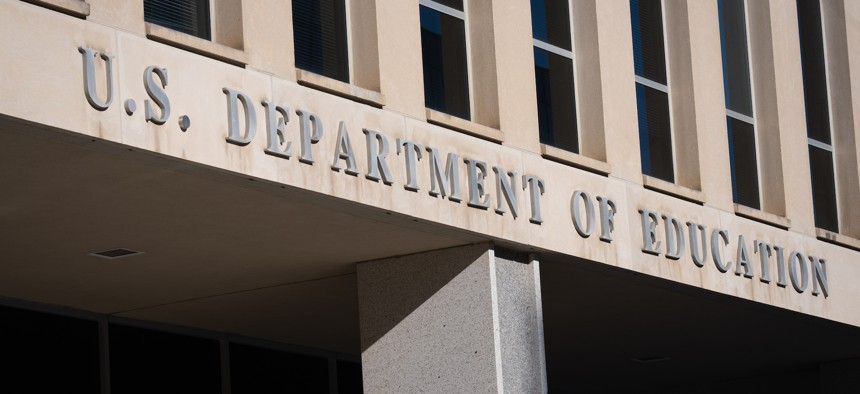
The Education Department recently reversed layoffs that occurred last year at its Office for Civil Rights. Sarah L. Voisin / The Washington Post / Getty Images





Education Department spent up to $38M paying employees not to work before reinstating them, watchdog reports
The Government Accountability Office also reported that the caseload for the department’s Office for Civil Rights increased by an average of 98 cases per week during part of the time that these staffers were on paid leave.

The Government Accountability Office found in a Monday report that the Education Department spent $28.5 million to $38 million on nine months of paid leave for employees in its Office for Civil Rights before ultimately reinstating them to their positions.
In March, the Education Department undertook workforce reductions as part of President Donald Trump’s efforts to downsize the civil service as well as an executive order for the Education secretary to “take all necessary steps to facilitate the closure” of the agency. Eliminating the department would require congressional authorization.
Between reductions in force and buyouts, the administration halved Education’s workforce.
OCR, which enforces federal civil rights laws at educational institutions, also lost 299 of its 575 staffers as a result of the March RIFs and closed seven of its 12 regional offices.
Impacted employees were supposed to be officially separated in June, but their terminations were delayed by multiple preliminary injunctions brought about from several federal lawsuits. Then, in December, Education brought back 85 OCR staffers and rescinded the remaining RIF notices in January.
While that played out, affected OCR employees weren’t allowed to work and were put on paid leave. Based on court filings, GAO determined that Education spent $28.5 million to $38 million compensating such individuals between March and December.
“For more than nine months, Education Secretary Linda McMahon sidelined hundreds of employees at the Office for Civil Rights from the critical work of protecting our nation’s most vulnerable students and families, while costing American taxpayers up to $38 million and mounting a massive backlog of complaints from parents and students,” said Rachel Gittleman, president of American Federation of Government Employees Local 252, which represents Education employees. “Instead of following court orders and federal law, the Trump Administration chose to keep these civil rights professionals on paid administrative leave rather than letting them do their jobs, while students, families and schools paid the price.”
GAO reported, based on Education’s most recent data, that OCR’s caseload increased by an average of 98 cases per week between June 27 and Sept. 23.
Investigators also faulted the department for not being able to show that its analysis of the RIFs at OCR addressed all potential costs and savings associated with them. Specifically, they said officials neglected to consider the costs of severance pay, unemployment insurance and handling appeals or grievances.
“By not demonstrating that its analyses accounted for all potential costs and savings, and by not documenting such analyses, Education lacks reasonable assurance that its RIF actions achieved the stated goal of reforming the federal workforce to maximize efficiency and productivity,” the report said. “Specifically, Education cannot ensure that OCR improved service to the American people, increased productivity or reduced its overall budget for fiscal years 2025 through 2027 with its actions.”
GAO recommended that Education estimate the total costs and savings associated with its March RIFs, but the department disagreed. Officials argued that because OCR staffers were reinstated that such an analysis is unnecessary.
Investigators also reported that, between March and September, OCR received more than 9,000 complaints, resolving about 7,000 of them. Roughly 90% of the resolved cases were dismissed.
Between 2010 and 2020, dismissal was the most common outcome of resolved OCR complaints regarding alleged hostile behaviors, ranging from about half to around 80%, according to a 2021 GAO report. That report noted that the dismissals occurred for a variety of reasons, the most common being that OCR “did not receive consent to disclose the name of the complainant.”
Pursuant to the directive calling for its elimination, Education has detailed dozens of its employees to other departments. Staffers told Government Executive, however, that the transfers, so far, effectively amount to a change in physical location rather than an alteration of work or chain of command.
Trump has twice replaced the acting inspector general for the Education Department. That watchdog is also investigating the consequences of staff reductions at the agency.
Share your news tips with us: Sean Michael Newhouse: snewhouse@govexec.com, Signal: seanthenewsboy.45
NEXT STORY: As Trump administration cries ‘fraud,’ experts worry it does more harm than good