

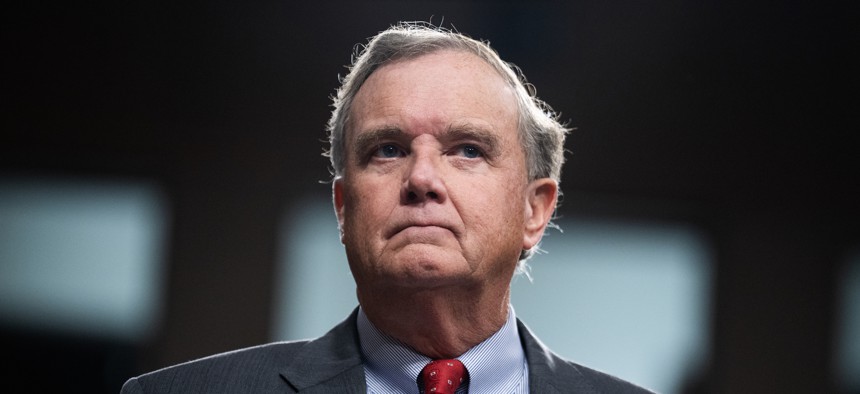
Platte Moring, inspector general for the Defense Department, arrives at his Senate confirmation hearing on Sept. 18, 2025. He served as deputy general counsel at DOD during Trump's first term. Tom Williams / Getty Images




Most newly confirmed Trump inspectors general previously worked in his administration, raising fears about independent agency oversight
These oversight officials may have to recuse themselves from investigations of programs they previously worked on, an expert said.

Just before the holidays, the Senate, in a party-line 53-43 en bloc vote, approved five of President Donald Trump’s picks for agency inspectors general, bringing the total number of confirmed watchdogs during his second term to at least eight.
A Government Executive analysis found that six of these IGs previously worked in Trump’s first or second administration, often at the departments they now have inspection authority over. Government oversight advocates argue these appointments, in conjunction with removals and replacements of several watchdogs last year, could transform the IG position from an independent watchdog into a partisan official.
“The notion that someone can go from member of the administration to independent overseer of that very same administration strains credulity," said Mark Lee Greenblatt, former Interior IG who was fired by Trump in 2025. “I think the American public would be hard pressed to think that a member of the administration can evaluate the programs and individuals of that administration, or the administration officials and programs of the opposing party, in a fair and independent manner.”
For example, IGs Chris Fox for the Intelligence Community, Cheryl Mason at the Veterans Affairs Department and John Walk at the Agriculture Department all previously served as senior advisors to the heads of the agencies that they now audit.
Faith Williams, the director of the Effective and Accountable Government Program at the nonprofit Project on Government Oversight, said this could create issues if one of these IGs reports on a program that they previously worked on, as the officials are subject to standards meant to minimize conflicts of interest.
“If they're following these standards — not just to the letter of the law, but to the spirit — then they should recuse themselves from involvement in [oversight of] any programs that they were personally involved in or substantially involved in during their prior positions,” she said.
Greenblatt contended that even if an IG recuses themselves, there still is an undue influence.
“How can [an IG employee] who is supervised by someone be expected to opine or do work on something that could, in theory, come out negatively for their supervisor?” he asked. “That's just totally untenable.”
Williams and Greenblatt both flagged that Thomas Bell, the IG for the Health and Human Services Department who served at the agency during Trump’s first term, in his Oct. 29 confirmation hearing said he would “examine, evaluate, audit and investigate agencies within HHS to support the initiatives of President Trump and Secretary Robert F. Kennedy Jr.”
“That is just simply not the job of an inspector general,” Williams said. “It is not their job to support the agenda. It’s their job to be a watchdog over the agency.”
The other two IGs who previously worked in the president’s administration are Platte Moring at the Defense Department, who served as deputy general counsel at DOD during Trump’s first term, and William Kirk at the Small Business Administration, who held positions in the Education Department’s Office of General Counsel in Trump’s first and second administration.
Kirk, according to his LinkedIn, also served in several positions at the EPA IG beginning in 2022.
While he didn’t previously work in the Trump administration, Anthony D’Esposito, the new Labor IG, is a former GOP congressman. The New York Times reported in 2024 that he may have violated House ethics rules by apparently hiring his fiancee’s daughter as well as a woman with whom he was alleged to have had an affair.
Senate Democrats expressed concerns during D’Esposito’s Oct. 23 confirmation hearing that he would run for office again, pointing out that his campaign website is still up.
Greenblatt warned that making IGs more political would weaken their effectiveness.
“One of the key parts of the independence of the inspector general system is that the IGs aren't beholden to an individual political party, an individual political actor or an individual political administration. The IGs could serve in office and know that their jobs didn't hang in the balance of an election,” he said. “That gives them great freedom to call balls and strikes fairly based on the evidence. Removing that, where they become a standard political office that turns over with each administration, runs the risk of making them political like the other thousands of partisan positions in government.”
Likewise, Williams said that removing the expectation that IGs can serve across administrations in a nonpartisan fashion would create a “more sycophantic inspector general system.”
“In a fundamental sense, we would lose inspectors general as this nonpartisan, independent watchdog,” she said. “We would lose that foundation upon which their oversight is built.”
Share your experience with us: Sean Michael Newhouse: snewhouse@govexec.com, Signal: seanthenewsboy.45