

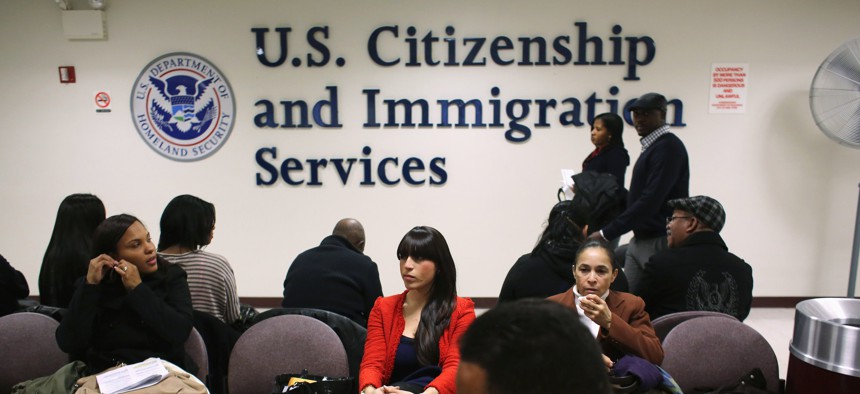
Immigrants wait for their citizenship interviews at the U.S. Citizenship and Immigration Services district office on Jan. 29, 2013, in New York City. USCIS runs the largest federal FOIA program. John Moore / Getty Images




USCIS’ arbitrarily strict FOIA policy is keeping some migrants from receiving their immigration records, whistleblower alleges
In a protected disclosure to Congress, an agency employee claims that U.S. Citizenship and Immigration Services since 2024 has been finding ways to reject Freedom of Information Act requests from migrants in order to make it seem like the agency is complying with a court order.

Updated Monday, Dec. 22
U.S. Citizenship and Immigration Services said in a Dec. 15 compliance report that it reduced its Freedom of Information Act request backlog for certain immigration records by 99.96% over the course of three months, an impressive feat given recent workforce cuts to agency FOIA teams and a 43-day government shutdown occurred during the period.
But a whistleblower disclosure sent to the Senate Homeland Security and Judiciary committees on Friday argues that the agency has adopted unnecessarily strict criteria to summarily reject FOIA requests from migrants seeking documents for their immigration proceedings.
“The circumstances alongside the whistleblower’s disclosures suggest the reported reduction does not reflect timely, good-faith FOIA processing but rather mass closures of requests and other procedural mechanisms that remove requests from the pending inventory without reasonable searches or release of responsive records,” according to the document.
In 2020, a federal judge in Nightingale v. USCIS ordered the agency to meet statutory FOIA deadlines (generally 20-30 business days) for A-File immigration record requests, eliminate existing backlogs for such requests within 60 days and submit quarterly compliance reports.
USCIS’ National Records Center maintains more than 55.6 million immigration records and has the largest federal FOIA program.
In the disclosure submitted to Congress, which was handled by the Government Accountability Project nonprofit, an unnamed disabled Marine veteran who has worked in the agency’s FOIA office for more than a decade alleged that policies enacted over the past two years are intended to manufacture compliance with the Nightingale order.
Due to changes made in May, for example, the whistleblower said that migrants are receiving documents that are entirely redacted due to privacy and law enforcement reasons, even when it is information that the individual themselves provided to the government.
And in September, according to the disclosure, FOIA staff were ordered not to act on requests if the individual lists their attorney’s address instead of their own, which has been a common practice, or the requestor’s last name isn’t exactly the one USCIS has on file.
USCIS said those practices are necessary to comply with privacy laws and ensure records are released to the correct individuals.
A spokesman for the agency, Matthew J. Tragesser, said that "USCIS receives over 2,000 Freedom of Information Act requests a day. Almost all of the requests are for individual immigration files and records. Many people who request records have similar names, birth dates, and countries of birth. To ensure we comply with privacy laws and send the records to the right person, USCIS carefully checks the identity of each requestor. If we can’t definitively identify persons, we let them know why and allow them to correct and resubmit their requests. These efforts help prevent delays for the records requestors who provide all the required information. USCIS is dedicated to handling all records requests fairly, accurately, according to the FOIA and privacy laws and rules.”
As a result, an individual who submitted a FOIA request about a month before their immigration court hearing on Nov. 24 did not receive their records because they provided non-requisite additional information that listed their parents’ maternal surnames, which USCIS did not have listed (e.g. Adam Lane Owen versus Adam Lane). This rejection occurred despite the A-File record numbers matching.
The whistleblower did say that the agency has begun informing individuals if their FOIA request is denied due to mismatched parents’ names, but they also pointed out that such notice is not helpful unless the requestor can successfully guess how their parents are listed in the agency’s records.
To compare, between Sept. 15 and Dec. 15, 2024, USCIS closed 5,427 FOIA requests due to individuals submitting inaccurate or incorrect information, according to the document. During the same period in 2025, there were 41,918 such rejections.
While immigration policy has been a priority of the Trump administration due to mass deportations, the whistleblower disclosure shows that the FOIA issues at USCIS predate the current president.
In fact, the first policy change mentioned in the disclosure occurred in March 2024 when FOIA officials apparently instructed employees to tell Cuban nationals who request certain documents that confirm their entry or admission to the U.S. that there’s no record, even though USCIS could possess that information.
“Without timely access to their records, individuals face a severe information imbalance. Government attorneys and immigration prosecutors have full access to the A-File while the noncitizen and their counsel remain in the dark,” according to the disclosure. “The imbalance caused by FOIA compliance failures creates a substantial and specific threat to public safety as processing delays result in unjust deportations, prolonged detention and family separation.”
The whistleblower said that since they’ve flagged these issues to higher-ups, they’ve been told to “disengage” with USCIS’ counsel, which they interpreted as a gag order, and they were the lowest rated supervisor in their branch for fiscal 2025.
Sen. Dick Durbin, D-Ill., the ranking member of the Senate Judiciary Committee, said that USCIS' actions violate the spirit of the Nightingale court order and may run afoul of FOIA requirements.
"New policies that allow the agency to reject FOIA requests reduce transparency and are just one more way that the Trump-Noem DHS is operating with impunity," the senator said in a statement to Government Executive. "The information contained in case files is vital as immigrants increasingly are the targets of violent enforcement actions and must dispute false narratives devised by this administration."
Share your experience with us: Sean Michael Newhouse: snewhouse@govexec.com, Signal: seanthenewsboy.45