
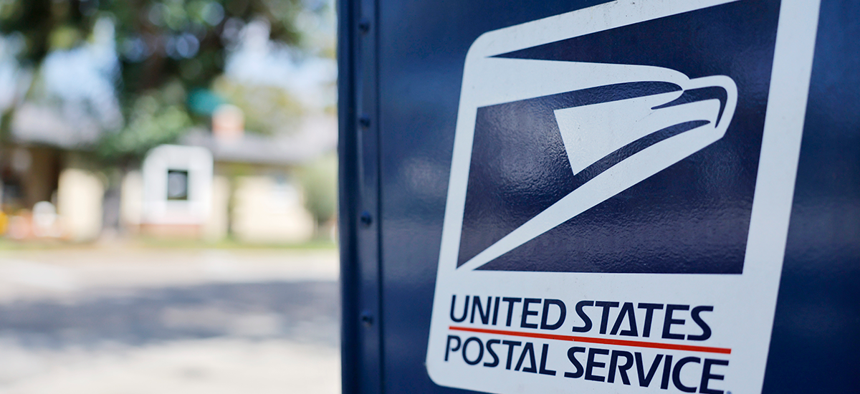
USPS reported a $6.5 billion net loss for fiscal 2026, an improvement from the $9 billion net loss it reported the previous year. Photo by Mario Tama/Getty Images




USPS ‘got the job done’ delivering ballots, as postal unions push to permanently block mail-in voting EO restrictions
A largely self-funded USPS is asking the incoming Democrat-controlled Congress for substantially more funding as the agency looks to avoid running out of cash.

The Postal Service is touting its work delivering mail-in ballots on time during this year’s midterm elections.
Before Election Day, USPS officials told reporters it would be business as usual for the agency. The Supreme Court in mid-September blocked USPS from carrying out a final rule implementing an executive order President Donald Trump signed in March to impose new rules on mail-in voting.
Postmaster General David Steiner applauded the agency’s handling of mail-in ballots at a public meeting of the USPS Board of Governors.
“In this election, the USPS did exactly what we can always do. We put our heads down, and we got the job done,” Steiner said Tuesday.
But postal unions are calling on USPS to permanently rescind its final rule.
The Supreme Court’s ruling leaves the door open to USPS implementing the final rule for the 2028 presidential election. Justice Brett Kavanaugh wrote in his concurring opinion that "there is at least a fair prospect that the final rule falls within the Postal Service’s statutory authority," but added that state and local election officials did “not have sufficient time to reasonably implement the rule” before this year’s elections.
The American Postal Workers Union held a rally outside USPS headquarters calling on the agency to permanently rescinded its final rule.
Rep. James Walkinshaw, D-Va., said that because of a USPS whistleblower report, “we know that the system the Postal Service was planning to implement was highly flawed, would have created mass chaos, [and] could have resulted in tens of thousands of ballots being invalidated.”
APWU President Jonathan Smith said the final rule's return in an upcoming election would unlawfully cede authority from state and local election officials.
“We know that the battle is not over, and the worst thing that can happen is the anxiety, the anguish, goes all over again in 2028, when it’s clear that it’s not postal workers’ responsibility to do this,” Smith said.
National Rural Letter Carriers Association President Patrick Pitts said USPS "has a responsibility to deliver the mail, not police it.”
“Elections are administered by the state and local election officials, not postal employees. Our responsibility is to deliver election mail securely, promptly and without political interference,” Pitts said.
Chelsey Wininger, executive Director of the Democratic Association of Secretaries of State, said the USPS board should make sure this rule “never sees the light of day again.”
“This executive order is trying to force federal control over who can and cannot receive a ballot in the mail. Democratic secretaries fought back to defend voter rights because the Constitution is clear – it is states that have the power to run elections, not the federal government," she said.
Jessica Jones-Capparell, director of government affairs for the League of Women Voters, called on the USPS board to remove "unnecessary barriers of interference.”
“Voting by mail isn’t simply a convenience. It can be the difference between being able to participate in an election and being shut out," she said.
"We require congressional attention"
Meanwhile, the largely self-funded USPS is asking the incoming Democrat-controlled Congress for substantially more funding as the agency looks to avoid running out of cash.
USPS reported a $6.5 billion net loss for fiscal 2026, an improvement from the $9 billion net loss it reported the previous year. Steiner said USPS finances are “moving in the right direction,” but added that the agency “cannot be financially strong in the long term without fundamental changes to our legislatively dictated business model.”
“We require congressional attention and action. We require action fast,” Steiner said.
The USPS Board of Governors approved a $2.01 billion appropriations request for fiscal 2028 – a substantial uptick compared to what the largely self-funded agency normally receives from Congress.
Steiner told Government Executive in an August interview that USPS would need about $4-6 billion in funding from Congress to continue to maintain its current level of service to the public.
USPS Chief Financial Officer Luke Grossman said that request includes cost reimbursement for providing free mail for blind and disabled individuals and mail-in ballots for overseas voters.
It also includes payments due to USPS under the 1993 Revenue Foregone Act and a “public service cost reimbursement” to sustain the agency’s mandate to deliver mail and packages to 169 million addresses six days a week.
Grossman said the appropriations request also covers previously unpaid installments under the Revenue Foregone Act and “unfunded mandates” funding the Postal Inspection Service, the USPS inspector general’s office and the Postal Regulatory Commission.
Grossman said the agency “continues to manage through a cash crisis,” and that “our actions alone cannot resolve the challenges brought on by an outdated business model.”
He said that Congress doesn’t take action to improve the agency’s financial position, “we will need to take other steps to improve our financial position.”
“We will need to make drastic changes in the number of post offices,” Steiner said. “And we will need to look at other areas to generate the cash we need to meet our obligation to our employees.”
The USPS board elected Dan Tangherlini, a former head of the former General Services Administration to serve as its next chairman. Tangherlini applauded the agency’s performance in a “complicated election cycle” in which USPS “took an uncomfortable starring role.”
“We’re proud that the U.S. mail provided again up to the task, he said. “Even under intense scrutiny, the USPS team did what they do every day - showed up and got the job done," he said.
As for the agency’s financial predicament, Tangherlini said that “We are canaries in the vast federal coal mine of fiscal dysfunction.”
“We know how to fix what we call the uncontrollable expenses,” he said. “The reforms are not easy, but they are also not complicated.”
If you have a tip that can contribute to our reporting, Jory Heckman can be securely contacted at jheckman.29 on Signal.
NEXT STORY: Planning behind USDA employee relocations ‘unknown,’ after agency chief rebuffs watchdog’s review