

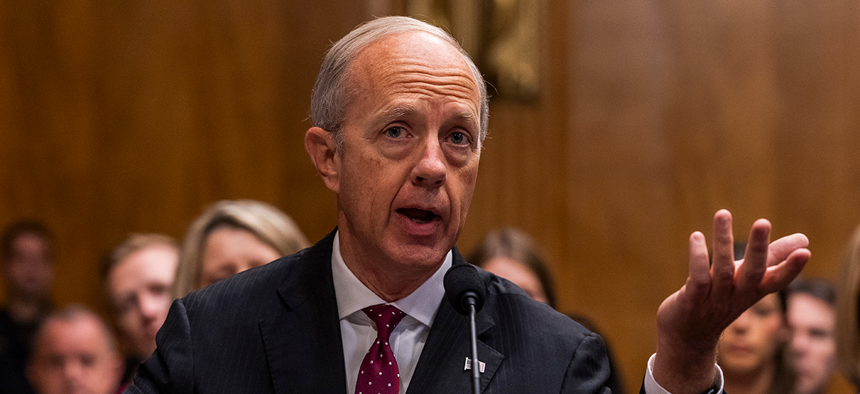
OMB Deputy Director Eric Ueland has been tapped by President Donald Trump to head Government Accountability Office for a 15-year term Photo by Finn Gomez/Getty Images



‘I’m not here as a plant.’ Trump’s GAO pick vows to oversee administration he helped run
Eric Ueland said he had little discussion with his boss, OMB Director Russ Vought, about his interest in leading the Government Accountability Office.
President Donald Trump’s fast-tracked pick to lead a governmentwide watchdog agency took up most of lawmakers’ attention at a truncated confirmation hearing Thursday.
Deputy Office of Management and Budget Director Eric Ueland, tapped by the president to head the Government Accountability Office for a 15-year term, told the Senate Homeland Security and Governmental Affairs Committee that his work at OMB would be a “value-add” for GAO, and that if confirmed, he would focus on “optimizing the work that GAO does.”
Ueland said under his tenure the watchdog agency would offer “blunt straightforward advice about what might work, what could change for the better, and what truly is not working.”
“I understand the responsibilities of the comptroller general. And if I am privileged to be confirmed, I will fully discharge those responsibilities,” Ueland said. “I’m not here as a plant, a stooge, a lackey for anybody. My role and responsibility is to call it as I see it. And that is exactly what I will do if I have the privilege of being confirmed.”
Ueland, a top budget official and close ally of OMB Director Russ Vought, was nominated on Monday by Trump.
The last time lawmakers vetted candidates for GAO’s top job in 2010, the congressional commission spent more than a year on its search. But last week, members of the commission were given 24-hours’ notice on a federal holiday to come up with at least three candidates.
A committee aide told Government Executive that Ueland's nomination was “preordained” by the White House, and that GAO received his ethics paperwork before the commission produced two other names. A growing group of Republican and Democratic lawmakers, current and former GAO officials, former agency watchdogs and federal employee unions have criticized the Trump administration for largely sidelining Congress in the selection process.
Sen. James Lankford, R-Okla., said the “White House seems to have followed the letter of the law” in nominating Ueland for comptroller general.
“I'm not sure the spirit of the law, but they have actually gone through the process that needed to be done to be able to put the nominees forward, to be able to have the input,” Lankford said.
Nevertheless, Lankford said Ueland is a “great candidate in this role for GAO,” given his experience at several executive branch agencies and on Capitol Hill.
Committee Democrats grew frustrated at the hearing over what they saw as Republicans rushing candidates through the Senate confirmation in the final weeks of a lame-duck Congress.
The committee concluded the first panel, which included Ueland and six other nominees, in about 40 minutes. Lawmakers also questioned Trump’s picks to lead the Department of Homeland Security’s cybersecurity agency, the Office of Government Ethics and agency inspector general offices.
Several nominees, including Trump’s picks to serve on the Postal Service Board of Governors and Postal Regulatory Commission, did not receive individual questions from lawmakers. In total, 13 total nominees appeared before the committee.
Ueland told reporters following the first panel that he was “happy to make my case” and “happy to answer any questions from any member on the other side of the aisle.”
If confirmed by the Senate, Ueland would lead an agency responsible for monitoring cases of impoundment, where agencies withhold funding enacted by Congress.
As of July 2025, GAO had opened at least 46 impoundment investigations and found in 12 cases that agencies had violated the Impoundment Control Act. Ueland told the committee that he “took an affirmative decision” not to review those GAO reports that found violations of the Impoundment Control Act.
“It was critical that if I am confirmed and have the privilege of serving as comptroller general that I not prejudge or come to this committee with formed conclusions about what it is that GAO has rendered as advice to Congress,” Ueland said.
Trump has said that he wants to challenge the law against impoundment, which he says is unconstitutional. Vought has declined to commit to adhering to that law when asked during congressional hearings. Ueland said he has made a “clear commitment to continue to follow the process at GAO as comptroller general.”
“What I know is that in the event I have the privilege of confirmation, GAO's process of reviewing claims about potential violations of law, pulling information from the administration as well as reviewing relevant statutes, and then providing responses and information to Congress for potential action will continue to be a hallmark of my tenure as comptroller general and the role and responsibilities of the Government Accountability Office," he said.
Democrats question Ueland’s independence
HSGAC Ranking Member Gary Peters, D-Mich., said that OMB under the Trump administration has not cooperated with any of GAO’s audit work, and told Ueland that “it’s really problematic that you're going to be the person that's supposed to oversee the administration for Congress.”
“How can Congress trust you to run GAO when your agency that you currently help lead is absolutely refusing to cooperate with GAO’s oversight?” Peters said.
Sen. Maggie Hassan, D-N.H., who is expected to serve as the committee’s chairwoman in a Democrat-controlled Congress next year, raised concerns that Ueland as the head of GAO would be asked to oversee administration priorities he helped lead at OMB.
“You've been nominated to serve as a watchdog over your current boss for an agency that your boss thinks shouldn't even exist,” Hassan said. “This is exactly why I am so concerned about your nomination. American taxpayers deserve an independent, nonpartisan watchdog at GAO, which is why Congress put in place a nonpartisan selection process that the White House has chosen to flout in jamming your nomination through the Senate. It is deeply, deeply concerning.”
According to Hassan, Ueland told the committee in writing on Wednesday that “the director of OMB in passing asked me if it was truly my interest to serve as controller general, and I replied, yes, but no discussion occurred.”
Ueland told the committee that was the extent of his conversation with Vought about the position, and that Vought said “essentially nothing” after he said he was interested in the job.
HSGAC Chairman Rand Paul, R-Ky., said the selection process for previous comptrollers general hasn’t been fully bipartisan in the past, and told Ueland that “your character is being attacked, that you won’t act in a fair way.”
The bipartisan commission in 2010 didn’t reach a final agreement on candidates, and Democrats and Republicans sent separate lists — although both lists included some of the same candidates, including former GAO comptroller general Gene Dodaro.
Ueland said he would give GAO a “medium grade” so far in reducing fraud, waste and abuse in government, noting that some things on the agency's high-risk list have been stuck there for decades.
“That's a significant challenge in demonstrating efficacy and results for GAO and the federal government writ large,” Ueland said.
He touted his role in the administration’s push to get more agencies to use the Treasury Department’s “Do Not Pay” dataset, and said that his tenure at OMB would help GAO more effectively reduce improper government spending.
“We're responsible at OMB for working with all departments and agencies on their financial management and control system. Our goal inside the administration that I've worked on is to deliver a clean audit for 2028,” Ueland said. “I look forward to the ability to both take that knowledge forward with GAO as well as help GAO focus and prioritize and amplify the work necessary inside the federal government in order to get there and, more importantly, stay there.”
The Defense Department failed a financial audit for the ninth year in a row, according to an inspector general report released Monday.
“Do you really want this job?”
Michael Chamberlain — the nominee to head the Office of Government Ethics, which works to prevent financial and other conflicts of interest for executive branch employees — also testified on Thursday. He is a right-wing political operative who served in the Education Department during Trump’s first term.
Sen. Richard Blumenthal, D-Conn., criticized the OGE nominee for not agreeing that there was an attack on the Capitol on Jan. 6, 2021.
“How do you expect to be the chief arbiter and adjudicator of ethics in the United States government when you cannot answer a simple factual question?” the lawmaker said. “Do you really want this job?”
Chamberlain responded that “matters that come before OGE and become before me will be evaluated in a fair and impartial manner, regardless of the individuals involved or the administration.”
During the second panel, Blumenthal contrasted the answers between two of the inspector general nominees. Maria D’Avanzo, an attorney who is nominated to be the watchdog at the General Services Administration, answered “I honestly don’t know the numbers” when asked who won the popular vote in 2020 and said there was a “chaotic protest” on Jan. 6 as opposed to an “attack.”
Conversely, Robert Steinau, who would lead the IG at NASA and previously served as an assistant IG in that office, responded that Joe Biden was elected president in 2020 and said “I would call that an attack” about Jan. 6.
“I think adherence to the truth and willingness to state the facts is the threshold qualification for someone in your job, and I'm disappointed, Ms. D’Avanzo, that you are unable to follow that example,” Blumenthal said.
Later, in response to questions from Paul, D’Avanzo testified that she “will be making the decisions as to when to start and stop investigations without impairment from any external force.”
There were two other IG nominees who were part of Thursday’s hearing — Mark Priebe at Education and Dennis Kirk to be the chief watchdog at the Interior Department. Priebe is a former senior official in the Education OIG who appears to have shared pro-Trump social media posts. Kirk is a co-author of Project 2025, and former Interior IG Mark Lee Greenblatt has argued that Kirk’s political background makes it “impossible” for him to provide impartial oversight of the department.
Priebe and Kirk were in the first panel and did not speak much, but when all of the nominees were asked who won the popular vote in 2020, Priebe said “Joe Biden won the popular vote and was certified to be the president” and then Kirk answered “I liked what he said.”
If you have a tip that can contribute to our reporting, Jory Heckman and Sean Michael Newhouse can be securely contacted at jheckman.29 and seanthenewsboy.45 on Signal.
NEXT STORY: Fewer Americans think ICE or the CDC is doing a good job, according to new surveys