

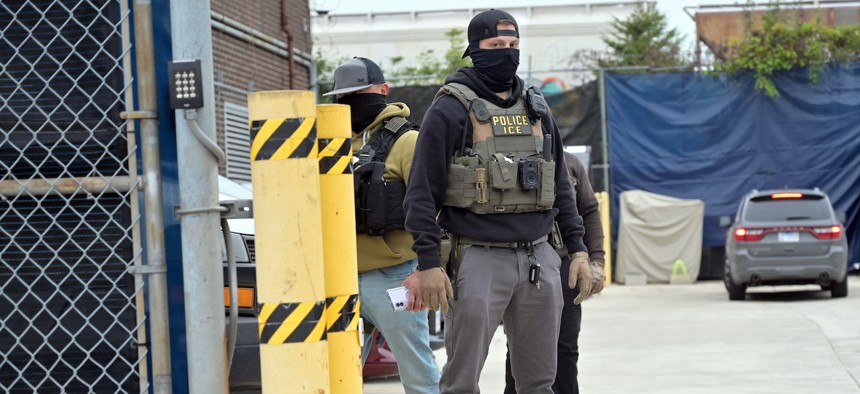
An Immigration and Customs Enforcement (ICE) officer wearing a tactical vests, body camera and face covering stands guard inside the perimeter gate of an ICE processing facility on Sept. 25, 2026, as demonstrators gather outside for an anniversary rally marking one year since the September 2025 protests during Operation Midway Blitz in Broadview, Ill. Jacek Boczarski/Anadolu via Getty Images





ICE resists automatic activation of body cameras despite oversight concerns
Federal investigators found gaps in guidance for immigration officers’ use of body-worn cameras, raising concerns about whether the agencies can ensure the devices are used as required.
Immigration and Customs Enforcement and U.S. Customs and Border Protection need to improve oversight and guidance for federal immigration officers' use of body-worn cameras, according to a Wednesday report from independent federal investigators.
Officials with the Department of Homeland Security, however, resisted a recommendation in the report from the Government Accountability Office that ICE change its current policy, in which agents choose when to manually turn on body cameras, as opposed to automatic activation.
In a response to GAO, the department — which oversees both agencies — argued that automatic activation on a body camera presents a risk to ongoing operations, such as recording sensitive interactions with informants or victims or inadvertently filming bystanders.
GAO said that statement was insufficient. “However, DHS’s response did not include information on environments where automated activation could be effective, or other controls that could help ensure compliance with activating cameras when required by policy,” according to GAO.
Multiple shootings
The report came after multiple high-profile cases of federal immigration officers shooting and killing people during interactions and enforcement actions, prompting calls for wider body camera use.
GAO made seven recommendations to the Department of Homeland Security to update its guidance for body cameras.
The department agreed with six, but disagreed with implementing automated camera activation controls, arguing that ICE’s current policy is sufficient. CBP does have automatic camera activation, which means the body camera turns on and starts recording when a weapon is drawn or emergency lights are turned on.
“Without reliable control activities, ICE risks gaps in documentation and video evidence that can make reviews of incidents more challenging,” according to GAO.
After federal immigration officers killed two U.S. citizens in January during an aggressive deportation drive in Minneapolis, the Trump administration directed body cameras to immigration agents.
In June, there were two back-to-back killings of immigrants in Texas and Maine that prompted border czar Tom Homan to announce that during traffic stops at least one ICE officer will wear a body camera.
Democrats have also pushed for all federal immigration officers to wear body cameras in the wake of the killings and violent interactions from agents that were recorded by bystanders.
Thousands of body cameras distributed
GAO investigators found that as of April, ICE issued 4,800 body cameras, splitting them evenly between its deportation wing of Enforcement and Removal Operations and the investigative law enforcement arm of ICE, Homeland Security Investigations.
And in June, CBP issued approximately 11,500 cameras, mostly to Border Patrol.
But GAO found problems in the cameras’ deployment.
“Most CBP and ICE offices have not developed specific operational guidance that explains how personnel should use, or not use, cameras under their unique operational circumstances,” according to the report. “The lack of guidance at this operational level increases the risk that CBP and ICE personnel will fail to use the cameras as required under policy.”
DHS agreed to the recommendations from GAO that the leaders of ICE and CBP should update their body camera program to include changes in requirements and costs and plan for any contingencies based on current risk.
The department also agreed that CBP and ICE should implement goals to ensure effectiveness for the body-worn camera program and that both agencies should ensure their sub-agencies are also given proper guidance on the expectations and appropriate uses of the body cameras.