

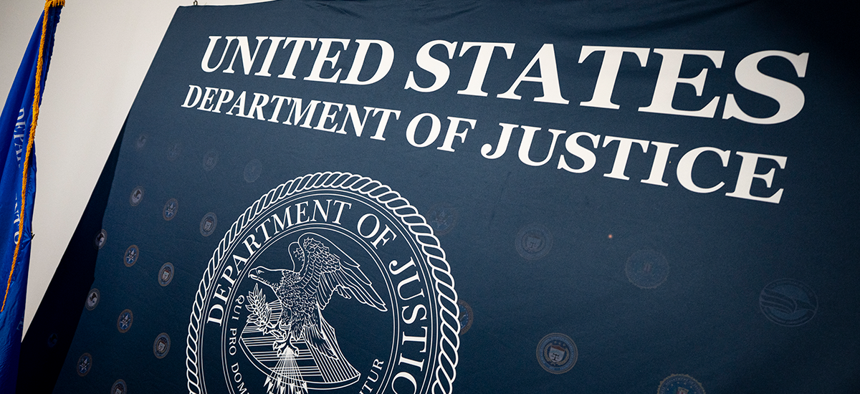
DOJ said its newly established National Fraud Enforcement Division is prosecuting 76 individuals for $490 million in alleged tax fraud schemes. Photo by Al Drago/Getty Image




Enforcement ‘surge’ from DOJ, IRS uncovers $490M in suspected tax fraud
Justice and IRS officials said this won’t be the last tax fraud enforcement surge of its kind. But it's not yet clear how much money they'll claw back from suspected fraudsters.

The Justice Department, working with the IRS and its criminal investigation unit, is stepping up efforts to prosecute cases of alleged tax fraud.
DOJ told reporters Wednesday that the tax section of its newly established National Fraud Enforcement Division is prosecuting 76 individuals for $490 million in alleged tax fraud schemes.
Assistant Attorney General Colin McDonald, the head of DOJ’s National Fraud Enforcement Division, said that those 76 prosecutions are a mix of new charges filed this week, as well as dozens of convictions through guilty pleas and “numerous sentencings of criminal fraudsters”
DOJ is touting these prosecutions as the results of its first “national tax enforcement surge,” which began in early September.
The Government Accountability Office estimates the federal government loses up to $304 billion in tax fraud annually. McDonald said more taxpayer dollars go to fraudsters every year than the combined budgets of the Departments of Energy, Justice, and Interior.
“No program is off limits for a fraudster. They will take from all of us until there is nothing left. Fraud against the American taxpayer is a crisis of the first order,” McDonald said.
Attorney General Todd Blanche launched DOJ’s National Fraud Enforcement Division in April. So far, it has announced over 1,000 fraud enforcement actions.
“Medicaid fraud, SNAP fraud, HUD fraud, Social Security fraud, SBA fraud, and the list goes on and on,” McDonald said.
The alleged fraud cases include individuals who used other people’s names and tax information to file fraudulent tax returns, and instances of payroll tax fraud – in which employers collect Social Security and Medicare taxes from employees, but pocketed the money instead of paying it to the IRS.
“We are not looking for the person who clicked the wrong button on an online filing form.
We are not looking for the family that misread a line on their tax return, or the small business owner who inadvertently claimed a deduction, but turned out not to qualify. We are looking for people who lied on purpose to take money that they knew did not belong to them,” he said.
IRS Chief Executive Officer Frank Bisigano said improving tax compliance is one of his “top priorities,” that the agency is relying on data analytics to “focus our enforcement efforts where they matter most.”
“Technology can only assist us, and we will continue to invest in it and using it to drive these efforts even further,” Bisigano said.
Bisignano and other senior IRS officials recently told employees at an all-staff meeting that the agency will invest in more AI tools to shrink the “tax gap” between the revenue the IRS collects every year, and the amount individuals and companies actually owe.
IRS Criminal Investigation Chief and Chief Tax Compliance Officer Jarod Koopman said the IRS and DOJ “remain committed to uncovering these schemes and holding offenders accountable.”
“If you purposely exploit the tax system, we will find you, we will prosecute you. And we will not stand by as you continue to steal from the American public,” Koopman said.
DOJ and IRS officials said this won’t be the last tax fraud enforcement surge of its kind. But it's not yet clear how much money they'll claw back from suspected fraudsters.
“Without strong security of protocols at the front end, preventing money from going to fraudsters, at that first step, a lot of that money gets spent – it dissipates,” McDonald said, adding that the fraud Enforcement Division is creating an asset forfeiture and recovery team “so that we can go after the proceeds as best that we can.”
“If those proceeds have gone into, for instance, a Rolls-Royce, or a luxury mansion, or an apartment building in Kenya, or whatever it might be, we will be using those tools as effectively as we can to ensure that we can recover that,” McDonald said.
The IRS, under the Biden administration, planned on tapping into billions of dollars from the Inflation Reduction Act to hire more enforcement personnel. In July 2024, it recovered $1 billion from wealthy individuals behind on their tax obligations.
But Congress has rescinded much of the IRA funding, and the IRS has shed more than a quarter of its total workforce under the Trump administration.
The latest data from the Office of Personnel Management shows the IRS has seen a net reduction of 240 employees in the 1811 criminal investigation job series since Jan. 20, 2025.
If you have a tip that can contribute to our reporting, Jory Heckman can be securely contacted at jheckman.29 on Signal.
NEXT STORY: USPS ‘ready to deliver’ ballots in midterms without mail-in voting EO restrictions