

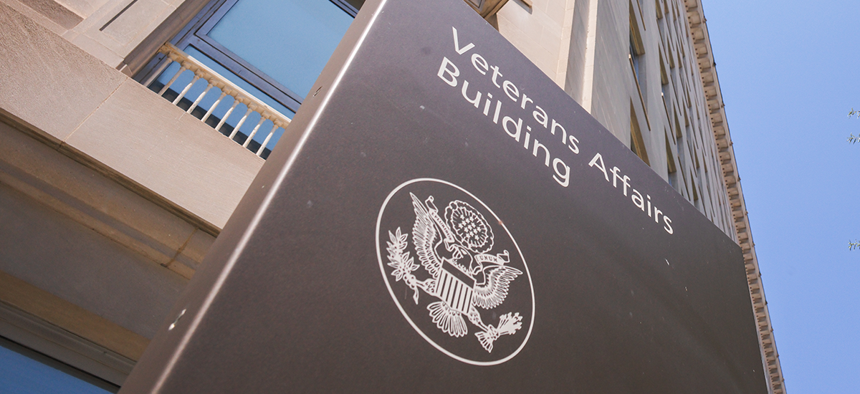
VA officials are contesting what it owes a third-party arbitrator, arguing that it isn’t obligated to pay for services rendered when the agency did not recognize AFGE. David Ake/Getty Images



VA disputes arbitration fees split with union it’s fighting to no longer recognize
VA officials say the agency will pay a "portion" of what a third-party arbitrator billed it, but is "unable to pay” for services rendered when VA didn't officially recognize its largest union.

The Veterans Affairs Department is disputing what it owes to a third-party arbitrator who recently settled a dispute between the VA and a union it is fighting to no longer recognize.
Arbitrator James M. Cooney determined in April that the VA violated its 2023 master agreement with the American Federation of Government Employees when it refused to grant official time to representatives AFGE Local 0025, which is based in Hagerstown, Md.
Cooney ordered the VA to “cease and desist from refusing to recognize the Union.” He also ordered the agency to provide back pay with interest, and restore leave time to union representatives who were improperly denied official time.
Official time is a practice in which union officials at federal agencies may be compensated for representational work, including contract negotiations and representing employees in grievance proceedings and internal investigations.
VA terminated most of its union contracts on Aug. 6, 2025. But a federal judge in Rhode Island granted a preliminary injunction on March 13, 2026 that required the VA to reinstate its contract with AFGE. The agency has attempted to re-terminate its contract with AFGE following the preliminary injunction, but has been rejected each time by U.S. District Court Judge Melissa DuBose.
This legal battle traces back to President Donald Trump’s March 2025 executive order that banned collective bargaining at the VA and many other federal agencies under the auspices of national security.
VA officials, however, are contesting what it owes the arbitrator in this case, arguing that it isn’t obligated to pay for services rendered when the agency did not recognize AFGE.
In emails obtained by Government Executive, Christopher Richins, an attorney with the VA’s Office of General, told the arbitrator that “the Agency may pay only for services rendered before August 6, 2025, and after the effective date of the preliminary injunction,” adding that the U.S. District Court in Rhode Island “did not order any retroactive relief” to the union when it granted the injunction.
Richins wrote that the VA will pay a “portion” of what the arbitrator has charged the agency, but “is unable to pay” for services billed in August 2025, September 2025 and January 2026.
Cooney told Richins in an email last month that “I still do not understand the Agency's logic or rationale for avoiding its obligations, especially given the Agency's active participation in the case.”
“It was my expectation that if the Agency actively participated in the arbitration process (which it ultimately did), it would honor an arbitrator's invoice for work performed, rather than designate that such services be rendered on a pro bono basis,” Cooney wrote in a subsequent email.
Cooney wrote in an email this Thursday that “the VA has initiated the payment process.” A VA spokesperson declined to comment.
AFGE Local 0025 President Darren Petite wrote in a grievance filed in August that VA should “bear equally the expenses of the negotiated arbitration process,” and that the agency “should not be permitted to accept and utilize the benefits of the arbitration process while disclaiming the corresponding financial obligations.”
Petite wrote that the union “does not presently assert retaliatory motive” to the VA for disputing payment to an arbitrator who ruled in favor of the union, but that “the timing and circumstances surrounding the Agency's refusal to honor its contractual payment obligation reasonably raise that concern.”
“Allowing a party to withhold contractually required compensation from a neutral arbitrator following an adverse decision would create, at minimum, the appearance that an arbitrator's compensation may depend upon the outcome of the case,” he wrote.
Petite added that this situation “may discourage neutral arbitrators from accepting future cases” involving the VA.
Timothy Bailey, the acting assistant director of VA’s Decision Review Operations Center, denied the union’s grievance in a Sept. 1 memo.
Language in AFGE’s master agreement with VA states that arbitrator fees and expenses are generally split between both parties. However, Bailey wrote that provision "does not independently authorize the expenditure of appropriated funds for arbitration services performed during a period in which the Agency was prohibited from recognizing or administering the collective bargaining agreement.”
“With respect to the arbitrator’s fees, the Agency is unable to pay any portion of the fees attributable to services performed between August 6, 2025, when the Agency ceased recognition of the Union and the collective bargaining agreement was no longer being administered, and March 27, 2026, when the preliminary injunction became effective,” Bailey wrote.
If you have a tip that can contribute to our reporting, Jory Heckman can be securely contacted at jheckman.29 on Signal.
NEXT STORY: ICE chief nominee’s path to Senate confirmation ends abruptly