

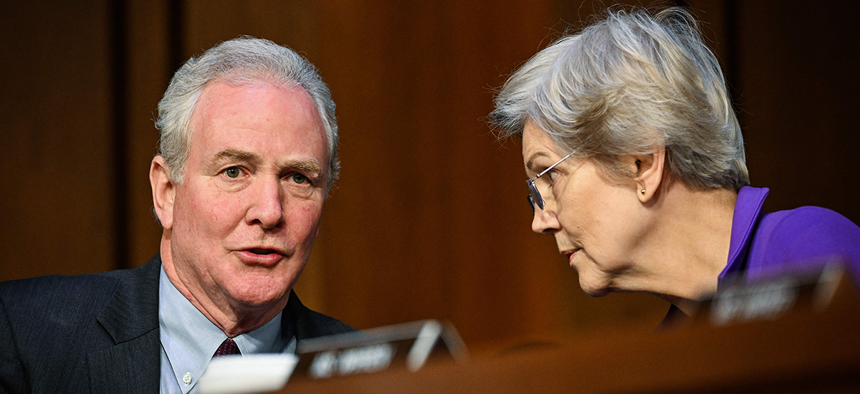
Sens. Elizabeth Warren, D-Mass. and Chris Van Hollen, D-Md. led colleagues in denouncing the suspension of advanced leave as a “cruel and unjustified plan that is likely to drive additional employees out the door." MANDEL NGAN/AFP via Getty Images



IRS and Social Security will see more employees quit without advanced leave, senators warn
Senate Democrats warn employees will “inevitably leave” both agencies following a suspension of advanced leave, adding to deep staffing cuts.

Senate Democrats are warning that new limits on annual leave and sick time at the IRS and the Social Security Administration will push more employees out the door, making it harder for Americans to get assistance from these agencies.
The IRS and SSA both announced in July that employees will no longer be granted advanced annual or sick leave until further notice. Federal employees are generally allowed to use “advanced” annual or sick leave for major medical emergencies, family care and bereavement of an immediate family member if they have already exhausted their annual leave or sick leave. With advanced leave, employees essentially borrow from a reserve of leave hours they will eventually accrue.
In nearly identical emails, the IRS and SSA told employees this policy change will ensure both agencies are providing a high level of customer service to the public and address several individual cases where employees took excessive amounts of advanced leave.
In a letter to Frank Bisignano, the IRS chief executive officer and Senate-confirmed commissioner of SSA, Sens. Elizabeth Warren, D-Mass. and Chris Van Hollen, D-Md. led colleagues in denouncing this new policy as a “cruel and unjustified plan that is likely to drive additional employees out the door, doubling down on the administration’s already disastrous efforts to push out federal employees.”
Sens. Kirsten Gillibrand, D-N.Y. and Ron Wyden, D-Ore., also signed onto the letter, shared exclusively with Government Executive.
“We are concerned that this policy will further weaken the already stressed resources of these agencies, leaving the American people with degraded access to their rightful Social Security benefits and needed IRS services,” the senators wrote. They estimate that the suspension of advanced annual and sick leave will collectively impact more than 120,000 IRS and SSA employees.
The IRS and SSA told staff that the suspension of advanced leave will remain in effect, pending efforts to reduce “significant” balances of advanced leave already taken. Both agencies wrote that in several cases, employees are unlikely to earn back the large amounts of advanced leave hours they’ve already used.
“This is debt carried against the future work of all our employees, work that has not yet occurred, and work the public expects us to deliver. This constrains our ability to invest in the people, tools, and resources our mission requires,” both agencies wrote in an email to employees.
The senators, however, say excessive use of advanced leave isn’t an issue at these agencies because “its availability is limited.” According to the Office of Personnel Management, agencies may grant a maximum of 240 hours of advanced sick leave to a federal employee, although the total number of hours permitted varies depending on the circumstances.
OPM guidance states advanced sick leave is a “flexibility” agencies can use to help new employees who haven’t accrued much leave yet, as well as more tenured employees experiencing personal hardships.
“Your actions give the appearance that this policy is less about improving service delivery, and more about punishing federal employees — and by extension, the American people,” the senators wrote.
Federal employees replenish their annual and sick leave over time. Employees who leave government service with a negative leave balance are legally obligated to refund the agency the cost of that advanced leave.
“In sum, this policy provides critical assistance to employees with significant needs and provides sufficient protections to ensure that employees’ leave does not materially affect government operations or lend itself to any attempted abuse,” the senators wrote.
An IRS spokesperson previously told Government Executive that the agency’s advanced leave restriction “aligns with the agency’s efforts to build a high-performing, highly engaged workforce operating as One IRS to deliver a world-class customer experience and aligns to our commitment to be responsible stewards of taxpayer dollars.”
The senators, however, wrote that “it stretches the bounds of plausibility to blame advanced leave, and not widespread, chaotic job cuts,” as a drain on agency efficiency.
The IRS has shed more than a quarter of its employees since President Trump's return to office, largely through voluntary separation incentives. About 7,000 SSA employees took those same incentives last year, bringing the agency to its lowest staffing level in about 50 years.
The senators wrote that the “chaos and short-staffing resulting from these cuts” led to longer wait-times over the phone, a backlog of unprocessed tax returns, longer wait times for claims appointments and employees attempting to do more with reduced training.
“When employees inevitably leave as a result of your policies, Americans will face additional challenges receiving assistance from the SSA and IRS, delaying their access to benefits and critical tax refunds, respectively, exacerbating existing failures in service delivery with the added employer costs, borne by taxpayers, stemming from an increase in the quit rate, which includes a loss in productivity and quality, as well as needed new funds to support hiring, onboarding, and training,” they wrote.
Bisignano has touted the performance metrics at both agencies, telling lawmakers that SSA and IRS don’t need more employees to meet public expectations. Both agencies are relying on widespread employee reassignments to address acute staffing shortages across their operations.
Among their questions, the senators asked Bisignano to provide data from the past 10 years on the number of employees who have taken advanced leave, the total hours of leave taken, and the total cost of providing that leave.
They’re also asking Bisignano to explain why the IRS and SSA are “imposing a blanket suspension” of advanced leave, rather than pursue “specific and targeted policy enforcement,” and whether the agencies have conducted any analysis on the impact this policy will have on recruitment and retention.
The National Treasury Employees Union is asking a federal judge to block the IRS from enforcing its suspension of advance leave, on the grounds that Bisignano’s de facto leadership of the agency without Senate confirmation violates the Appointments Clause of the Constitution.
If you have a tip that can contribute to our reporting, Jory Heckman can be securely contacted at jheckman.29 on Signal.
NEXT STORY: IRS watchdog audits employee reassignments, as agency looks to extend some tours of duty