

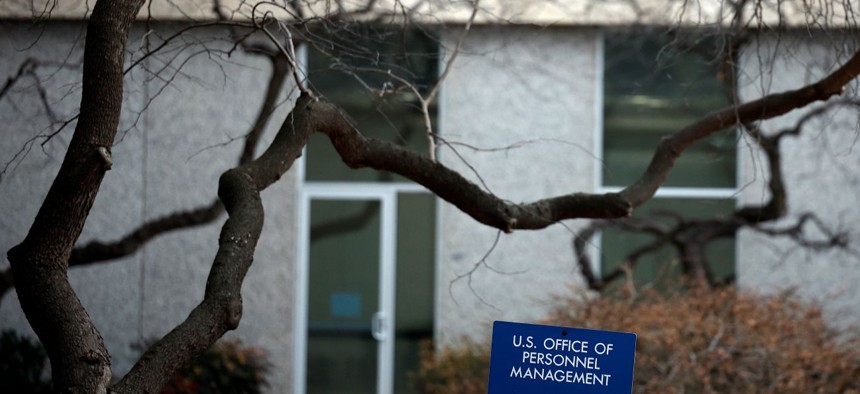
The Office of Personnel Management has revised an essay question that asked federal jobseekers their favorite Trump administration policy, after a federal judge found it likely violated the First Amendment. Kevin Dietsch/Getty Images

Following court order, OPM replaces “favorite EO” question for jobseekers
The Office of Personnel Management’s latest essay question for federal job applicants asks less about their personal politics and more about their ability to follow instructions.

The controversial essay prompt asking federal job seekers about their favorite Trump administration policy or executive order is officially on the way out, in the wake of a court ruling earlier this month finding it likely violated applicants’ First Amendment rights.
U.S. District Judge George O’Toole ordered the Office of Personnel Management to halt federal agencies’ use of the question, which critics described as a “loyalty test,” finding that it “directly links” jobseekers’ personal views with their potential duties as a federal employee. O’Toole issued a stay blocking agencies from including the question on federal job applications going forward but said he could not require the reconsideration of hiring actions that already occurred while the question was being distributed.
In a message last week, OPM instructed agencies to cease considering responses to the favorite executive order question for “any open vacancy,” but said they do not need to reopen previous hiring actions or repost job announcements, provided they close by Friday.
For existing job postings that remain open into next week and new job postings, agencies must now ask a new “Question 3,” one more tailored toward avoiding First Amendment concerns.
“In this role, you will be expected to professionally and efficiently implement executive direction,” the prompt states. “Provide an example where you implemented leadership direction on a strategy or policy decision that differed from your own recommendation.”
The memo also posits a new fifth essay question, tasking agencies with choosing between one and three “agency-wide priorities” and asking applicants how they would help the agency advance those initiatives.
“Agencies should populate the bracketed text with important priorities drawn from the agency’s strategic plan, annual performance plan, or other current agency priorities,” OPM wrote. “The text must be the same for all announcements within the agency.”
Although OPM’s essay questions, which the HR agency has stressed are optional, no longer explicitly query job applicants’ personal political views, Don Kettl, professor emeritus at the University of Maryland and former dean of its School of Public Policy, said the questions still create friction that will hurt federal hiring.
“The administration has been arguing strongly that they are using purely objective measures to measure the merit of potential employees in the application process,” Kettl said. “But when you start introducing essays that are inherently subjective both in the way they are framed and in the way they are graded, you run counter to the other thrust of this. OPM wants to be able to say, ‘This is just another measure,’ but to have essays graded subjectively in a process that is aimed at being objective creates an inherent contradiction.”
If you have a tip that can contribute to our reporting, Erich Wagner can be securely contacted at ewagner.47 on Signal.
NEXT STORY: FDA nominee faces bipartisan scrutiny over vaccines and abortion drug