

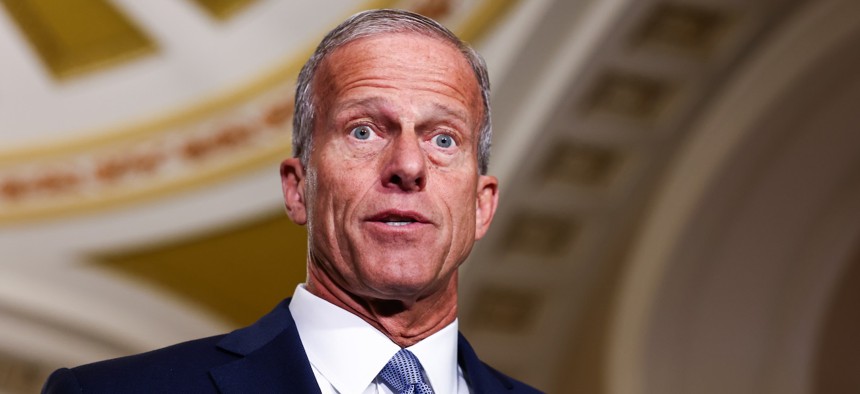
Senate Majority Leader John Thune, R-S.D., said Tuesday that efforts to keep the federal government funded past the November elections were underway. Finn Gomez/Getty Images




Lawmakers look to avoid government shutdown, and reconsider getting rid of them entirely
The latest proposals would change how Congress handles funding lapses and could reshape the budget fights that have repeatedly disrupted federal operations.
Ahead of this year’s midterm elections, congressional leaders are taking earlier-than-usual steps to avoid a government shutdown this fall.
Federal employees faced the longest government shutdown in history last year, followed by the longest partial shutdown, which impacted the Homeland Security Department. Both shutdowns led to federal workers missing paychecks.
The House passed a continuing resolution on Tuesday that would keep the federal government funded through Dec. 4. The bill passed roughly along party lines in a vote of 220-205, with Republicans overwhelmingly voting in favor of the bill.
House Speaker Mike Johnson, R-La., told reporters on Tuesday that Republicans are looking to avoid a government shutdown ahead of “a very consequential midterm election.”
“If the Democrats can't support this basic principle, then they alone are going to own the chaos that ensues if the government shuts down after September 30,” Johnson said.
House Democratic leaders rejected the stopgap spending bill, calling it a “premature and desperate attempt by Republicans to abdicate their responsibility to govern while there are still several months left to negotiate a bipartisan agreement.”
Congress hasn’t passed a comprehensive spending deal on time in decades, and often passes a last-minute continuing resolution to continue deliberations.
Senate Majority Leader John Thune, R-S.D., said Tuesday that Senate Appropriations Committee Chairwoman Susan Collins, R-Maine, is working with Democrats on the committee to keep the federal government funded “past the November elections, so that we don’t have the specter of a government shutdown.”
“The disruption, the chaos that creates is just something that both sides ought to be willing to try and avoid. And so I think it's going to be really important that we figure out a path forward to get a bipartisan agreement to fund the government that will keep the government open and ensure that government employees are getting paid,” Thune said.
Meanwhile, the House Appropriations Committee is revisiting legislation that would permanently eliminate the threat of government shutdowns.
The Prevent Government Shutdowns Act led by Sen. James Lankford, R-Okla., would trigger an automatic two-week continuing resolution any time a lapse in congressional appropriations occurs. Lankford initially introduced a version of this bill in 2019 along with Sen. Maggie Hassan, D-N.H.
The bill would require Congress and Office of Management and Budget staff to remain in Washington, D.C., until a spending deal is reached. The continuing resolution would remain in effect beyond the initial two weeks if lawmakers don’t reach a deal by then.
Lankford told the committee that the bill puts the burden on Congress to reach a spending deal, and would no longer treat federal employees as a bargaining chip in these negotiations.
“Federal workers and their families should not suffer when Congress has not finished their appropriation work – but they do,” Lankford said.
Lankford said his bill wouldn’t result in a "perpetual CR,” but would instead hold lawmakers accountable for reaching a bipartisan spending plan.
“If we have to be here every day, we will get our work done, because we will find a way to be able to solve the problem,” he said.
The American Federation of Government Employees supports the bill. AFGE National President Everett Kelley wrote in a letter to the committee that “there are no concrete signs that the regular appropriations process will advance spending measures that are enacted in time” to avoid a shutdown on Oct. 1.
“AFGE is growing increasingly concerned that for a second consecutive year federal agencies and departments that depend on annual appropriations will go unfunded, and federal workers unpaid,” Kelley wrote.
Several Republicans on the committee showed support for the bill. Committee Chairman Tom Cole, R-Okla., said the government shutdowns should not “become an accepted norm in the appropriations process.”
“Government shutdowns are reckless, and they do nothing other than create chaos and uncertainty,” Cole said.
Rep. Mike Simpson, R-Idaho, chairman of the interior, environment and related agencies subcommittee, said the risk of government shutdowns is greater with narrow majorities in the House and Senate.
“They’re getting worse and worse. And when you get narrower and narrower majorities, they’re going to become more frequent,” Simpson said.
Democrats on the committee, however, pushed back on the idea of automatic continuing resolutions.
Ranking Member Rosa DeLauro, D-Conn., said CRs “can be helpful when used sparingly,” and can be important to facilitate full-year funding agreements, but said they “should not be our first choice” to avoid government shutdowns.
“I am sympathetic for the goal of reducing government shutdowns. But the permanent funding proposals we will discuss here today would, in my opinion, create far more problems than they would solve,” DeLauro said.
Democrats have used government shutdowns to push back on the Trump administration’s impoundment and recission of congressionally appropriated funds. DeLauro said automatic CRs would “cement nearly complete control over government funding within the White House.”
“Why would we voluntarily forfeit that authority?” she said.
Rep. Lauren Underwood, D-Ill., said automatic CRs “fail to meet the changing needs of our districts.”
“They do not protect federal workers. They do not protect federal resources,” Underwood said.
Shalanda Young, the OMB director under the Biden administration, told the committee that “what we currently have is unacceptable,” but added that shutdowns are “one of the many symptoms of what is broken” in Congress.
“For too long, congressional dysfunction has been the norm, while congressional leadership uses workarounds as substitutes for the difficult work of legislating,” Young said.
If you have a tip that can contribute to our reporting, Jory Heckman can be securely contacted at jheckman.29 on Signal.
NEXT STORY: ICE ramps up arrests as deportation effort expands