

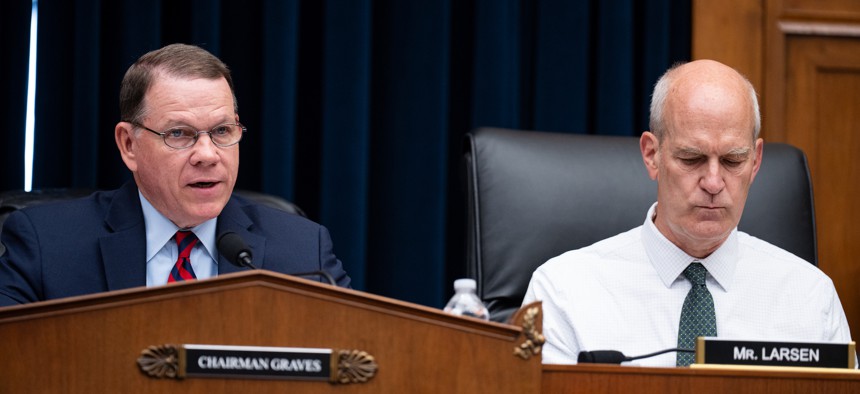
Chairman Sam Graves, R-Mo., and ranking member Rick Larsen, D-Wash., participate in a House Transportation Committee hearing on June 27, 2024. Graves on Wednesday said there's overlap between the Trump's administration Federal Emergency Management Agency recommendations and the bipartisan FEMA Act. Bill Clark / CQ-Roll Call, Inc / Getty Images




FEMA overhaul proposal spotlighted by bipartisan lawmakers
Supporters testified that the FEMA Act would help disaster survivors and local governments more easily access assistance.

The House Transportation and Infrastructure Committee used a Wednesday hearing to tout a bipartisan bill that would overhaul the Federal Emergency Management Agency, as President Donald Trump also seeks to reform the disaster response and recovery agency.
Representatives from both parties and experts argued that the FEMA Act (H.R. 4669) would enable disaster survivors to receive federal assistance more quickly.
“We make them figure out FEMA instead of building a system around them,” said Craig Fugate, who was the agency’s administrator during the Obama administration. “We are not survivor-centric. We are process- and program-centric.”
The measure, which the panel last year advanced in a 57-3 vote, would create a unified disaster application system and make FEMA an independent, cabinet-level agency. Supporters contended that the agency’s current location under the Homeland Security Department creates unnecessary layers of leadership.
“This needs to be an independent agency with a direct line to the president of the United States,” said Rep. Greg Stanton, D-Ariz., one of the bill’s original cosponsors. “It will save time on emergency management proclamations. It will save time in emergency response, and make the whole process much quicker.”
The legislation makes several changes to FEMA’s assistance programs with the goal of expediting payments and streamlining requests.
“For some smaller counties, they just don’t have the staff or the expertise to navigate through some of these application processes,” said Cynthia Lee Sheng, representing the National Association of Counties. “When we make it much more simpler…I think that will greatly help our local capacity.”
While Trump proposed eliminating FEMA at the start of his second term, an administration-backed review council earlier this year instead recommended that state and local governments take a greater share of responsibilities following emergencies.
On Wednesday, committee Chairman Sam Graves, R-Mo., said there’s overlap between the administration’s proposals and the bipartisan bill.
“While there are some differences, the goals and many of the approaches to those recommendations mirror our FEMA Act,” he said. “For example, we all agree reforms must be focused on a system that is state-led, locally executed and federally supported.”
Several speakers expressed a similar sentiment; although, Chuck Chaitovitz, who represented the Chamber of Commerce, added that “empowering local leadership cannot mean weakening the federal role.”
Throughout the hearing, panel Democrats accused Trump of politicizing FEMA, pointing to administration-led staff cuts and a report that the president has approved 89% of disaster funding requests from states with a Republican governor and two Republican senators compared with 23% for states with Democratic leadership.
If you have a tip that can contribute to our reporting, Sean Michael Newhouse can be reached securely at seanthenewsboy.45 on Signal.
NEXT STORY: CDC nominee faces questions over whether she can lead the agency independently