

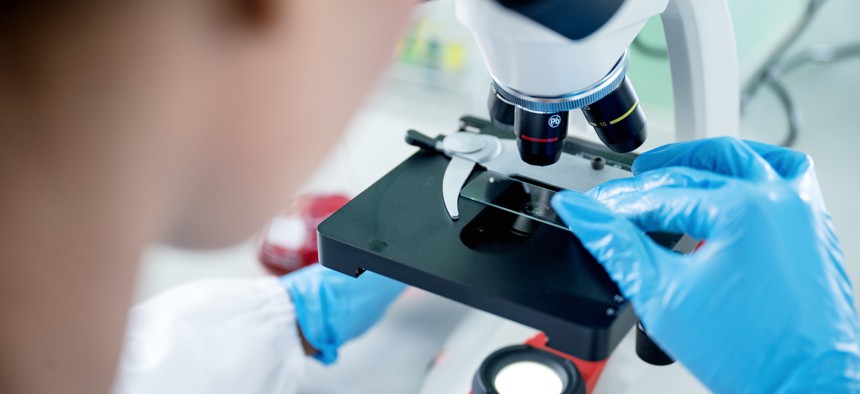
Federal science agencies shed nearly 118,000 employees between September 2024 and February 2026. Nitat Termmee / Getty Images




Weakening career staff while boosting political appointees at science agencies is causing ‘generational damage,’ nonprofit warns
The Partnership for Public Service reported that the federal government is spending less on scientific research in a majority of states and congressional districts.

The American public is in the throes of experiencing the consequences of the Trump administration’s overhauls to federal science programs, according to Max Stier, the president and CEO of the Partnership for Public Service nonprofit. Specifically, during a press briefing on Tuesday, he criticized workforce reductions at science agencies, cuts to government-backed research and efforts to give greater influence to political appointees in the grantmaking process.
“They're all three doing the same thing, which is destroying the extraordinary success that we have been able to enjoy as a nation through scientific development and innovation,” he said. “And they’re ongoing. These are not one and done things.”
In a report published on Tuesday, the Partnership found that federal science agencies lost nearly 118,000 employees between September 2024 and February 2026, as the Trump administration sought to downsize the civil service.
Using data from the Office of Personnel Management, researchers determined that the federal workforce decreased by 12.3% during the same period. Science agencies, however, often experienced deeper reductions.
For example, the Substance Abuse and Mental Health Services Administration lost 41.7% of its staffers. A coalition of scientists and research organizations recently reported that job cuts at SAMHSA and other science agencies are undermining the president’s efforts to combat addiction.
While the number of federal science employees fell in every state between September 2024 and February 2026, Alaska experienced the largest percentage reduction — 36.7%. The Partnership attributed this to staff cuts at public lands agencies, such as the Forest Service, National Park Service and Bureau of Land Management, which oversee around 60% of land in Alaska.
A similar dynamic played out in other Western states, including Idaho, Montana, Wyoming and Utah, which all lost more than a quarter of their federal science workforces during the same period.
“This is not a red state, blue state issue,” Stier said. “Many of the states that most benefit from science investments from the United States government are actually traditional red states.”
The Partnership previously reported that, between fiscal years 2024 and 2025, the federal government spent nearly a quarter less, respectively, on scientific research and development contracts and science agency project grants.
In its latest analysis, researchers noted that this led to 36 out of 50 states and about two-thirds of congressional districts receiving less funding in federal science project grants. Additionally, 32 states got less government research and development contract funding between those two fiscal years.
During his remarks, Stier also criticized a recent proposed rule from the Office of Management and Budget that would overhaul the federal grantmaking process, including by requiring political appointees to approve awards to ensure they advance the president’s priorities.
“It opens the door for additional corruption is what it does,” he said. “[It leads to] choices on the allocation of public dollars on the basis of political interest — and maybe private pecuniary interest — as opposed to the best chances of generating a real return for the American taxpayer and the American public.”
In the proposed rule, OMB officials argued that the changes are necessary to “prevent wasteful spending and misuse or mismanagement of federal funds.” In particular, they criticized awards during the Biden administration for diversity, equity and inclusion programs.
The National Institutes of Health in recent months has modified its grant review process to identify research that contains words associated with diversity (e.g. race or gender), which has held up some grant disbursements and forced scientists to rewrite proposals.
The Partnership recently reported that the number of political appointees in the federal government has swelled during Trump’s second term and that they’re being assigned to agencies that haven’t employed such officials in recent history.
In total, Partnership officials argued that these reforms are causing “generational damage” to U.S. science.
“We're going to start to see scientists moving abroad and not coming back. We're going to start to see the pipelines of talent into government start to dry up,” said Brandon Lardy, the Partnership’s data director, during Tuesday’s briefing. “It's not a switch that you can flip on and off. It's going to take years, if not generations, to recover from some of these losses.”
In a March poll by Nature of roughly 1,600 researchers, more than 75% reported that they were considering leaving the U.S.
If you have a tip that can contribute to our reporting, Sean Michael Newhouse can be reached securely at seanthenewsboy.45 on Signal.
NEXT STORY: Trump appoints housing official to be acting director of national intelligence