

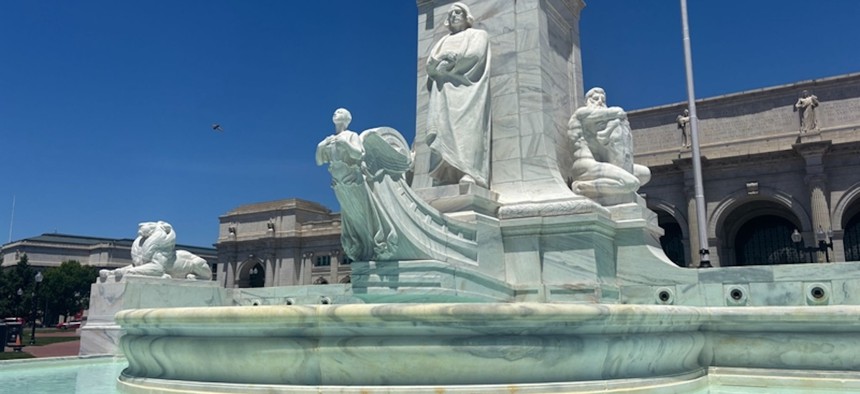
The Christopher Columbus Memorial Fountain outside of Union Station in Washington, D.C., on June 16, 2026. The Columbus Circle fountain is one of nine ornamental fountains in Washington, D.C. that have recently undergone improvements reportedly funded in part by National Park Service fees. Amelia Twyman/States Newsroom




Interior’s use of park fee revenue raises questions over federal funding rules
Lawmakers are seeking details on whether National Park Service visitor fees and pass revenue are being redirected under existing authorities, highlighting how discretionary funds are allocated across competing maintenance and capital priorities.
House and Senate Democrats, mostly from Western states, are demanding transparency from the Interior Department after media reports revealed the Trump administration redirected roughly $90 million in national park fees to help fund renovations and upcoming celebratory displays in Washington, D.C.
The administration’s use of fee revenues to pay for fountain repairs, statue upgrades and fireworks shows in preparation for America’s 250th birthday on July 4 diverts money from national parks in desperate need of billions of dollars in maintenance, lawmakers wrote in two separate early June letters to Secretary of the Interior Doug Burgum.
“The public deserves to know how their park fees are being spent, and Congress cannot conduct appropriate oversight without basic information about these transactions,” Rep. Gabe Vasquez of New Mexico and seven other Democratic representatives wrote in their letter, dated June 12.
A group of 11 Senate Democrats, led by Sen. Adam Schiff of California, sent a similar letter to Burgum on June 10.
According to a DOI spokesperson, the National Park Service “has not only been focused on beautifying the district but has also been working on many deferred maintenance projects throughout the country,” pooling money from “endowment funds” and the sale of park passes.
How the funding stream works
The National Park Service, housed within Interior, gets a portion of its funding from entry fees and visitors’ purchases of recreational passes. Under the Federal Lands Recreation Enhancement Act, at least 80% of the fee money must go back to the national park where it is collected.
The remaining 20% is available for overall Park Service use, a policy meant to help support parks that do not charge entry fees or only make a small amount of revenue, according to NPS. Just over 100 parks charge an entrance fee out of the more than 400 that make up the National Park System.
The National Mall in Washington and various memorial sites are part of the group that do not charge visitors to enter, meaning it is legal for DOI to spend leftover revenue on projects in its own backyard.
But the amount the department has allocated to renovations so far this year appears to greatly exceed how much it has put toward maintaining the district’s public spaces in the past, according to Tony Irish, a former Interior senior attorney under Trump and an attorney under earlier presidents who is now senior counsel with the nonprofit Public Employees for Environmental Responsibility.
Reflecting pool repair
Multiple news outlets, including The New York Times and The Washington Post, reported NPS is using at least $60 million in fees paid by parkgoers to fund the repair of nine ornamental fountains across Washington, D.C.
Documents showed an additional $7 million was redirected to help pay for the renovation of the Lincoln Memorial Reflecting Pool, while more will be put toward funding a $1.6 million Fourth of July fireworks display.
“While other administrations have let the city fall into decay, President Trump has made Washington, D.C., safe and beautiful again, and we should all be grateful,” the Interior spokesperson said in an emailed statement on June 16.
In their letters to Burgum, lawmakers also demanded clarity on the reported use of revenue from the sale of digital park passes, called America the Beautiful passes, as there is no current law that requires those funds be spent in a specific place.
“Credible sources with direct knowledge of these matters have now reported to Congress that much, if not all, fee revenue from online America the Beautiful passes is being used to fund the President’s ‘beautification’ projects in Washington,” they wrote.
Along with Vasquez, the House letter was signed by Reps. Sarah Elfreth of Maryland, Darren Soto of Florida, Adelita Grijalva of Arizona, Dina Titus and Susie Lee of Nevada, Joe Neguse of Colorado and Jill Tokuda of Hawaii.
Joining Schiff in signing the Senate letter were Sens. Martin Heinrich and Ben Ray Luján of New Mexico, Angus King of Maine, Kirsten Gillibrand of New York, Ron Wyden and Jeff Merkley of Oregon, Ed Markey of Massachusetts, Jack Reed of Rhode Island and Michael Bennet and John Hickenlooper of Colorado.
Delayed park maintenance
Many critics are pushing back against the Trump administration for not channeling fee funds back into the national parks that need them, including popular travel destinations such as Grand Teton and Yellowstone.
“Last month, I was in Joshua Tree exploring one of our beautiful national parks and was again reminded what a treasured legacy these lands represent,” Schiff said in a June 17 statement to States Newsroom.
“This is just the latest scheme by the President to put himself before the American people, and it will have devastating impacts on parks that millions of people visit every year,” he added.
The National Park System is backlogged with about $24 billion worth of repairs to buildings and infrastructure, according to NPS.
Vasquez said New Mexico’s Carlsbad Caverns National Park “has over $45 million in deferred maintenance” alone.
“The administration is choosing to let roads, trails and wastewater systems in the park fall into disrepair amid the peak summer visitor season so it can paint statues gold in Washington,” he said in a June 15 statement to States Newsroom. “This is unacceptable, and I am demanding action from the Department of the Interior to correct course.”
Irish also said DOI’s current use of fee revenues for D.C.-area renovations could lead to more money being spent in the long run because of the rush to complete some projects, like the $14 million reflecting pool. Completed just at the beginning of June, the reflecting pool has already amassed clumps of green algae.
“Not only are we displacing higher-priority needs right now, but we’re still going to have unmet needs in the future at an additional cost to the taxpayer, the fee payers within that,” Irish said.
Vasquez and his colleagues, in their letter, asked that NPS restore funding to national parks to help preserve them for future generations.
The senators went even further, including a list of detailed questions about park funding in their letter and asking DOI to respond by June 23.