

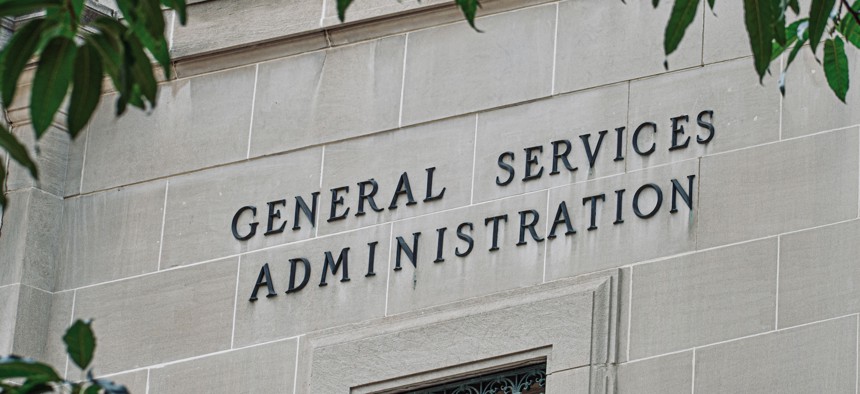
The General Services Administration manages federal buildings. Douglas Rissing/Getty Images





Underused federal offices targeted as GSA releases utilization data
The agency found that thousands of federal buildings did not meet a statutory 60% minimum average utilization rate.

The General Services Administration on Tuesday released federal office space utilization data, which officials said would aid the Trump administration in its effort to reduce the government’s real estate portfolio.
“Exposing these inefficiencies empowers us to fix them. We cannot afford to delay,” wrote GSA head Edward C. Forst and Rep. Scott Perry, R-Pa., the chairman of the subcommittee over public buildings, in a commentary for Government Executive. “Now that we have this information, it is time we get to work. We can and we must do better. We will look to reduce excess property and realign our nation's real estate portfolio around a stronger, more efficient core.”
The data was released pursuant to a provision in a 2024 law that requires GSA to flag any federal building or leased space with a utilization rate that is less than 60% on average and to then take steps to shrink the agency’s property.
This information, which GSA described as “the first government-wide snapshot of space utilization,” lists thousands of properties that did not meet the 60% benchmark between Jan. 12, 2026 and March 6, 2026.
GSA reported that some of the data, which comes from the Cabinet departments as well as larger agencies such as NASA and the Social Security Administration, could be “incomplete, outdated or contain inaccuracies.”
“As this information has been compiled from partner agencies and third-party sources, GSA cannot opine on its accuracy or completeness,” officials wrote on the web page that contains the data.
Agencies used several methods to collect the information, including analyzing badge scans to get into a building, sensors to to track occupancy and aggregated and anonymized mobile location data.
Forst and Perry wrote in the Government Executive commentary that they would prioritize offloading buildings that need significant repairs; GSA reports that the maintenance backlog for federal buildings is between $26 billion and $50 billion.
The duo also said that GSA would try to co-locate agencies with similar missions and maintain “historic, well-located federal buildings that promote civic architecture.” On his first day back in office, President Donald Trump signed a memorandum adopting a policy that federal buildings should be “visually identifiable as civic buildings and respect regional, traditional and classical architectural heritage.”
Forst previously reported that the release of the utilization data was delayed by the fall government shutdown. Last week, GSA announced the sale of a vacant building in downtown Washington, D.C., which officials said was the first major sale of a federal property in the capital during the second Trump administration.
If you have a tip that can contribute to our reporting, Sean Michael Newhouse can be reached securely at seanthenewsboy.45 on Signal.
NEXT STORY: States say ICE pulled Medicaid data despite court order