

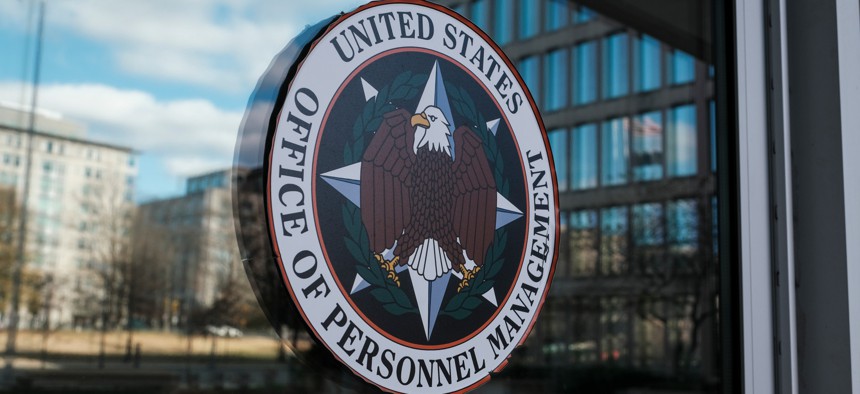
OPM's guidance on the Policy/Career Schedule will be essential to establishing the guardrails for employee protection. Michael A. McCoy / For The Washington Post / Getty Images




The ‘new’ Policy/Career Schedule does NOT (necessarily) politicize the federal workforce
COMMENTARY | The Policy/Career Schedule may not be Trump 1.0's Schedule F, but there are guardrails that can allay some fears about its implications.
Let’s all take a deep breath. The rules recently issued by the Office of Personnel Management regarding its “new” Policy/Career Schedule do not mean that “the end of democracy as we know it” is upon us. We’re not there yet, although if Trump’s advisors have their way, and he postpones the 2026 midterm elections because of a made-up national emergency (like a war we apparently didn’t start), we may be. But that’s another matter, one I will not even attempt to defend. Rather, this commentary is all about those final OPM rules regarding the Policy/Career Schedule –actually just a renamed, slightly revised iteration of the “old” Schedule F—and my view is that those rules, not to mention the new schedule, are not nearly as bad as folks are making them out to be.
So, it’s deep breath time again! In that regard, I’ll warn you now that this is NOT a “technical” piece that provides the details of the new schedule...if readers want that, there are excellent articles already out there on the internet, including OPM’s own guidance documents, and they can go to them. Rather, this commentary is directed at the real (vs. the implicitly and sometimes intentionally hyperbolic) implications of one’s conversion to the Policy/Career Schedule. And while it is not as bad as many suggest, it could be...and as a result, I do offer some guardrails, both statutory and otherwise—as do the OPM guidance documents, themselves—that would mitigate some of the very real concerns raised by such a conversion. So...
Many federal civil servants are already ‘excepted’ from Title 5 protections
As someone who once presided over a workforce of “about 100,000” civilians in various U.S. intelligence agencies—95% of whom were “excepted” and thus (in theory) with far fewer civil service protections than most of their Title 5 colleagues—I would argue that this new/old schedule does not automatically politicize the federal civil service. Nor do OPM’s recently published rules overtly or covertly establish partisan political “loyalty” to Trump as a litmus test for what used to be one’s apolitical civil service appointment or promotion. Rather, properly implemented, they are all about more accountability, and they may just rebalance a civil service system that, to too many American citizens, had become far too insulated from the reality of the workplace.
It’s worth noting here that in addition to my experience with a large “excepted” civil service workforce that mostly existed (for very good reasons) outside of the Title 5 security blanket, I also resigned from a political appointment in Trump 1.0 as chair of the Federal Salary Council, back in October 2020. That resignation, which was leaked (not by me) and thus garnered far more publicity that it deserved, was over the initial issuance of Schedule F and its true intentions at the time. President Trump had just penned an executive order establishing it, and when I asked senior politicos about its true intentions, it became clear to me that it was all about putting people politically loyal to Trump in the career federal bureaucracy...perhaps in reaction to the revelations of another moreAnonymous Trump appointee (pun intended).
But since then, OPM has done a couple of things that mitigate my fears...and hopefully those of my colleagues. At least those who are willing to take a deep breath.
OPM guidance offers some additional guardrails
In that regard, OPM issued guidance way back in January 2025 (indeed, that guidance was one of its very first of many such issuances since) that took much of the sting out of the new Policy/Career Schedule. It stated that a career civil servant need not support our current president—or more importantly, ANY president—politically, so long as they carried out that president’s particular policy agenda “faithfully” and “to the best of their ability.” In other words, OPM’s guidance said that civil servants are just required to do their jobs, nothing more and nothing less.
Although there’s plenty of ambiguity in that statement, that clarification was enough to establish a legal defense, and had it been part of the original Schedule F Executive Order back in October 2020, I likely would not have resigned.
To me, it’s all about accountability...and the sworn duty of every civil servant, whether they are to be converted to that new Policy/Career Schedule or not. At the end of the day, federal employees can, will and should be held accountable for doing their jobs. That’s just as it should be. And those covered by the new Policy/Career Schedule will NOT be able to appeal a determination to the contrary to a third party. In other words, their termination will be final. Unless they can show that they followed a president’s lawful agenda “faithfully” and “to the best of their ability.”
In my book, that’s not so bad. But there’s more protection in that regard. According to OPM, a covered civil servant cannot be fired for his or her politics. Period. Full stop. Just as they cannot be fired based on their marital status, their sex, etc. Those are all pretexts, and if they are the real basis for someone’s removal, they are all illegal.
Of course, that depends on the transparency of those reasons, and that in turn depends on whether you’re a “glass half full” or a “glass half empty” person. The “half empty” folks (and there are many!) will say that you should give the benefit of the doubt to a civil servant...in other words, he or she should be protected and should only be terminated when a third party (like the Merit Systems Protection Board or the courts) concludes that they haven’t done their jobs. And the new schedule (and OPM’s implementing rules) take away that protective presumption for covered employees.
Those folks assume that those civil servants have performed satisfactorily—they’re given that presumptive benefit of the doubt and it’s up to their superiors to prove otherwise—and thus they should be protected by default. And if you’re converted to the Policy/Career Schedule, that benefit of the doubt, that default, is forcibly taken away from you. Hence the “half empty” view.
But I count myself among the other “half-full” (?) group who say that federal employees should be removed if they do not do their jobs, and unless and until they can prove a pretext, or some other legal reason for their retention, the official proposing their removal (or some other adverse action) should be given that benefit of the doubt. To me, that’s okay. Call me naive, but I trust those managers—most of whom are career civil servants themselves—to do the right thing. So, here’s my bottom line: If an order from my superior, political or otherwise, is lawful, I’m duty bound to follow it as a civil servant employed by the people to serve them. Not only when I like what I’m being told, although that shouldn’t have anything to do with it, but all the time!
And, even if an otherwise lawful order crosses a moral “red line” of mine (believe it or not, that too happens...and it has happened to me), I have the option of resigning based on my conscience. But I should not go “underground” as some would argue—and continue to accept my paycheck from the public—as to do so just underscores the hyperbolic and unsubstantiated fears of a deep state. But leaving is a choice I can make.
Civil servants take an oath to give their best advice...without fear
To be sure, I’m also duty bound to give that political superior my best advice, preferably in advance and preferably in private...even if it’s advice that my political superior doesn’t want to hear. But if after I’ve given that advice, that political superior tells me to “do it anyway,” I will. If it is otherwise lawful. If it’s illegal, I won’t follow it. Even if it’s the Secretary of Defense telling me to do so, I won’t follow it if it’s illegal (Secretary Hegseth, are you listening?). But if it’s lawful, I’m duty bound.
The danger, of course, is that if I tell that politico what he or she doesn’t want to hear, I’ll be fired just for doing so...before I’m even given the chance to “faithfully” comply with a lawful order and carry it out “to the best of my ability” as required by OPM’s own guidance. That’s the worst-case scenario, but it’s a real one, and it’s what has the “glass half empty” folks so worried, however speculative or rare that may be.
And I’ll be the first to admit that it is legitimately worrisome. You cannot have career civil servants who are afraid to speak truth to power, especially in a policy sense, for fear of losing their jobs. I know this all too well, having come from the Intelligence Community, where “speaking truth to power” (in many cases, to the president himself!) was the job!
That’s why I argue that civil servants are owed some transparency—that is, at least de minimis due process—before they can be fired. In my opinion, they are more than just “at will” chattel. They earned the public’s trust, sometimes arduously via the convoluted federal hiring process, and should be treated accordingly. They should be given the reasons for their termination (or any other adverse action proposed against them) in writing and in advance, and among other things, they should also be able to respond to those reasons to someone in their agency other than the official who proposed the action in the first place.
But in my “half full” mind, that should be the end of the matter...no MSPB or judicial review, except perhaps under the most extraordinary of circumstances.
That is not the case today, and as I said, it’s worrisome...on both extremes of the default line. To be sure, there’s plenty of gray here, especially at those worst-case extremes, as many of my colleagues have repeatedly pointed out. So, there is the risk that our civil service could conceivably become populated not by political partisans loyal only to a particular president, but rather by those who are afraid to speak truth to power, out of fear for their jobs.
So, yes, that is a risk, and it’s a real one.
What OPM can do to alleviate those fears
What we need are reasonable statutory guardrails to mitigate that risk. As I have noted, one such guardrail has already been put in place by OPM, although it’s just guidance, and in my view, it deserves to be codified in statute. To do so would give it far more permanence, not to mention a statutory defense for civil servants terminated for arbitrary and capricious reasons, and I’ve argued as much till I’m blue in the face.
But, as long as OPM stands by its own guidance and more importantly, is willing to police and enforce it, career civil servants—to include those who were “fired” because they dutifully (if not willingly?) followed President Biden’s DEI edicts—should be safe. After all, they were simply following the lawful orders of the duly elected president in office at the time.
Is that enough? I don’t know, but if additional guardrails—in the form of more transparency and/or de minimis due process—are necessary, they can (and should) be imposed by Congress. For example, Congress can easily (that is, literally with the stroke of its bipartisan pen) extend the eligibility of Policy/Career Schedule employees to receive recruiting, retention and/or relocation incentives, as well as become eligible for other benefits currently barred by law.
Thus, Congress can do so if it wants. Whether it will or not remains to be seen, but unless and until it does, let’s all take a deep breath and see what OPM does next. That’s what really matters now.
Ron Sanders is a fellow of the National Academy of Public Administration and a federal civil servant for almost 40 years, including over 20 as a member of the Senior Executive Service. In that capacity, he served as director of civilian personnel for the Defense Department, chief human resources officer for IRS, associate director for HR strategy at OPM and associate director of National Intelligence for human capital, as well as the chairman of the Federal Salary Council.