

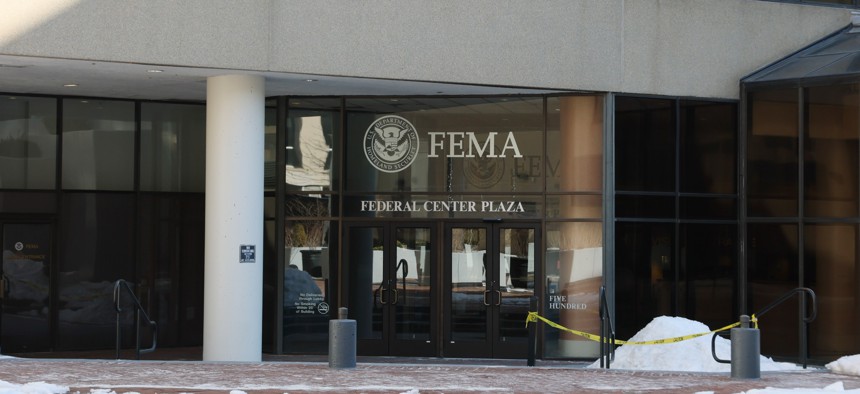
The Trump administration has sought to end FEMA's Building Resilient Infrastructure and Communities, or BRIC, grant program, though a federal judge ordered it be restored. Michael M. Santiago / Getty Images




Despite court order, a critical FEMA program remains frozen
Months after a judge ordered the Trump administration to restore climate adaptation grants, FEMA insiders say the agency hasn’t budged.
When it comes to adapting to the consequences of climate change, the federal government has relied heavily on one flagship program: Building Resilient Infrastructure and Communities, or BRIC. Administered by the Federal Emergency Management Agency, BRIC has doled out $4.5 billion in grants to help states and cities prepare for future disasters. Wildfire retrofits in Washington State, safe rooms in Oklahoma, and sewer systems in Detroit have all benefitted from the program.
Despite bipartisan support for the effort, the Trump administration issued a memo announcing its intent to shut down BRIC in April. Then, in December, a federal judge ordered FEMA to restore the program’s funding and “promptly take all steps necessary to reverse” the termination. The agency had two months to appeal.
Though that deadline passed last week, the Trump administration is still holding out. Two FEMA officials told Grist that the agency has taken no apparent steps to revive BRIC in compliance with the December court order. As a result, state and local governments across the country are holding critical projects in limbo as they await a resolution.
The officials who spoke to Grist requested anonymity to avoid retaliation from agency leadership. Separately, a FEMA spokesperson said the agency complies with court orders, but did not respond to questions about the future of BRIC.
FEMA’s deadline to appeal the judge’s ruling was Feb. 9. On Tuesday, a coalition of state attorneys general accused the Trump administration of dragging its feet on compliance. (Those attorneys represent the states behind the original lawsuit over BRIC, which resulted in the December ruling.)
“Over two months have passed and Defendants have offered no indication to Plaintiff States, the public, FEMA’s regional offices, or apparently even Defendants’ own attorney that they have complied with the Order,” attorneys for almost two dozen states wrote in a court filing on Tuesday. The states asked the judge to compel FEMA to follow the order and make BRIC funding available.
BRIC actually launched during the first Trump administration, but most of its funding came from the Biden-era Bipartisan Infrastructure Law. That money endowed more than 2,000 projects nationwide. At the time of the April memo shuttering the program, FEMA told Grist that BRIC “was yet another example of a wasteful and ineffective FEMA program.” (The acting FEMA director who issued that memo, Cameron Hamilton, lost his job a few weeks later after telling Congress that he didn’t think Trump should abolish the agency.)
The BRIC pause is one part of an overall freeze on the agency’s disaster mitigation spending. The Department of Homeland Security, which oversees FEMA, has placed the agency under a de facto spending moratorium, requiring Secretary Kristi Noem’s sign-off for any expenses over $100,000. The agency has not approved any new disaster mitigation projects, has refused to process paperwork for projects that were already in progress, and has been slow even to reimburse communities for the cost of disaster recovery, a core activity mandated by Congress.
When a group of around two dozen states sued to stop the cancellation of the program in a Massachusetts federal court, FEMA claimed that it was not canceling BRIC. Instead, it said in a court filing that it “ha[d] not ended” the program and “continue[d] to evaluate whether to end the … program or to revise it,” even as it acknowledged it had not made new funding available.
The judge rejected that argument and issued an injunction preventing the agency from stopping the program. Judge Richard Stearns, who was appointed by former President Bill Clinton, wrote in an order that the law “entitle[s] the States to a certain measure of funding for mitigation projects each fiscal year.”
The state attorneys general allege that FEMA has not provided states, grantees, or regional offices with any new information about the future of the program — nor has it made two years of suspended BRIC funding available to states. The plaintiff states said in Tuesday’s court filing that a senior agency official had told them FEMA is “still in the process of connecting with leadership about how BRIC will operate and on what timelines.”
Two agency employees who work on disaster adaptation confirmed the states’ allegation that FEMA has not yet restored the program. The decision on how to proceed appears to rest with senior Homeland Security officials, they added.
“I haven’t heard a word internally, at all,” one of the officials told Grist.
The December court order found that the states could suffer irreparable harm if BRIC projects that were already underway lost funding or collapsed due to an abrupt shutdown. The state attorneys general are now arguing that FEMA’s recent delays further threaten those projects. Attorneys for the states said that FEMA has refused to provide updates on the status of frozen projects, even when state officials have warned that projects are in jeopardy. The states submitted more than a dozen affidavits showing that FEMA has declined to provide updates for stalled projects, including a seismic retrofit for a rural California hospital and a pair of public school safe rooms in Wisconsin.
The Massachusetts cities of Chelsea and Everett, just outside of Boston, were relying on around $50 million in BRIC money to fund an ambitious flood protection project. The cities were going to build a flood barrier and storm surge control project that would prevent tidal flooding in a floodplain that contains a high school, a rail line, and a regional produce distribution center. The barrier would have doubled as an expansion of a park that will be submerged by high tides in the coming years.
But FEMA paused the project’s funding last spring, after the April memo. Since then, the effort has been in limbo. The pause has meant that the two cities lost out on $50 million in matching money from a state fund. After a year in stasis, local officials are weighing whether to split the project into separate stages, pursuing the storm surge system alone while punting on the other parts.
“We could just put it on a shelf and wait for federal funding, or we could attempt to break the project into phases,” said Emily Granoff, who leads the project and is the deputy director of housing and community development for the city of Chelsea.
“This project needs to happen,” she added, “but we don’t have the information we need.”
President Trump and Secretary Noem have said they want the federal government to play a smaller role in disaster recovery, but disaster experts told Grist that destroying BRIC will jeopardize that goal. That’s because BRIC projects ultimately reduce disaster recovery costs by funding more resilient infrastructure before it’s needed.
“If they’re really concerned about the escalating cost of natural disasters and the burden on the federal government, they should be concentrating on resilience,” said Leo Martinez-Diaz, the director of the climate and sustainability program at the Carnegie Endowment for International Peace. “That’s the only thing that ultimately reduces the losses.”
"This story was originally published by Grist. Sign up for Grist's weekly newsletter here."
This article originally appeared in Grist at https://grist.org/politics/trump-fema-bric-resilience-lawsuit/.
Grist is a nonprofit, independent media organization dedicated to telling stories of climate solutions and a just future. Learn more at Grist.org