

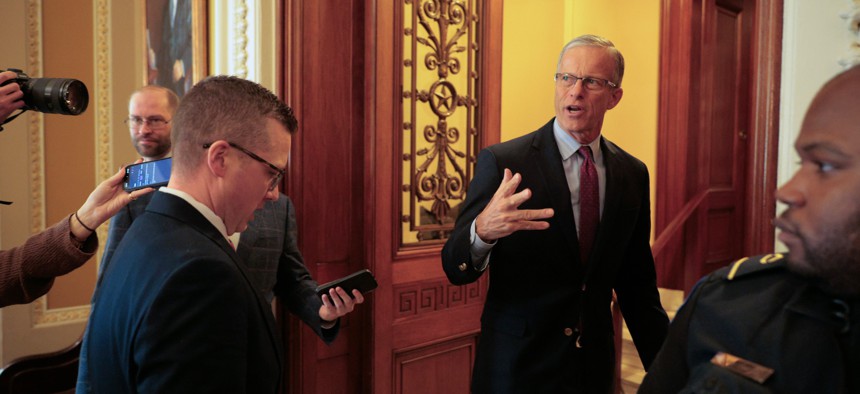
Senate Majority Leader John Thune, R-S.D., speaks briefly with reporters as he heads for the Senate Chamber at the U.S. Capitol on Jan. 30, 2026. Thune said he will bring compromise legislation between Senate Democrats and the White House up for a vote on Friday. Chip Somodevilla / Getty Images





White House initiates shutdown process as Congress hopes to keep duration minimal
Impacted employees will soon receive furlough notices, though they could still avoid missing any time.

Updated Jan. 31 at 9:17 a.m.
The Senate on Friday evening approved a spending package that ensures nearly all agencies are funding through fiscal 2026, but the agreement came too late to stave off an appropriations lapse.
Parts of the government are poised to shut down at midnight and the White House said it must go through the formal procedures that accompany that outcome, despite a resolution appearing imminent. The House is still in recess and will not return until Monday, meaning funding cannot be restored until that afternoon at the earliest.
“We have been sending guidance to agencies this week, including today, on the likely lapse in funding,” an Office of Management and Budget spokesperson said on Friday. They added that OMB was following the “normal shutdown process” and would send a memorandum later on Friday instructing them to kick off shutdown procedures. Agencies would then notify employees who will be deemed excepted—and would therefore have to work during the shutdown—and who will be furloughed.
OMB Director Russ Vought issued the memo late Friday instructing agencies to "execute plans for an orderly shutdown," adding it was the administration's hope "that this lapse will be short."
Senate Democrats and the White House came to an agreement late Thursday to fund the vast majority of federal agencies, while providing a two-week stopgap continuing resolution to the Homeland Security Department. Passage of that bill was delayed Thursday night and into Friday as lawmakers negotiated over which amendments to attach the package. Senators reached such a deal late in the afternoon on Friday and passed the bill that evening, allowing the House to vote as soon as it returns next week.
The deal came hours after eight Republicans joined all Democrats in defeating a previous measure, which the House had approved with broad bipartisan support. It was set to coast to President Trump’s desk until Border Patrol agents fatally shot Alex Pretti on Jan. 24, leading to demands from Senate Democrats that more restrictions be placed on the Homeland Security Department’s immigration enforcement efforts as part of the agency’s funding bill.
The bill would fully fund the departments of Defense, Labor, Health and Human Services, Education, Transportation, Housing and Urban Development, State and Treasury, as well as other related agencies. The remaining federal agencies previously received their full-year appropriations and are not at risk of shutting down.
Current funding for those agencies subject to the new bill is set to expire at the end of the day Friday. Those agencies will see their appropriations lapse at midnight, though the impact of the shutdown could depend on when the House acts. OMB stressed on Friday it does not have the authority to stave off the impacts of a shutdown simply because a vote is expected to occur.
In 2018, funding briefly expired for agencies and OMB declared the impasse was merely a “short, technical lapse.” It provided agencies flexibility in implementing shutdown procedures due to the imminence of a resolution, though the situation created widespread confusion across the government.
All federal employees who would normally report to work on Feb. 2 would be expected to do so anyway, as is standard practice on the first working day after a funding lapse to initiate “orderly shutdown activities.” Depending on when the House acts, OMB could advise furloughed employees to remain at work or to go home and await an update.
Senate Minority Leader Chuck Schumer, D-N.Y., has laid out his caucus’ demands for DHS reforms, including the removal of masks by DHS law enforcement personnel, mandated use of body cameras, a requirement for third-party warrants to enter homes, the end of roving patrols in metropolitan areas by Immigration and Customs Enforcement and more uniform restrictions on use of force by federal agents. Democrats plan to negotiate over those items with the White House while the two-week DHS CR is in effect.
This story has been updated with new information on the status of appropriations.
Share your news tips with us: Eric Katz: ekatz@govexec.com, Signal: erickatz.28
NEXT STORY: Court orders OMB to publish more info about how federal funding is distributed