

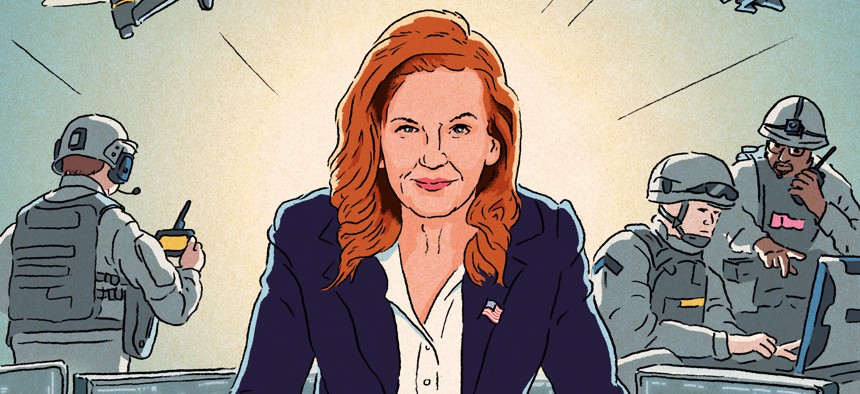
Kirsten Davies was sworn in as the chief information officer of the Defense Department on Dec. 23, 2025. Tim Bouckley





DOD's CIO says it's time to rethink the Pentagon's technology playbook
Kirsten Davies said her office is shifting away from its traditional role as a backend policy shop to become a forward-leaning strategic unit.
Federal officials are increasingly seeking to adopt new technologies to enhance agency operations. At the Pentagon, the Office of the Chief Information Officer is looking beyond IT transformation to ways it can more effectively get digital capabilities into the hands of warfighters.
Pentagon CIO Kirsten Davies recently spoke with Nextgov/FCW about her digital transformation strategy, efforts to refine the department’s acquisition process and more. This interview has been edited for length and clarity.
Nextgov/FCW: What are some of your office’s priorities under the current administration?
Kirsten Davies: President Donald Trump and Secretary Pete Hegseth have given us a tremendous opportunity with a mandate for change. What you're seeing out of the Department of War now is enormous enthusiasm and momentum around that.
For example, the secretary has been very clear that we will take acquisition risk today in order to reduce operational risk tomorrow. Operational risk, in this case, means that at the core of everything we do is our work to enable and empower our warfighters. When I came into this role, I really wanted to bring the cause of the warfighter straight into the DNA of the Office of the CIO.
We're shifting gears tremendously away from being just a policy shop. Policy work is extraordinarily important, but operational effectiveness, warfighter readiness and empowerment from a digital perspective are critical. Through the work of the Office of the CIO, what we're able to do is really shift gears and transform how we think about that.
It's not IT for the sake of that “T.” It's developing a technology footprint that enables and empowers our warfighters from the core all the way to the edge.
Nextgov/FCW: How are you going about transforming the Office of the CIO’s operations to meet that mandate for change?
Davies: We have four pillars for the transformation we are undertaking. The first is establishing an enduring digital foundation, so thinking of all the things we do when it comes to network transport and data centers. We are modernizing our data transport ability across this space and transforming the way we think about it from undersea to celestial, so satellites and everything in between. We obviously have a lot of work we're doing to build out the infrastructure for artificial intelligence and modernize the way in which we think about that.
Pillar two is the agile digital capabilities. I say agile very specifically because we are not going to do fast waterfall. We are going to get after agile delivery and agile development, so truly get into industry best practices when it comes to the software development life cycle and when it comes to the totality of the agility we need to get digital capabilities to the warfighters faster, more securely and more resiliently.
The third pillar is cybersecurity of the warfighting ecosystem. What you will be seeing out of my office is a much more holistic and transformative approach to cybersecurity, and that includes operational technology and the internet of things. When it comes to OT, we can’t treat it like IT, and we can’t neglect it as if it doesn't exist. So you're going to see a lot more focus on OT out of my shop as well.
And then pillar four is upskilling, cross-skilling and partnering. We can talk about people all day long, and we can talk about the fact that everyone owns security. We need to embrace that as an ethos for us and work across our defense industrial base and across our allies and our partners internationally as well. And then also work with our interagency partners at the Cybersecurity and Infrastructure Security Agency, FBI and the National Security Agency.
Nextgov/FCW: Can you talk more about the work you’re doing on the operational technology front?
Davies: Everything is connected, so the digitization of our industrial base is critical for us. The secretary has talked about reinvigorating our industrial base. From a cybersecurity perspective and from a technology perspective, all these devices are connected. There's more than automation involved. Now it's machine learning and also AI that are being more and more deliberately rolled out and leveraged in industry and in government.
When we talk about the OT aspect of these things, that's everything from building management systems to the critical infrastructure that supports our installations here in America and abroad. It is working with our defense industrial base partners.
All of this is foundational operational technology. We must have appropriate availability, resiliency and security in order to ensure our warfighters have what they need when they need it. And this is underpinned by our technology footprint that goes from the core all the way to the edge.
What we're working through now is setting up an OT council. The notion of this is to have industry expertise, department use cases and defense industrial base partners come to the table and say, “How do we get after this better?”
Nextgov/FCW: How are you outlining your strategic vision in a way that enhances private-sector engagement and drives technology modernization?
Davies: We are transforming from what has been a back-office IT function into a forward-leaning strategic department function that includes, by necessity, very strong collaboration across the building.
I’ve got great partnerships with Emil Michael, undersecretary of defense for research and engineering, where the Chief Digital and Artificial Intelligence Office is, and with Undersecretary of War for Acquisition and Sustainment Mike Duffey’s shop, where he is radically transforming the way in which we approach acquisition and procurement.
You'll see there’s no daylight among us as a leadership team as we move forward with the secretary's vision to enable and empower our warfighters and to ensure the lethality, resilience and readiness of our warfighters from a very specific perspective.
Acquisition at the department has historically been a very long process and was often focused on massive capital investments like ships. We have to shift gears when it comes to technology, when it comes to software, when it comes to cloud, when it comes to infrastructure buildout. Technology changes at a much more rapid cycle than planes and ships and all those things.
What we're working on inside the building and across the leadership is how do we drive not only a more agile approach to developing and delivering capabilities, but how do we drive a more agile approach to acquisition for things that can shift every six months? Infusing that kind of methodology into our thinking is what we're getting after.
Nextgov/FCW: How are you trying to speed up the department’s acquisition and procurement processes?
Davies: We're underway right now on a refinement of our risk management framework. The RMF and the authority to operate are legal frameworks for the ways in which industry partners can work with us. Right now, if we are testing software in one part of the department, that approval, we’ll call it, doesn't necessarily transfer over to another part of the department. And that doesn't make common sense.
We’re not just going to digitize a piece of paper to a PDF; we are actually going to refine the totality of the process itself, including moving to more automation and moving to inheritance of one ATO to another ATO. We want to actually overhaul the whole ATO process in and of itself.
I think that's a very specific example of how we are getting after what the secretary's vision is, which is to reduce barriers to entry. It's to reignite our defense industrial base and really reduce these compliancy and check-the-box exercises to get at meaningful outcomes.
Nextgov/FCW: How is a platform like GenAI.mil helping enhance AI comfortability across the department?
Davies: GenAI.mil is such a brilliant example of the first of many initiatives that are to come out of the department. The adoption and usage rates have been extraordinary. We have 1.3 million users right now, which is amazing. We have over 100,000 agents that have been built by users to support their tasks and their work cycles. In some cases, they have been able to take a two-week task and complete it in two hours.
This is such a beneficial and helpful tool when it comes to day-to-day tasks that our employees and our warfighters can do much more rapidly now. What I love seeing about this is it saves our people for meaningful work. When we can leverage automation, machine learning, supervised machine learning and AI, that frees up time for people to apply their critical thinking, their analytical thinking, their skill sets, their experience and their expertise. From the warfighters to the civilians to the contractors, it frees them up to focus on work that really adds tremendous strategic value to the department, ultimately enabling our warfighters to have greater capabilities at their fingertips.
We recently announced partnerships with eight AI companies to deploy their tools on our classified networks. What you're seeing is this acquisition reform in motion.
The other thing you're seeing is the tremendous leadership from President Trump when he said he wants America to be tops in technology, in AI and in cybersecurity, and you are seeing that worked out at the Department of War. We are implementing that vision.
Nextgov/FCW: How do these efforts fit into DOD’s overall modernization strategy?
Davies: Traditional modernization can be like evolution. It can be an incremental change and take a really, really long time. True transformation goes at speed, and we are working at the speed of warfighters. We need data supremacy for decision dominance.
We have modernized the architecture to be deployed. We are getting after the defense business systems rationalization. In the midst of all that, in parallel, we’re seeing great advancements not only in the core enterprise technology aspects that I oversee, but also the edge use cases that are worked out by our service members and our joint forces and supported by our Office of Research and Engineering and the Defense Advanced Research Projects Agency.
You're seeing that change at pace. And one of the things I’ve been really vocal about across the department and especially with our defense industrial base is that their innovation is our warfighter innovation. Their strength is our warfighter strength. Their security is our warfighter security. So we are really getting after these things in a partnership way that is with speed. It is with agility. When we find barriers, we are breaking them down. When we find unnecessary burdensome check-the-box exercises, we're tackling them at pace.
Nextgov/FCW: How are you expanding the department’s future IT and cyber workforce?
Davies: We are working on an extended plan rollout to build on the great work this office has already done. The president and the secretary have given us a mandate to really get after skills-based training, which is what we’re pursuing.
Throughout my entire career, I have been trying to eliminate the requirement for degrees before people can get a job because if threat actors can be script kiddies and teenagers, then we need to be employing great skills where the skills are and figuring out how to incorporate them. You’re going to see a full life cycle approach out of my office, which is also working with Katie Sutton, who is the assistant secretary of war for cyber policy.
We are working on a full life cycle approach to skills-based hiring, cross-skilling and upskilling. We're looking at how we can develop a much more fulsome model for our warfighters who go into veteran status to ensure they are well trained to continue to support the national security mission wherever they go next. You're going to see a lot more of that coming out of my office.