

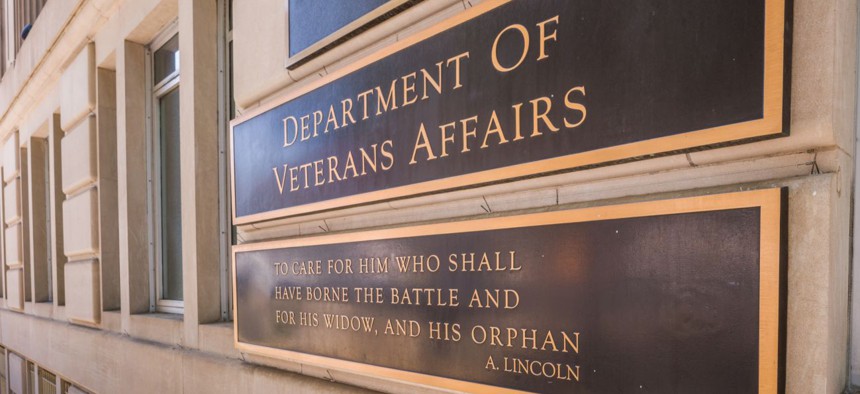
A federal judge on Friday declined to issue a decision seeking to modify an earlier court order to restore VA workers' collective bargaining rights, despite finding that management has sought to "subvert" her rulings. J. David Ake/Getty Images



Judge: VA is “subverting” court order in union case
But a federal judge said Friday that she is unable to modify her now-stayed injunction restoring VA employees’ collective bargaining rights because questions about the scope of her order are at the “heart” of the department’s appeal to circuit court.

A federal judge on Friday declined to issue a conditional ruling that could eventually restore Veterans Affairs Department collective bargaining rights, though she acknowledged that the department’s management has sought to “subvert” her prior decisions.
Earlier this year. U.S. District Judge Melissa DuBose found that the VA likely violated employes’ First Amendment rights when it sought to implement President Trump’s executive orders banning collective bargaining at most agencies on national security grounds and ordered the restoration of the department’s contract with the American Federation of Government Employees.
But over the summer, the VA announced that it planned to again terminate its contracts with AFGE when they were set to expire in August, claiming that the union failed to come to the bargaining table to renegotiate the deal within 30 days of management’s request to do so. Union officials countered that they had met that requirement and indeed have been in active negotiations on the ground rules for bargaining a new contract.
The commencement of new contract negotiations ordinarily would trigger a provision of the CBA automatically extending its duration past the Aug. 8 expiration date indefinitely. In August, DuBose moved to enforce her prior order preserving the CBA, but a three-judge panel on the U.S. Court of Appeals for the First Circuit walked back that decision, finding that it improperly modified DuBose’s earlier injunction while it was the subject of another appeal.
Last month, after VA formally terminated its CBA with AFGE, the union urged DuBose to issue an “indicative ruling,” a rare measure by which a judge can seek to clarify a ruling that is subject to appeal, provided that the appellate court remands the case back to the lower court for that purpose.
In an order Friday, DuBose validated the union’s argument, but found that she could not fulfill its request because the question of whether the VA had triggered the automatic contract extension provision is at the “heart” of the department’s appeals.
“Plaintiffs argue that the modification [of my order] is appropriate here because defendants are continually trying ‘to subvert the preliminary injunction,’” DuBose wrote. “The defendants counter that the proposed modification ‘goes to the heart of what the First Circuit is reviewing.’ The court agrees with both parties’ statements.”
The judge also noted that despite the VA’s claims otherwise, both parties in the case have been “more or less continually engaged in various steps” related to renegotiating the collective bargaining agreement.
“Despite the various court orders in this case and in the corresponding appeal, it appears that the parties have in fact been participating in conversations and actions designed to determine ground rules that would govern the renegotiation of the master CBA,” she wrote. “The parties are, of course, free to continue with those steps while the consolidated appeal is pending. The current injunction order also contemplates that the master CBA could be ‘terminated or amended in a lawful manner.’”
Opening briefs from the VA in both of its appeals of DuBose’s earlier orders are due Dec. 23.
If you have a tip that can contribute to our reporting, Erich Wagner can be securely contacted at ewagner.47 on Signal.
NEXT STORY: ‘Gagged’ immigration judges return to Supreme Court, asserting ‘First Amendment black hole’