

NASA's Black Marble team received a Golden Goose award. LaserLens / Getty Images




Using holiday lights to inform hurricane recovery? Award honors ‘seemingly odd’ federally funded research that brings about groundbreaking discoveries
The Trump administration has sought to upend federal support for scientific research, including through budget cuts and granting political appointees more control over the grantmaking process.

Miguel Román, the deputy director for atmospheres and data systems in NASA Goddard Space Flight Center’s Earth Sciences Division, started his career at the space agency with a much simpler title: intern.
“Summer 2003 was a sublime moment for me because I truly saw people walking the halls of this building, and they were literally changing the books of science by making major discoveries at the time by building large flagship missions and pointing them down at Earth and measuring things we had never looked at before,” he said. “Twenty-some years later, I'm sitting in the corner office of that building.”
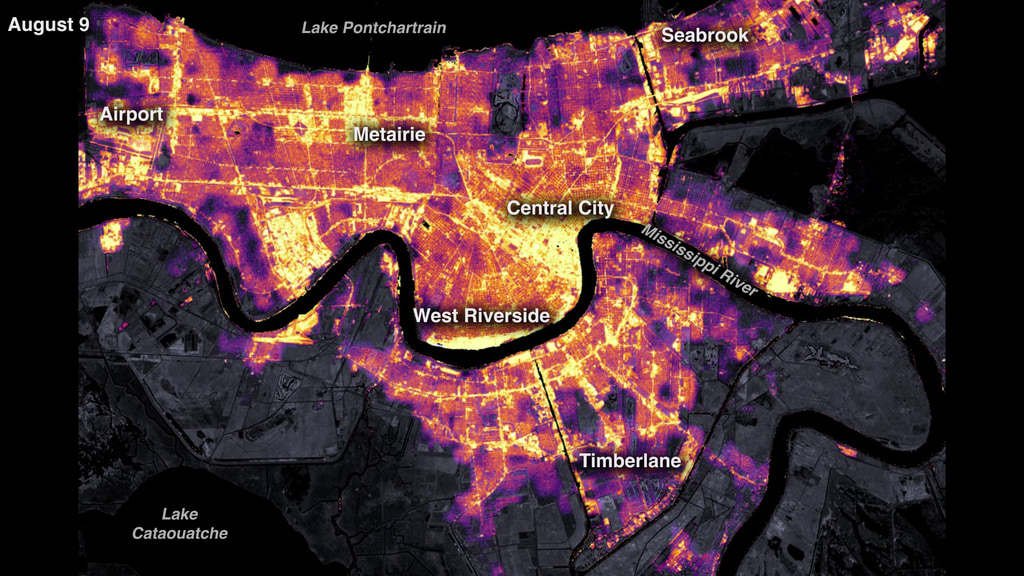
Román himself has changed science books through his work on Black Marble, a NASA project that provides a near real-time measurement of nighttime light around the world. Its data has been used to support disaster response, humanitarian organizations in conflict zones and as a proxy for economic activity.
Black Marble is part of a trio of winners for this year’s Golden Goose awards, an annual program put on by the American Association for the Advancement of Science that honors “unexpected, seemingly odd federally funded research that ultimately leads to transformative breakthroughs for science and society.” Winners were recognized last week during a ceremony at the Library of Congress.
Past honorees include researchers that contributed to mRNA vaccines, artificial intelligence and GLP-1 drugs.
Black Marble’s quirky origin story is that initially NASA was picking up nighttime lights that researchers couldn’t explain.
“We thought the instrument was broken because the lights over desert areas where we drew all our calibration — very stable sites — were going up and down every year,” Román said. “Up until that moment, we didn't realize that we were seeing the effects of Muslim cities celebrating the end of Ramadan.”
The NASA official said that Black Marble’s life-saving applications started to become apparent during hurricane recoveries, such as Hurricane Maria in 2017 that hit Puerto Rico, where Román is from.
“I was looking at changes in places where I knew the names of streets, and I had walked. If you're a citizen of that locale, and you know what's going on, it carries a different weight,” he said. “We went from curiosity and something a little fun and happy to answering our call to service and having a sense of urgency and taking that seriously as a group, even though we're a science agency. The capability was there. We had data systems. At that point, it wasn't about the science as much as it was also making the data available to the people making decisions on the ground.”
Román added that Black Marble data is increasingly being used by Fortune 100 companies for matters like assessing AI supply chains and insurance decisions.
“NASA built an ecosystem around public value that drives the national economy and national interests,” he said. “We are still doing the curiosity-driven work, but we're also helping eat up the risk that industry may not stomach to allow folks to take on this capability.”
“Scientific research is more than just about the funding; it relies on people”
The Golden Goose awards were founded in 2012 as a response to former Sen. William Proxmire’s “Golden Fleece Awards.” When he was in Congress from 1975 through 1988, Proxmire targeted federal spending that he considered to be wasteful, which often included scientific research funding.
“The idea for the Golden Goose award was to demonstrate that sometimes research that might sound silly or odd or a waste of taxpayer dollars can have amazing contributions to society,” said Joanne Padrón Carney, the chief government relations officer for AAAS.
For example, the other two Golden Goose honorees this year are:
- Histotripsy, which can break apart tumors without surgery or heat, that originated with a graduate student, Zhen Xu, trying to quiet noisy lab equipment. The research was supported by the National Institutes of Health and Defense Department, and Xu has since co-founded a multi-billion health company to commercialize the technology.
- Sidney Nagel, whose research backed by the National Science Foundation and Energy Department on phenomena like “the ring left behind by a spilled drop of coffee” has led to “applications ranging from inkjet printing and industrial manufacturing to grain silo design and diagnostic techniques that analyze dried blood and saliva droplets.”
Carney is concerned, however, that various actions taken by the Trump administration will stymie future scientific discoveries. Specifically, she pointed to attempts by the Office of Management and Budget to give political appointees more power in approving grants and the president’s proposed fiscal 2027 budget cuts to science agencies: NIH (-12.8%), NSF (-54.7%) and NASA Science (-46.3%). Congress largely rejected Trump’s proposed reductions to science agency funding last fiscal year.
Regardless of whether the administration’s efforts are ultimately successful, she worries that they will still deter young people from becoming scientists.
“Scientific research is more than just about the funding; it relies on people. Our concern is that these young, hopefully aspiring, scientists that may be in elementary school, high school or even college — they may not be considering going into scientific research as a career path because they're seeing the challenges facing the current cohort of scientists that we have across the United States,” Carney said. “Research really relies on people, ultimately, and their curiosity and their drive and persistence.”
If you have a tip that can contribute to our reporting, Sean Michael Newhouse can be reached securely at seanthenewsboy.45 on Signal.
NEXT STORY: Bureau of Prisons is the latest agency ordered to reinstate union rights