

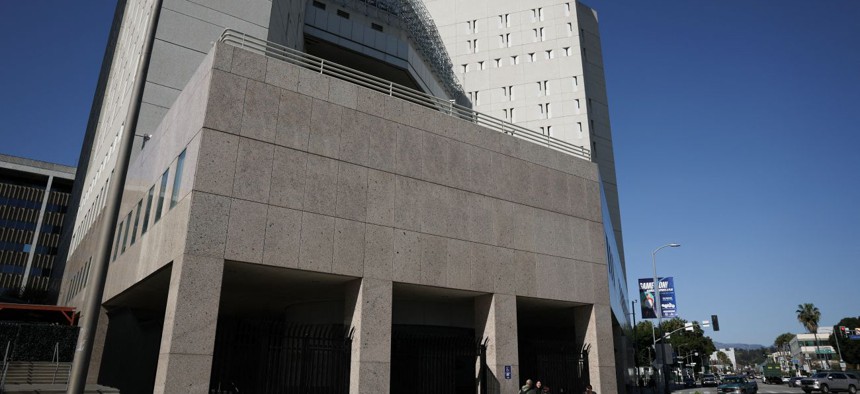
The U.S. Bureau of Prisons said Thursday that it has reterminated union contracts despite an injunction requiring their restoration, arguing nothing in a judge's order last week prevented such a move. Patrick T. Fallon / AFP via Getty Images




Bureau of Prisons re-terminates union contracts despite court order
Attorneys for the Trump administration said there is nothing in U.S. District Judge Vernon Oliver’s preliminary injunction preventing BOP from canceling its collective bargaining agreements a second time.

The U.S. Bureau of Prisons terminated its union contracts for the second time Thursday, just two days after the American Federation of Government Employees called upon its leadership to be held in contempt over failure to comply with a court order restoring the agreements.
Last week, U.S. District Judge Vernon Oliver ordered that BOP reinstate its collective bargaining agreements, finding that the September 2025 contract terminations, conducted under the auspices of President Trump’s executive orders banning unions at most federal agencies on national security grounds, violated the Administrative Procedure Act because the agency’s stated reasoning was likely “entirely pretextual.”
But on Tuesday, union officials reported to the court that they had experienced widespread “defiance” of Oliver’s preliminary injunction. Wardens reportedly told union officials their instructions were to wait, rather than comply with the ruling; one employee was denied union representation at a disciplinary hearing and was ultimately fired after 19 years at the agency.
In a court filing Thursday responding to AFGE’s contempt motion, the bureau alleged that leadership had instructed the agency to reinstitute its CBAs and that it simply took time to wind up those systems—union officials began getting approval for official time requests Tuesday, after the labor group filed its motion.
“Plaintiffs allege that wardens have been told not to comply with the PI and not to work with the union,” wrote BOP’s attorneys. “As indicated above, the BOP avers no such guidance was given by BOP leadership. On the contrary, beginning the morning of September 30, 2026, [Human Resource Management Division Senior Deputy Assistant Director Jonathan] Hemingway describes the focus of BOP senior leadership being on implementation and compliance with the preliminary injunction and remained the focus of bureau leadership until the agreement was terminated on October 7.”
In BOP Director William Marshall’s new termination notice, he rescinds the 2025 termination notice, as well as a blog post in which he said he was cancelling the union contracts because AFGE is not the “kind of union” he supports, though the latter message remains on BOP’s website. He argued that the contracts were “not intended to operate” independent of the federal sector labor rules the agency is now exempt from, and that engaging with the union distracts from its national security mission.
“Maintaining the CBA despite the president’s exclusion order has already caused, and will continue to cause, significant and irreparable harm to the bureau,” Marshall wrote. “These harms include substantial monetary, operational and resource impacts relating to staffing and scheduling, implementation of the First Step Act, staff and inmate safety, necessary infrastructure repairs, adoption of technological advancements and updating mission-critical policies and procedures . . . These monetary, operational and resource impacts directly interfere with the agency’s ability to meet its national security duties and responsibilities, as well as its other duties and responsibilities.”
Other agencies have tried a similar tactic, to limited success. The Veterans Affairs Department terminated its CBA for a second time last March, earning a swift rebuke, and then-Homeland Security Secretary Kristi Noem was similarly chastised in a case involving efforts to overturn prior administrations’ administrative extension of collective bargaining rights to Transportation Security Administration workers.
In a statement Thursday, Brandy Moore White, president of AFGE’s Council of Prison Locals, denounced management’s effort to cancel her union’s contracts a second time, and vowed to continue to fight the initiative in court.
“Our collective bargaining agreement and local agreements provide essential protections for employees who work every day in some of the most challenging and dangerous conditions in federal service,” she said. “The public should be outraged. These agreements are not simply pieces of paper; they provide stability, due process and a meaningful voice for the men and women who keep our institutions safe. Our members deserve nothing less than full compliance with the court’s decision.”
If you have a tip that can contribute to our reporting, Erich Wagner can be securely contacted at ewagner.47 on Signal.
NEXT STORY: Some former federal employees are still struggling to find the right fit