

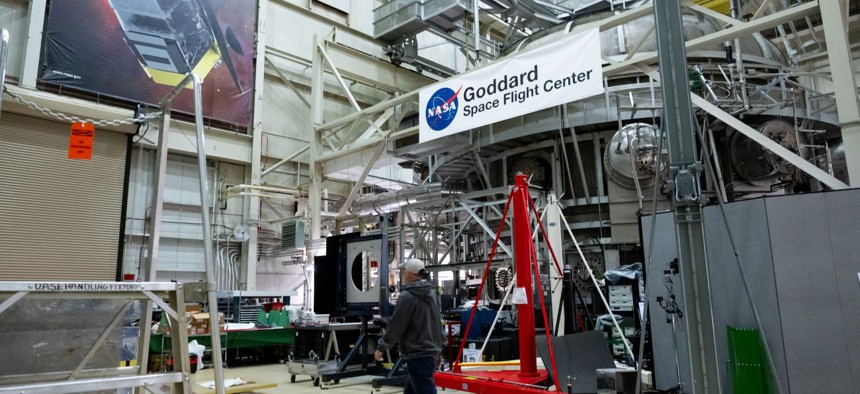
Employees alleging workplace discrimination at the National Aeronautics and Space Administration said a recent EEOC decision against them misapplied both facts and the law. Photo by SAUL LOEB / AFP via Getty Images


NASA employees: EEOC committed ‘flagrant distortions’ to decertify class complaint
EEOC officials touted a long-running discrimination case against NASA as an example why federal sector cases were in need of reform. The employees who brought the case said commissioners railroaded them.

A group of National Aeronautics and Space Administration employees on Thursday challenged the Equal Employment Opportunity Commission’s decision last month to strip them of class-action status in a long-running discrimination case, accusing the commission’s Republican majority of committing “flagrant distortions” of the facts and law.
In 2013, NASA workers filed a class action complaint with EEOC, alleging that the agency’s performance appraisal system systematically advantaged white employees and disadvantaged Black and Asian-American workers. Due to delays on EEOC’s part, an administrative judge did not certify the class until 2022, over NASA’s objection.
But in a decision last month, the Republican majority atop the EEOC voted 2-1 to decertify the class and, in an unusual step, ruled in NASA’s favor on the merits of class agents’ individual complaints, rather than remand the case back to the administrative judge. Weeks later, EEOC officials cited it and other long-delayed cases as part of their argument for ending class action cases in the federal sector entirely and removing federal workers’ right to request a hearing before a judge in cases alleging discrimination.
On Thursday, complainants in the case filed a motion asking EEOC to reconsider its decision, a necessary step before appealing the decision in federal circuit court. Though they missed the 30-day deadline to make such a motion, they said that is because EEOC failed to inform them of its ruling.
The motion alleges that EEOC’s decision relied on a jaundiced view of both the underlying facts in the case and federal civil rights law.
“This type of radical change in established legal procedures, achieved partly through distorted depictions of the arguments and evidence in the case, undermines the rule of law, which is rooted in principles of stability, fairness and civil justice,” attorneys for the complainants wrote. “While reconsideration is rarely granted, it is imperative in this case.”
EEOC’s August decision summarizes the NASA employees’ complaint as alleging that judging employees’ performance based upon teamwork and communication creates a disparate impact negatively impacting Black and Asian-American employees’ performance ratings. The Trump administration has separately staked out the position that disparate impact liability is unconstitutional.
“Specifically, class agents allege the ‘communication’ and ‘collaboration and teamwork’ critical elements—which are included in every employee’s performance plan—led to disparate outcomes for African-American and Asian-American employees compared to their white peers,” EEOC wrote. “Class agents attribute these disparate outcomes to the fact that the performance system relies extensively on a frontline supervisor’s subjective discretion to score these elements.”
But the complainants said that was just one of six interrelated flaws in the performance appraisal system, and EEOC declined to address the others.
“Class agents in no way elevated the fourth [Employee Performance Communication System] flaw as more important than the other five,” the NASA workers’ motion states. “Yet the ‘Facts’ section of the decision misleadingly singles it out . . . Then the discussion of EPCS in the analysis section again focuses on the standards for communication and teamwork. The decision briefly mentions only one of the other six identified flaws; it entirely ignores the other four.”
They also took issue with the commission’s decision to decide the underlying merits of the case, despite not providing the parties with an opportunity to submit legal briefs.
“Without input from the parties, the commission erroneously concludes that ‘the agency’s practices are undisputedly job-related and consistent with business necessity’ and that ‘class members have not, and cannot, demonstrate a viable alternative to the challenged employment practice,’” the complainants wrote. “[But] class agents do not challenge that supervisory discretion is necessary and appropriate in EPCS. Instead, they challenge the level of discretion that NASA gives supervisors and contend that viable alternatives would reduce that discretion while meeting NASA’s need to evaluate and improve performance.”
For example, while NASA advises supervisors to write “standards” for employees at the start of the year that are “SMART”—specific, measurable, aggressive yet achievable, results-oriented, and time-based—examples that NASA provides to supervisors are not in that format. The complainants argued the agency could correct this by changing the examples it provides to supervisors, improving training more broadly, or engaging in targeted training for supervisors whose standards write-ups are not in SMART format.
In a statement last month, the EEOC’s lone Democratically appointed commissioner, Kalpana Kotagal decried her colleagues’ decision to decertify classes in this case and two others and suggested they were pretextual in nature.
“These decisions break with these longstanding agency goals by making it harder for federal employees to pursue class claims and get relief in the class complaint process,” Kotagal said. “Shockingly, the commission goes out of its way to decertify classes in decades-old cases, or to resolve questions not before the agency. Unfortunately, the outcome of these decisions feels predetermined: to make it harder for workers to challenge systemic discrimination and vindicate their civil rights.”
If you have a tip that can contribute to our reporting, Erich Wagner can be securely contacted at ewagner.47 on Signal.
NEXT STORY: Judge halts ‘favorite EO’ question on federal job applications