

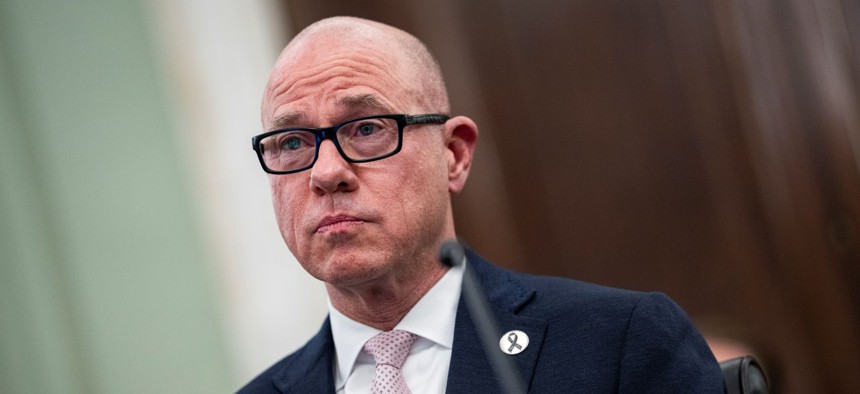
FAA Administrator Bryan Bedford defended his decision to only distribute 1 percentage point of a 3.8% congressionally authorized raise for air traffic controllers, arguing he must see more efficient scheduling at the agency first. Photo by Al Drago/Getty Images



FAA administrator defends withholding part of ATC pay raise
Democrats on a House appropriations subcommittee accused FAA Administrator Bryan Bedford of trying to “squeeze” the already overstretched air traffic controller workforce.

Democrats on a House spending panel had pointed questions last week for Federal Aviation Administration Administrator Bryan Bedford over his decision to withhold a portion of a pay raise for air traffic controllers that Congress enacted earlier this year.
Earlier this year, Congress set aside $140 million in appropriations to fund a 3.8% pay raise for federal air traffic controllers, enacted as part of the deal to end the 76-day shutdown of the Homeland Security Department. But to date, Bedford has only OKed the dispersion for a 1% pay raise, arguing that the workforce must adopt new efficiencies in order to “unlock” the rest.
Bedford has justified his position by noting that the funding law authorizing the 3.8% pay increase grants him “sole discretion” to implement the raise, subject to the implementation of improvements in “workforce scheduling, staffing utilization and other operational efficiencies.”
Democrats on the House Appropriations Committee’s subcommittee on Transportation, Housing and Urban Development and Related Agencies pressed Bedford on that decision during an FAA oversight hearing last week.
“Part of the way we tried to address the staffing issues was with a 3.8% raise, but they’re getting 1%,” said Rep. Mike Quigley, D-Ill. “This can’t supercharge the plan to dramatically increase [staffing], I would see it’s discouraged. For someone who wants to do this or currently does this, it shows a lack of concern about the stress they’re under, financial and otherwise. Why hasn’t it happened yet? Why haven’t we given them this pay raise that we voted for?”
Bedford noted that in addition to the 1% raise, air traffic controllers received a “contractual” 1.6% raise, an apparent reference to their union contract, and said he was following Congress’ instructions.
“Let’s be clear, I have the utmost respect for ATCs; I value the work they do, and as a pilot myself, I rely on them,” he said. “I’m grateful we have them up there and we are supercharging the hiring . . . I could quote the statute, but Congress asked me to look for ways to improve staffing efficiency. That’s what you asked me to do, and if we could get it, then we would do the 2.8% [raise] as part of that. But we have not been able to.”
At issue are statistics indicating that the average time an ATC is actively managing air traffic per shift has fallen from more than five hours per shift 15 years ago to roughly four hours per shift today, Bedford argued.
“That’s not to say that they aren’t doing work, we just don’t know exactly what that work is because we don’t punch time cards, per se,” Bedford said. “But we can tell with the data we have that 15 years ago we were operating many more hours ‘on desk’ than today . . . We’re asking questions and what we’re seeing are schedules that are very inefficient.”
But Rep. Bonnie Watson Coleman, D-N.J., said air traffic controllers are already stretched too thin. An irony of the FAA’s push to hire thousands more ATCs is that training those new hires adds even more to employees’ workloads, at least in the short term.
“Is it your contention that you don’t have operational efficiency while you have understaffed, overworked individuals who are responsible for the safety of air traffic,” she asked. “Is that what you’re saying?”
“I listen to the data,” Bedford said. “I know you’re listening to a lot of anecdotal information, but the data will tell something totally different.”
“You may look at data, but I listen to people,” Watson-Coleman said. “If I hear consistently that the people that we as Congress are supposed to protect are being negatively impacted, that the people responsible for the safety of our airways are depressed and overworked and have mental health issues that aren’t being addressed properly, I listen to that and I recognize it as more than just anecdotal.”
Later, Bedford touted the more than 4,000 new hires the agency has made in the last 18 months but expressed frustrations at improving staffing levels in the New York region.
“There’s a lot of work between hiring and then training someone before they can actually dispatch traffic,” he said. “There’s another fact of whether we can get them to New York. That’s the most difficult place in the national aviation system to staff. I’m not sure why, but we’ve got to figure that out.”
Rep. Jim Clyburn, D-S.C., the panel’s ranking member, said he had a different recollection of Congress’ intent behind the pay raise language.
“I’ve been here three decades, but before that I spent three decades as a manager of governmental entities,” he said. “As I read the legislation on the pay raise, the intent was to put air traffic controllers on par with law enforcement. That was the intent of the 3.8%. The discretion that was given to you, I think, was with then improving the environment [they work in]. And I suspect that the reason you may be having trouble getting people to work up in New York is because of their pay.”