

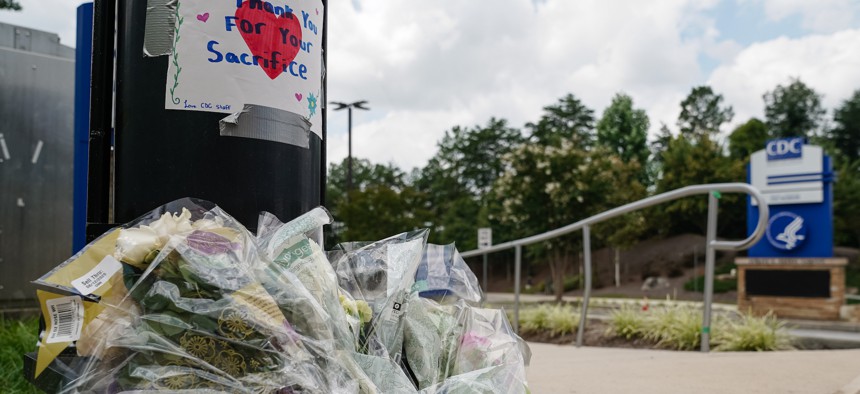
Flowers are seen below a handwritten sign outside the Centers For Disease Control headquarters in Atlanta on Aug. 9, 2025, following a shooting that left a responding police officer dead. Elijah Nouvelage / Getty Images




‘We’re still in hell’: A year later, CDC employees remain shaken by headquarters shooting — and angry at agency leaders’ response
The agency is also contending with deep workforce cuts and leadership changes as a new director prepares to take over.

About a year ago, a gunman opposed to the COVID-19 vaccine opened fire on the Centers for Disease Control and Prevention’s headquarters in Atlanta, killing a responding police officer before committing suicide. There’s still damage from the attack that hasn’t been repaired, according to Yolanda Jacobs, the president of the union local for CDC HQ employees.
Between the shooting, staff cuts and leadership turnover, staffers say they are being pushed to the brink. While some are cautiously optimistic about the agency’s new director, they also feel the administration is hostile toward the CDC workforce, pointing to rhetoric from senior leaders during events associated with the one-year anniversary of the attack.
“The last 18 months have been hell for a lot of CDC employees,” Jacobs said during a virtual press conference on Aug. 7. “You know how they say ‘taking you to hell and back,’ we haven’t gotten back — we’re still in hell.”
As part of commemorations on Aug. 7, Health and Human Services Secretary Robert F. Kennedy Jr. visited CDC’s headquarters where he met with the family of slain police officer David Rose and participated in a fireside chat with agency employees.
According to Jacobs, who did not attend the chat, employees described the town hall as more “badgering and beating down the employees versus we’re here and we’re going to lend support.”
“I do think that it stepped away from being something beautiful — commemorating the death of someone who sacrificed his life for us — and it turned into more of a political fest,” she said.
Another CDC staffer, who preferred to be unnamed due to fears of retaliation, said that employees feel senior officials — such as Kennedy and National Institutes of Health Director Jay Bhattacharya, who has been leading the CDC until the new head is sworn in — are trying to blame the workforce for last year’s shooting.
“A theme that Bhattacharya always comes back to when he's talking to us is that basically ‘We need to listen, and we don't respect people and the whole reason nobody believes in public health — or trusts public health — is because of us not listening to people,’” she said. “It's pretty obvious that they're victim blaming and really telling us it's our fault that we got shot up.”
In addition, a CDC employee who attended the fireside chat shared a photo with Government Executive of a poster featuring Bhattacharya as a wrestler to thank him for his leadership at the agency.
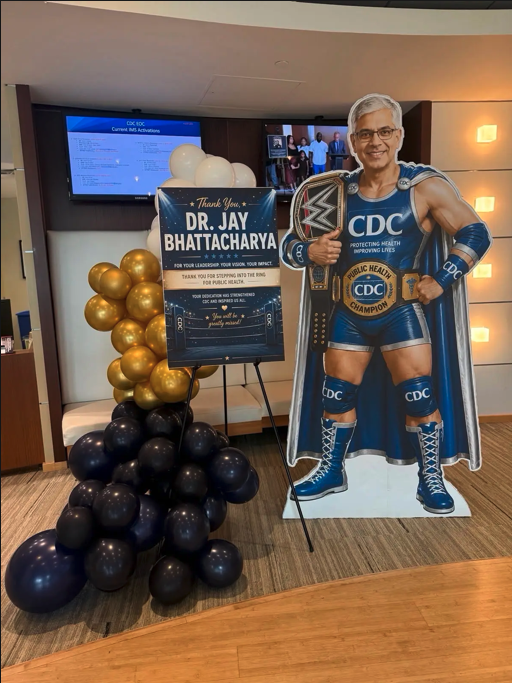
Photo provided by a CDC employee who attended the Aug. 7 fireside chat.
“Just looking at the photo, I see leadership that is totally out of touch with the needs of its employees that does not really understand the magnitude of all that is happening and continues to happen,” Jacobs said.
A group for CDC alumni hosted a commemorative event on Aug. 8 that was unaffiliated with the agency.
“They obviously understood how the first anniversary was going to be really hard for us, and so they put together that service for us and having it off campus was really nice,” the unnamed employee said.
In response to a request for comment, an HHS spokesperson said that: “Secretary Kennedy unequivocally condemns last year's horrific attack and remains fully committed to the safety and well-being of every CDC employee. Any claim that the administration does not take this tragedy or its lasting impact on the CDC workforce seriously is simply false.”
As the Trump administration laid off and otherwise downsized the civil service, CDC’s workforce shrunk by nearly 30% since 2024. And the agency’s former director, Susan Monarez, was fired after only about a month in the position for, she said, refusing to pre-accept vaccine decisions and fire career employees who work on vaccine policy.
Last week, the Senate confirmed a new CDC director, Erica Schwartz, the former deputy surgeon general. At the time of her approval, Jacobs said in a statement that the new leader “has an opportunity to turn the tide.”
“All of us are more than anxious and willing to work with our leadership to get the agency back on solid footing…We just need to know that leadership feels the same way,” she added during the virtual press conference. “Until that happens, we’re going to continue to see employees having mental breakdowns — and we’re seeing a whole lot of that — and we’re going to see a lot of people taking their skills elsewhere where they feel that they’re more valued. And in the end, can we blame them for that?”
If you have a tip that can contribute to our reporting, Sean Michael Newhouse can be reached securely at seanthenewsboy.45 on Signal.
NEXT STORY: Judge rejects VA’s third attempt to cancel union contracts