

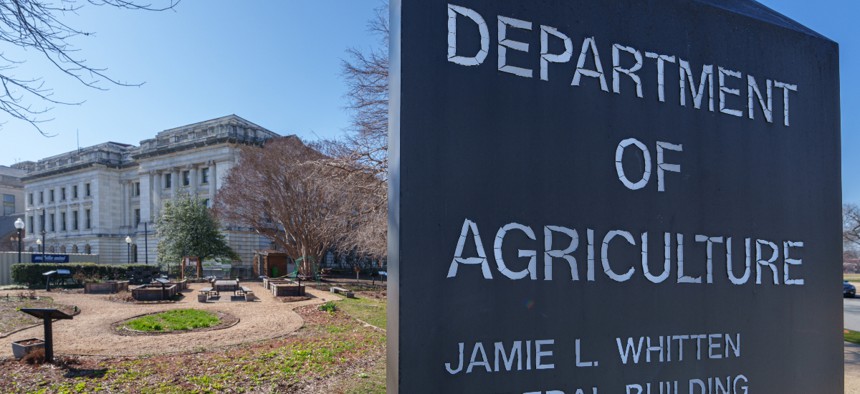
USDA is asking thousands of employees to relocate across the country, as part of sweeping reorganization plans it began unveiling last year. J. David Ake/Getty Images





As USDA relocation deadlines near, employees say questions remain unanswered
Employees say they still lack key details about exemptions, moving costs and next steps as USDA continues issuing relocation notices.

Updated at 4:39 p.m. ET
The Agriculture Department is still sending relocation notices to employees on a rolling basis, despite a lawsuit seeking to put these plans on hold.
Employees also say the department has yet to answer key questions related to these upcoming moves, even as deadlines quicly approach.
USDA is asking thousands of employees to relocate across the country, as part of sweeping reorganization plans it began unveiling last year.
Employees across USDA’s component agencies have been getting relocation notices over the past few months, and must decide this summer whether they will accept relocation or leave their jobs. Staff who opt into the relocation generally must report to their new offices by September or October.
USDA announced last summer that it would relocate more than half of its Washington, D.C.-based headquarters employees out to five regional hubs across the country. It expanded its relocation plans to include many of its subcomponent agencies this spring. The department put part of its headquarters complex up for sale.
Department leaders have repeatedly claimed that most employees who get relocation notices will move to keep their jobs. But in its April 2025 Agency RIF and Reorganization Plan, recently made public by plaintiffs in a lawsuit, USDA states that a “significant number” of employees are not expected to relocate.
In this internal document, USDA planned to cut its total workforce by at least 23%, or by 31% when considering its public safety and inspection workforce.
USDA keeps relocation plans moving despite lawsuit
The Supreme Court ruled last summer that the Trump administration has sweeping authority to shrink the federal workforce through firings and layoffs. But unions and nonprofits leading the lawsuit argue that USDA’s actions “directly conflict” with spending bills passed by Congress that prohibit USDA from carrying out reorganization plans without the approval of lawmakers. They’re seeking a preliminary injunction from a federal judge that would temporarily block USDA’s relocation plans.
Mary Pletcher Rice, USDA’s acting principal deputy assistant secretary for administration, told the court on Friday that the department’s ARRP “does not reflect USDA’s current plans.” Under an agency staffing plan last updated in February, USDA forecasts a “modest increase in staffing,” and seeks to hire nearly 16,000 employees in fiscal 2026.
The U.S. District Court for the Northern District of California is scheduled to hold a hearing on Sept. 1 on whether to grant the injunction. Despite this upcoming court date, USDA is continuing to send out relocation notices to employees at its component agencies.
Employees say they're making decisions without answers
In a notice reviewed by Government Executive, USDA’s Natural Resources Conservation Service recently told employees that relocation notices will go out to headquarters staff by July 31 and state staff by Aug. 14.
“NRCS leadership is committed to a transparent process, ensuring fairness, dignity, and respect for all employees. Personnel actions will be executed in accordance with federal merit requirements,” NRCS Chief Colton Buckley wrote in the notice.
Employees at the Food Safety and Inspection Service, which is relocating about two-thirds of its D.C.-area workforce to “mission-critical locations,” were told last month they must decide whether to relocate or quit their jobs by June 30.
Employees at the National Institute of Food and Agriculture also received their relocation notices last month. Non-bargaining unit employees got their notices weeks before those with union representation.
A NIFA employee told Government Executive that her relocation notice states she must decide whether or not she will relocate by July 29, but major questions about the possible move remain unanswered.
“This whole relocation has been marked with pervasive disorganization,” the NIFA employee said. “We’ve been asking about the injunction and if we should still be trying to sell our houses [and] commit funds to moving, but have been told the agency is moving ahead ‘business as usual.’”
Employees will be partially compensated for relocation expenses through the department’s new “lump sum” reimbursement model. Unions say the new reimbursement model is less generous than what USDA offered to employees who relocated under the first Trump administration, and could mean some employees end up spending thousands of dollars out of pocket in moving costs.
If employees opt into USDA’s “management-directed relocation," they receive an automated email that directs them to follow up with their supervisor on next steps. But the NIFA employee said those supervisors don’t have more details to offer, and that staff are running around in circles to get answers.
“The employee reaches out to their supervisor, who has no idea what’s next. The employee gets referred back to the MDR letter, which says someone will reach out. We end up with employees asking each other, ‘How do I talk to a relocation specialist? How does this work? What did you do?’” she said.
USDA officials have said in meetings that the department will roll out a process for employees to request a hardship exemption from relocation. USDA also told employees that there will be a process to review reasonable accommodations that would prevent employees with disabilities or medical conditions from relocating.
According to the NIFA employee, however, that process hasn’t been finalized yet, and USDA officials were surprised to hear in meetings that employees were already being denied relocation exemptions.
“The MOU mentions the ability to appeal, but folks have been told in their hardship denials that there is no appeals process,” the NIFA employee said.
A USDA spokesperson declined to comment, citing pending litigation.
Unions warn relocations could deepen staffing losses
USDA shrank its workforce by about 20,000 employees largely through voluntary separation incentives last year – about a fifth of its total workforce.
Department leaders say the upcoming relocations are meant to bring its employees closer to the farmers, ranchers and other customers that they serve. But about 90% of USDA’s workforce is already outside of the D.C. metro area.
Genny Kotyk, president of the National Federation of Federal Employees’ Forest Service Council, said in a virtual briefing last Thursday that the Forest Service is still issuing relocation notices.
“This week alone, some of our senior level staff are getting their notices, that they're going to have to make a decision about moving or resigning. That's happening in real time right now,” Kotyk said.
Forest Service Chief Tom Schultz told lawmakers that about 500 Forest employees are being asked to relocate as the agency moves its headquarters to Salt Lake City. The agency sent notices to 6,500 employees telling them that they could possibly be impacted by the agency’s relocation plans, but later said not all employees who received notices will be impacted.
Kotyk said that in an internal poll conducted by the union, only 7% of the 3,000 employees who responded said they would relocate if asked. About 40% of those 3,000 employees have some level of qualification that allows them to respond to wildland fires when needed.
“Potentially, that could be 93% of those 6,500 walking out the door along with those fire qualifications,” she said.
Chearice Vaughn, a financial and business loan specialist with USDA’s Rural Development mission area and president of the American Federation of State, County, and Municipal Employees Local 3870, said she is one of about 45 employees who recently received relocation notices to move from D.C. to Dallas.
“Relocating us hundreds of miles away doesn't make the work better,” Vaughn said. “It just adds moving costs, resignations, and lost expertise. That's not good government. That's a waste of taxpayer dollars to solve a problem that does not exist.”
Some agencies expect especially steep losses
According to Vaughn, 64% of impacted employees said in internal polling that they would not move to keep their jobs. Nearly all of them said they would stay in their jobs if they didn’t have to relocate to Texas.
Rural Development employees asked to relocate work for the Rural Utility Service and the Rural Business-Cooperative Service. These offices process loans and grants that fund rural water towers, broadband lines, electric co-ops and small businesses.
“It's a forced choice: Uproot your entire life, or leave federal service,” Vaughn said. “When a loan specialist with 30 years of underwriting experience walks out that door, that vacancy doesn't get refilled overnight. That's an active loan file that stalls, a water project that waits another year, a rural business loan that doesn't close in time to save the jobs that it was meant to create.”
Vaughn said that of the 45 employees asked to relocate, 86% are people of color, 72% are women, 90% are over the age of 40, and half have an approved reasonable accommodation on file.
“Whatever the intent behind this policy, the impact is falling overwhelmingly on Black women, older workers, and people with disabilities,” she said.
Some USDA components might see more severe staffing cuts than others. USDA's ARRP calls for cutting the Food and Nutrition Service’s workforce by at least 46% and directs FNS to “deemphasize the food stamp program,” referring to the Supplemental Nutrition Assistance Program (SNAP).
FNS lost about a third of its staffing last year, shrinking its more than 1,700-employee workforce down to less than 1,200 employees.
Officials and former leaders question the impact
Former FNS Administrator Cindy Long said FNS has always been a “leanly staffed organization relative to its massive responsibilities,” but would likely see further workforce attrition amid USDA’s relocation plans.
“Employees and the public have virtually no detail on how the new organization is supposed to operate and how it's expected to improve program operations,” Long said.
Two FNS employees told Government Executive that staff haven’t yet received notices to relocate to regional “hubs” across the country, but have gotten notices to move out of their Alexandria, Virginia headquarters and move to the George Washington Carver Center in Beltsville, Maryland and the Yates Building in downtown D.C.
USDA agencies saw major staffing losses when it relocated hundreds of D.C.-based employees to Kansas City under the first Trump administration — a much smaller-scale plan than what USDA is proposing under the second Trump term.
The Government Accountability Office found the vast majority of employees at the Economic Research Service and the National Institute of Food and Agriculture quit rather than relocate to Kansas City in 2019.
“The relocation of USDA agencies under Secretary [Sonny] Purdue, resulted in enormous staffing losses,” Bernie Kluger, a former senior advisor for management in USDA’s Office of the Secretary, now managing director of Prospect Partners, LLC, told Government Executive. Kluger said that this time around, “it would be safe to assume that the numbers would be comparable.”
GAO found that ERS and NIFA dealt with major staffing losses and saw substantial decreases in productivity. According to GAO, it took both agencies about two years to recover from those staffing losses. Even then, the watchdog agency says ERS and NIFA staff are now less experienced and less diverse.
“USDA already ran this experiment on our own agencies in 2019, and the results are sitting in the government's own audit,” said Laura Dodson, the vice president of AFGE Local 3403, which represents employees at ERS and NIFA.
The National Treasury Employees Union Chapter 226, which represents FNS employees, says more than 80% of staff who took an internal survey claim they will not relocate to keep their jobs. The American Federation of Government Employees Local 3403, which represents USDA researchers, said it expects to see similar results.
If you have a tip that can contribute to our reporting, Jory Heckman can be securely contacted at jheckman.29 on Signal.
NEXT STORY: Federal employees say they’ll quit if they have to move to New Jersey