

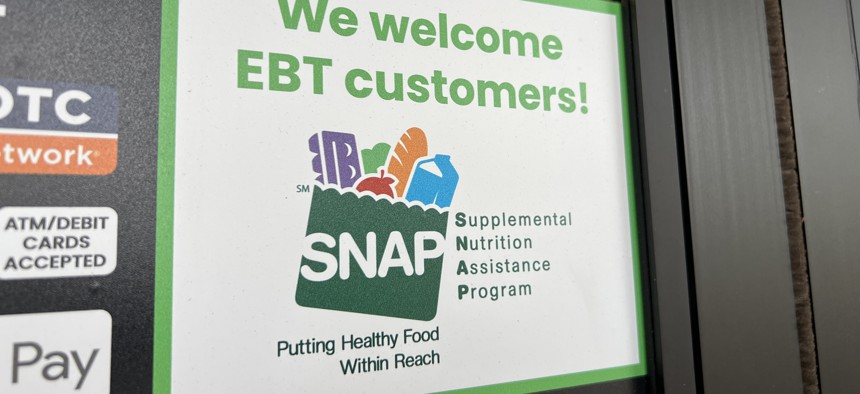
The Food and Nutrition Service oversees 16 nutrition programs, including the Supplemental Nutrition Assistance Program. Smith Collection/Gado/Getty Images





Workers predict significant disruptions to food assistance programs as USDA announces more relocations
Programs like SNAP and WIC "simply will not function" if employees exit en masse after declining mandatory relocations across the country, union says.

The Agriculture Department is relocating hundreds of additional employees away from its Washington-area and regional offices, this time focusing on food assistance program employees.
The Food and Nutrition Service will relocate most of its staff to new hubs USDA has established around the country, including to Indiana, Texas, Missouri and North Carolina. The relocations are part of a larger reorganization of FNS, which will now go by the Food and Nutrition Administration, that a union representing the agency’s workforce said would lead to closures of regional offices in Boston, Chicago, Atlanta and San Francisco.
The changes are part of USDA's reorganization that will see 2,600 employees shifted from the capital region into the new regional hubs.
FNS oversees 16 nutrition programs, including the Supplemental Nutrition Assistance Program and Women, Infants and Children, that collectively serve one-in-four Americans annually. The reorganization and relocations will improve customer service and not result in any disruption to program execution, USDA said.
“As part of this reorganization, we are changing our structure from regional offices to Hubs that will offer improved program support across the nation,” said USDA Deputy Undersecretary of Food, Nutrition, and Consumer Services Patrick Penn.“This new structure will enhance our customer service to the millions of families reliant on these programs and allow for greater employee and partner collaboration.”
The National Treasury Employees Union chapter that represents FNS workers questioned USDA's claim that no programs would be affected by the changes, suggesting that a large number of employees would refuse the relocation and the resulting loss of staff would have catastrophic impacts on operations.
“SNAP, WIC, and school meals depend on FNS employees,” said Amy Rosenthal, the chapter’s president. “Our workers have built their lives in the communities across America where they live. Asking them to make the impossible choice between uprooting their families and losing their jobs will force most of them to quit.”
Democratic lawmakers in the Washington region—Virginia Reps. Suhas Subramanyam Don Beyer, Eugene Vindman and James Walkinshaw; Maryland Reps. Steny Hoyer, Glenn Ivey, April McClain Delaney, Kweisi Mfume and Jamie Raskin; and Del. Eleanor Holmes Norton, D.C.—said the changes amounted to a “mass layoff and illegal reorganization under the guise of a relocation” that would force employees to choose between their careers and uprooting their lives.
“In one swift move, the administration is undercutting food assistance, food safety, and farmers. This will make every single American less healthy and less safe," they said in a joint statement, adding the relocations would be a “disaster” and they would do everything they could to fight and reverse them.
Under President Trump, FNS has shed 30% of its workforce. About one-third of the remaining 1,200 employees currently live in the capital region, most of whom report to the FNS headquarters in Alexandria, Virginia. The agency will leave in Washington its director and “a small footprint” of staff to “be responsive to Congress, interagency needs, regulatory work, and policy coordination.”
SNAP administration will be based in Indianapolis, while Child Nutrition Programs will be relocated to Dallas. A facility in Denver will house Emergency Management and Continuity of Operations, while some staff will also go to Atlanta, Los Angeles and New York.
“If this reorganization moves forward, these programs simply will not function—ultimately risking access to food for mothers, infants, students, children, and elderly people across the country,” NTEU’s FNS chapter said.
The department previously announced it would move its U.S. Forest Service headquarters, and 260 employees, to Salt Lake City, while the department’s Economic Research Service and National Institute of Food and Agriculture, will once again relocate employees to Kansas City. The Food Safety Inspection Service is sending most of its staff to Iowa and Georgia.
USDA’s fiscal 2026 appropriations bill blocked the department from reorganizing or relocating any offices or employees unless Congress authorizes it. The head of USFS recently told Congress his general counsel’s office approved the moves anyway, though Democrats suggested that would play out in court.
Following similar relocations at ERS and NIFA in 2019 moves, both agencies lost more than half of their staff, leading to a significant decline in productivity from which it took the agencies years to recover. The latest USDA reorganization plan received overwhelmingly negative feedback during the public comment period from lawmakers, employees and local governments on the larger USDA reorganization, as well in meetings the department held with tribal governments.
If you have a tip that can contribute to our reporting, Eric Katz can be securely contacted at erickatz.28 on Signal.
NEXT STORY: DHS funding bill heads to Trump, ending shutdown for department employees