

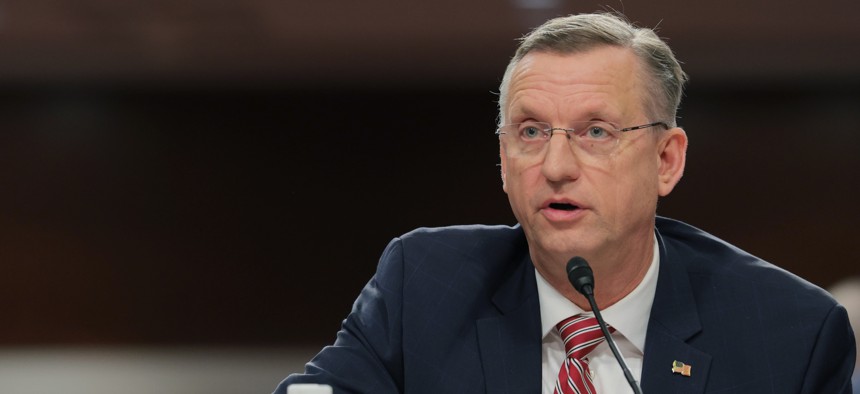
Veterans Affairs Secretary Doug Collins speaks during a hearing with the Senate Committee on Veterans' Affairs on Capitol Hill on Jan. 28, 2026 in Washington, D.C. Anna Moneymaker / Getty Images





VA’s reorganization, staffing caps a result of previous overhiring, officials say
The new restrictions on hiring reflect the needs in the field, VA leaders tell lawmakers.

The Veterans Affairs Department is looking to streamline its structure and cut positions in its workforce to reduce layers of bureaucracy and better align staffing to the needs of the department, agency officials told lawmakers on Wednesday, who said the changes would improve services to veterans.
VA Secretary Doug Collins defended the major shakeups to the organization of VA health care, suggesting the reforms were driven by employees in the field and veteran demands. Some members of the Senate Veterans Affairs Committee, which hosted Wednesday’s hearing, expressed skepticism of Collins’ plan to slash the number of regional offices—known as Veterans Integrated Service Networks, or VISNs—from 18 to 5, suggesting it would centralize decision making away from the field in favor of the department’s headquarters.
Collins and other VA officials said its current construct contains too many layers and it is therefore overly cumbersome to distribute and align department policies. Regional offices will maintain leaders who handle engagements with community stakeholders, medical centers, medical leadership and veterans and their families, while VISN directors will handle policy and funding issues.
The secretary similarly said staffing had ballooned out of control in recent years, which itself has led to the department becoming too unwieldy to manage. New staffing caps were developed in consultation with each medical center director, VA officials said, and adjusted to meet their requests.
“When you get an internal growth and you have an important department so large that they can't basically move because of internal frameworks,” Collins said, “this is where we get the problems.”
He added that “throwing employees” at VA’s problems creates “more bureaucracy, more overhead” that leads to “slowing down and actually removes folks from actually supporting our veterans.”
Greg Goins, the Veterans Health Administration’s acting chief operating officer, said Congress and VA anticipated the passage of the 2022 PACT Act—which made millions of veterans exposed to toxic burn pits newly eligible for department care—would lead to soaring new demands on the department and it hired commensurately. That surge never materialized as expected, Goins said.
“Our organization cannot withstand over time and be sustained with a 14% increase of personnel to support a 6% increase in workload of that same period, it's unsustainable,” he said. “It's not right for taxpayers.”
Sen. Maggie Hassan, D-N.H., said front-line health care workers should not be thought of as unnecessary bureaucracy. VA employees have for years suggested many department facilities are severely understaffed and staff are overworked.
“The doctors and nurses aren't overhead,” she said, adding VA was risking “arbitrary caps” that restricted VA’s capacity.
The issue raised some bipartisan concerns. Sen. Jerry Moran, R-Kan., who chairs the Senate VA committee, said after the hearing he was hopeful VA would allow the caps to be adjusted as needed.
“If there's a problem with it that develops, we would not want a cap to be the determining factor,” Moran said.
Collins stressed there would be no layoffs associated with the reorganization and other officials noted the department was removing vacant billets that were often created with congressional funding to back them up. VA shed around 30,000 employees in 2025 after walking back a plan to slash more than 80,000 through layoffs and attrition.
VA also announced on Wednesday it was investing a record $5 billion on health care infrastructure, including improving medical facilities, building upgrades and electronic health record modernization.
Several Democratic senators criticized Collins for stating over the weekend regarding his former employee, Alex Pretti, an intensive care unit nurse who was fatally shot by Border Patrol agents on Saturday. The secretary expressed his condolences to Pretti’s family and colleagues, but said he stood by his statement that he died because of the policies of local officials in Minnesota.
As the hearing was wrapping up, federal employees held a vigil outside VA’s headquarters to honor Pretti’s life.
“He wanted to make a difference,” said Sen. Richard Blumental, D-Conn., the committee’s top Democrat. “He did, as evidenced by the countless co-workers, veterans and families who have come forward with stories about his compassion and his positive impact on their lives. Alex loved his job.”
Share your news tips with us: Eric Katz: ekatz@govexec.com, Signal: erickatz.28
NEXT STORY: AFGE demands resignations of Noem, Miller following member’s slaying