

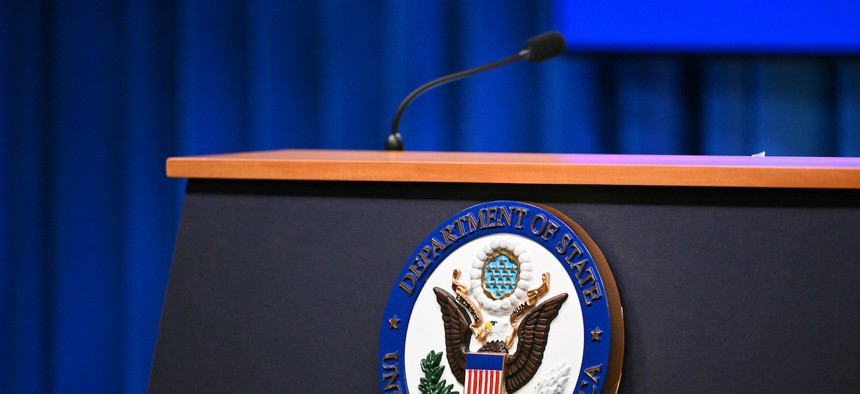
Justice attorneys said State should not have to “go back in time” to unwind actions from July. Mandel NGAN/AFP via Getty Images



After confusion, State will move forward with hundreds of layoffs
A judge said a statutory moratorium on RIFs does not require they be withdrawn entirely.

The State Department has backtracked on a commitment to rescind layoffs for around 250 foreign service officers, instead arguing a measure signed into law by President Trump and a subsequent court order does not require the employees be permanently reinstated.
The Trump administration will not send reduction-in-force rescission notices to the impacted employees, suggesting a court order required only that State temporarily delay implementation of their terminations. The judge on the case, California-based Susan Illston, agreed with the government’s argument and said the RIFs did not have to be walked back entirely.
Congress in November included a provision in the spending measure ending the 43-day shutdown that prohibited any action to implement a RIF, effective from the start date of the funding lapse through Jan. 30. State and a few other agencies subsequently took steps to carry out layoffs, which Illston then blocked last month when issuing a preliminary injunction. Her order called for the “withdrawal of the reduction in force notice” at State and the other agencies.
Illston clarified on Friday, however, that she was referring only to an updated notice State sent to employees on Dec. 2 informing them they would be separated Dec. 5. The injunction did not require the rescission of the original RIF notice State sent to the impacted employees in July.
The Trump administration previously appealed Illston’s December order to an appeals court, arguing it improperly required the rescission of the RIFs altogether. The appeals court ruled in the government’s favor, saying the relevant agencies did not need to unwind the layoffs. The administration subsequently, however, voluntarily withdrew its appeal and told plaintiffs in the case it would rescind the State RIFs.
“The government has withdrawn its pending appeal,” the Justice Department said in an email to the plaintiffs that was presented before the court. “Both Department of Education and State will proceed to rescind the RIF notices that are at issue in this matter.”
Education rescinded its shutdown RIFs, the plaintiffs said, but State has yet to follow suit.
Danielle Leonard, an attorney for the plaintiffs, told the district court on Friday that Congress intended to remove the looming threat of job loss from the foreign service officers entirely.
Allowing the underlying RIF notices to stand, she said, “would allow them to come back and say, we're going to try to fire these individuals within three or four days.” Such actions would become permissible after the RIF pause lifts on Jan. 31.
Illston agreed with that interpretation, while expressing some dismay that the government would not just scrap the RIF notices in question and start over in February when the congressional moratorium expires.
“I cannot understand why the government is fighting about this, but what you're fighting about is whether they all get re-noticed and have another 180 days, or whatever it is, or you get to can them immediately,” the judge said.
She added, however, that she did not see how her injunction “relates back to the original RIF.” Illston did not issue any formal order but suggested State could continue with its current plan.
In objecting to the RIF rescissions, Justice attorneys said State should not have to “go back in time” to unwind actions from July.
“Under these circumstances, it makes no sense to argue, as plaintiffs do, that otherwise valid RIF notices issued last summer must be rescinded simply because now-nullified processing and implementation actions occurred during a period when they were not permitted,” the attorneys said.
Most of the 1,350 employees to whom State sent RIF notices in July were civil servants, who were terminated in September. Those in the foreign service, however, were required to receive 120 days notice, meaning they were due for dismissal in November. Due to the government shutdown and a court order pausing federal layoffs, those cuts did not move forward at that time.
Share your news tips with us: Eric Katz: ekatz@govexec.com, Signal: erickatz.28