

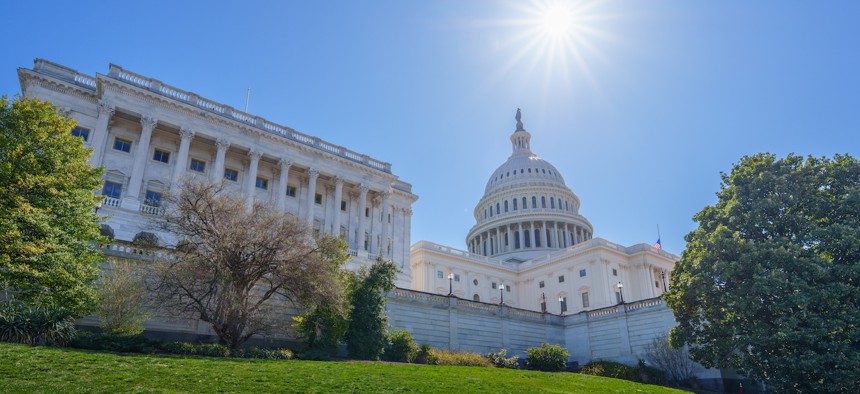
A provision in the spending bill that ended the most recent shutdown barred agencies from taking any step to implement a reduction in force from the day the shutdown began on Oct. 1 through Jan. 30. J. David Ake/Getty Images




Judge temporarily blocks layoffs at State as unions seek to apply shutdown deal pause at 4 other agencies
The Trump administration had argued the blanket RIF moratorium does not apply at five agencies.

Updated on Dec. 4 at 9:51 p.m.
A federal court temporarily spared around 250 State Department from dismissals at the 11th hour Thursday evening, though around 800 additional federal employees across four agencies are still hoping to win a similar reprieve after Congress paused any immediate reductions.
Unions and other groups representing the workers asked a federal court to quickly intervene to enforce a provision in the spending bill that ended the shutdown, which barred agencies from taking any step to implement a reduction in force from the day the shutdown began on Oct. 1 through Jan. 30.
Most pressingly, the American Federation of Government Employees, the American Foreign Service Association and Democracy Forward asked a federal judge in California to block around 250 layoffs that were scheduled to go into effect on Friday. State informed the employees the RIFs, about which it first notified employees in July, would take effect this week after the shutdown delayed the initial schedule.
On Thursday evening, California-based U.S. District Judge Susan Illston granted a temporary restraining order to block the layoffs from taking effect. The plaintiffs were likely to succeed on the merits of the case and would suffer irreparable harm without intervention, Illston said.
Illston also allowed the plaintiffs to update their complaint so she could review already implemented or pending RIFs at several other agencies, and agreed to consider their request for intervention on an expedited basis.
"Yet again, the president’s unlawful assault on the American people and those who serve them will be blocked by a federal court," said Democracy Forward President Skye Perryman. "We are pleased by the judge’s decision to grant a temporary restraining order to protect civil servants."
In addition to State, the Education Department is looking to finalize layoffs of 247 Office of Civil Rights employees for whom it originally sent notices in April. The department said it is awaiting clarity from the U.S. District Court, which, prior to the continuing resolution, had paused shutdown-related layoffs, to determine if it can move forward with separating the workers.
The Defense Department in October separated around 270 employees from the Defense Technical Information Center and the Defense Contract Audit Agency, which the plaintiffs in the ongoing lawsuit now say should be reversed as a result of the spending law that ended the shutdown. The employees received notice of their layoffs in August. The DTIC employees are now slated to be removed on Jan. 31—the first day allowable under the current CR—while the DCAA were formally separated from their roles on Oct. 4.
The plaintiffs similarly argued that the 200 layoffs that went into effect during the shutdown at the General Services Administration and the roughly 75 at the Small Business Administration should be reversed. SBA last month told impacted employees their RIFs were rescinded due to the CR, but reversed course the following day.
The Trump administration has pointed to legal guidance from the Office of Management and Budget and the Justice Department to justify its decisions to move forward with the layoffs. They said the RIFs were not in any way related to the shutdown and therefore the spending law did not apply to them. Agencies told the court that thousands of additional layoffs that were first sent out during the shutdown have been rescinded.
Democratic lawmakers have since said the law made no carve out for RIFs that preceded the shutdown, noting it applied to any layoff-related action between Oct. 1 and Jan. 30.
“No federal funds may be used to initiate, carry out, implement, or otherwise notice a reduction in force to reduce the number of employees within any department, agency, or office of the federal government” for the duration of the spending law, the continuing resolution ordered. Illston highlighted the word "implement" in issuing her decision regarding State.
AFGE and AFSA had requested the temporary restraining order by Friday morning to block the State RIFs before the department separated the employees.
“OMB and [the Office of Personnel Management] have no authority to direct other agencies to apply a misinterpretation of federal law,” the groups said. “Federal agency defendants likewise have no authority to violate” the CR.
AFGE National President Everett Kelley said Congress was clear in its intent.
“The language in the bill and the intent of Congress is unambiguous, and so is the illegality of agencies proceeding to fire workers regardless of the prohibition,” Kelley said. “Because this administration continues to defy the law, the courts must intervene and protect these illegal terminations from proceeding.”
One foreign service officer impacted by the forthcoming layoff told Government Executive State was moving quickly and basically saying, ‘Sue us.'"
This story has been updated to reflect the judge's decision.
Share your news tips with us: Eric Katz: ekatz@govexec.com, Signal: erickatz.28
NEXT STORY: Feds will probably have to work on Christmas Eve, but a holiday miracle would not be unprecedented