

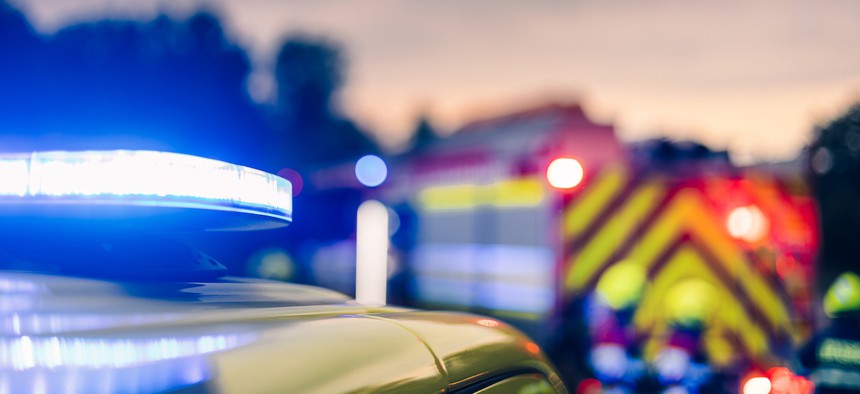
Jaromir/Getty Images



When every second counts: government tech helps first responders’ lifesaving missions
For first responders facing unpredictable moments, tech that helps them safely navigate dangerous environments is critical.

When disaster strikes, first responders are expected to sprint into chaos while everyone else runs away. Whether it’s a collapsed building after an earthquake or a smoke-filled office during an active shooter event, the ability to see around corners and know what’s happening inside a dangerous environment can be the difference between life and death.
Emerging technology from government labs is beginning to give emergency crews advantages they didn’t have even a decade ago. Two recent efforts from the National Institute of Standards and Technology highlight how improved situational awareness and indoor location tracking are becoming part of the first responder’s toolkit.
Drones have started to earn their place in public safety by supporting missions such as search and rescue and surveillance. In the military, they are even becoming decisive frontline weapons, demonstrating their versatility. However, most of those kinds of activities take place outside where a drone can really spread its wings or its propellers, and also receive strong guidance signals to help it navigate. But once the danger moves indoors, drones and the technologies that help drive them, like GPS, can’t easily follow.
One major challenge responders face is simply understanding any indoor environment they’re entering. In many disaster scenarios, sending a human into a building full of fallen debris, compromised structural supports and unpredictable hazards is a high-risk proposition. A better option is to send in a drone first, but only if the drone can reliably navigate complicated interiors and relay useful information back to the team in real time.
That’s the premise behind a prize challenge NIST sponsored to push drone makers to improve 3D indoor mapping. In many of these situations, drones equipped with cameras or sensors could capture video, identify hazards and map the inside of the building for incident commanders. But flying a drone indoors is harder than flying one outside: GPS doesn’t work well in many large buildings, drones have to navigate narrow hallways and stairs and even their own propeller turbulence can disrupt stability. The competition asked participants to build systems that could create high-quality 3D images and maps while flying a complex course and then deliver that data in ways that first responders could use during a real operation.
“This mapping technology can allow first responders to know where there might be potential victims,” said Stephanie Layman of NIST’s Public Safety Communications Research Division. “These maps can help direct responders more quickly to exactly where to send their people, as well as map a path to help get them back out safely. It’s about saving lives — including first responders’ lives.”
Work like this is about more than building better hardware. It’s about usable intelligence in life-or-death situations. Detailed 3D maps can show where obstacles or victims are located before a human team even enters the structure, and they give commanders a chance to make informed decisions based on real spatial data rather than guesswork.
The second challenge for first responders is not what’s inside the building, but who is inside and where exactly those people are. GPS has solved outdoor navigation for decades, but it collapses almost entirely indoors, where walls and ceilings block satellite signals. That becomes a serious problem when an incident commander loses contact with a firefighter who hasn’t checked in on a radio or when teams need to coordinate movements inside a multi-story building.
To address this, NIST and partners have been working on what they call the First Responder Smart Tracking (FRST) Challenge. The goal is to create wearable devices and localization systems that can track first responders through complex interior spaces using an indoor “localization test bed” to verify accuracy. The notion is simple: first responders need an affordable, rugged way to know exactly where their teammates are, not just outside, but through corridors, stairwells and maze-like interiors where time and precision matter.
GPS doesn’t solve this problem indoors because its satellite signals are too weak once they penetrate roofs and walls. Building materials like concrete, steel and glass, especially in high-rise structures, can disrupt or totally block the signals, leaving responders effectively blind. The challenge encourages innovation in solutions that are easy for first responders to carry and track as they move through a building. The devices need to constantly communicate their location back to base.
It’s easy to take location and mapping for granted when you’re walking down a familiar hallway with your phone guiding you. But in a crisis environment, first responders can end up in spaces where every turn, every obstacle and every second counts. The ability to pinpoint locations indoors, in near real time, can reduce confusion, speed rescue efforts and ultimately save lives.
Another development that promises to accelerate improvements in first responder tech is the recently opened Public Safety Immersive Test Center in Colorado. Built by NIST’s Communications Technology Laboratory, the facility is a dedicated space where emergency technology can be evaluated in realistic rescue and response scenarios.
The immersive test center allows engineers, first responders and researchers to simulate complex disaster environments, including collapsing structures, smoke-filled interiors and multi-agency response situations in a controlled, repeatable setting. By combining physical props with advanced sensor systems and instrumentation, the center makes it possible to observe how technologies such as drone mapping, indoor localization devices and communication systems perform under stress.
For example, testing might involve flying a drone through a mock collapsed building while simultaneously tracking rescue personnel wearing indoor position trackers. Researchers can then analyze how well mapping, location and communications systems work together, where they fail and what improvements are needed. That type of holistic evaluation is hard to achieve with field tests alone because real emergencies are unpredictable and difficult to reproduce.
According to NIST officials, the immersive test center gives first responder agencies and technology developers a shared environment where they can study new designs, validate performance and better understand how various tools behave in lifelike conditions. As indoor tracking and drone mapping technologies mature, being able to assess them side by side in realistic conditions will help ensure they’re not only capable in isolation, but interoperable and reliable when multiple systems must work in concert during actual emergencies.
Built in a modular fashion that allows rapid configuration to mirror almost any environment, the new facility is both massive and impressive. There is even a virtual tour available for anyone who wants to explore the various labs and test environments.
All of these efforts reflect a broader trend in technology that government and industry have embraced: using data and connectivity to augment human capability, rather than replacing it. Drones don’t carry responders into harm’s way; they prepare the way. Wearable indoor tracking systems don’t make decisions for crews; they give commanders a clearer picture of where their teams are and what risks they face.
These innovations have practical implications beyond niche research projects. Urban search-and-rescue teams, fire departments responding to multi-story apartment fires, law enforcement clearing complex interiors and disaster response teams entering unstable structures all stand to benefit from technologies that help them understand their environment and locate potential hazards. In an era where every second matters and situational awareness can be clipped by uncertainty, these tools may eventually become as essential as radios and protective gear.
Government investment in challenge-driven innovation like this often flies under the radar compared with headline-grabbing advances in AI or space exploration. But for first responders facing the real world’s most unpredictable moments, tech that helps them navigate dangerous environments safely is not just useful. It’s lifesaving.
John Breeden II is an award-winning journalist and reviewer with over 20 years of experience covering technology. He is the CEO of the Tech Writers Bureau, a group that creates technological thought leadership content for organizations of all sizes. Twitter: @LabGuys