

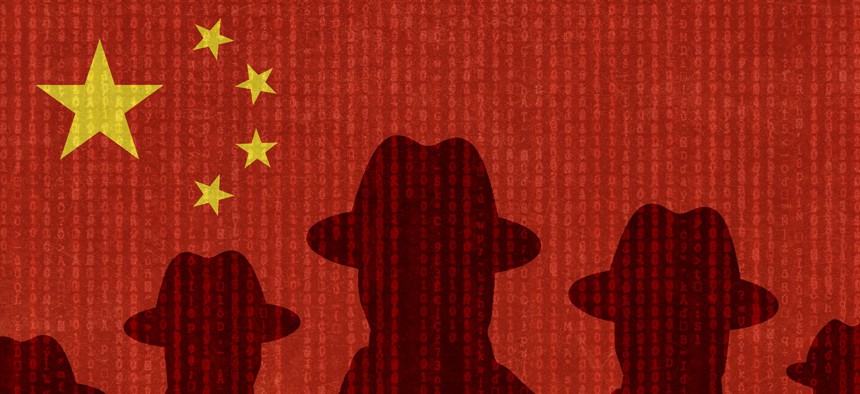
The attempts to gain insights from the former official help highlight the extent to which foreign adversaries are willing to go to extract intelligence from former government employees to aid in painting a picture of rivals’ geopolitical views. sqback/Getty Images


Former State official targeted in suspected Chinese spying effort tied to Venezuela research
The case highlights how former federal officials’ subject-matter expertise can make them targets for foreign intelligence efforts, raising new concerns about post-government research and national security.

A suspected Chinese intelligence outfit contacted a former senior State Department officer late last year requesting they draft an assessment of U.S. policy priorities in Venezuela in exchange for payment, Nextgov/FCW has learned.
The former official, who worked in a national security role while employed by the government and requested anonymity to speak candidly about their experience, said they wanted to speak out about the incident to warn other former federal employees, especially those in highly sensitive positions.
A person claiming to be Keven Lee from a firm called Foresight and Strategy contacted the former official. Both Lee and the firm’s name surfaced in research produced by the Foundation for Defense of Democracies that was first reported by Nextgov/FCW in September last year. That research assessed that the firm is part of a nexus of fake companies and websites likely tied to China.
The network has sought to recruit U.S. individuals with policy research experience, especially those who have worked in the government or at think tanks. The former official did not independently assess the group as Chinese-affiliated.
The attempts to gain insights from the former official help highlight the extent to which foreign adversaries are willing to go to extract intelligence from former government employees to aid in painting a picture of rivals’ geopolitical views. It’s also the first known public case in which the Foresight and Strategy network is confirmed to have sought out a former U.S. government employee for sensitive information.
The outreach came amid a U.S. campaign of airstrikes against supposed drug boats off the coast of Venezuela, which legal experts have questioned the justification for. And it occurred just weeks before a major U.S. operation at the turn of the new year ousted Venezuela’s leader Nicolás Maduro from Caracas and brought him to trial in New York.
After a virtual job interview, a purported Foresight and Strategy executive asked the former officer over email to draft a 1,000-word brief on U.S. policy approaches toward Venezuela that should draw from conversations they had with other State Department colleagues. The red flags began to go up.
“They knew their target well here,” the former official said in an interview, adding that jobless federal employees may be more desperate for paid work and could fall for these schemes.
Former government employees have become a prime target of foreign adversaries’ recruitment scams in the last year amid widespread layoffs, hiring freezes and growing uncertainty in the federal workforce. A State Department employee can be attractive to Chinese spies because of their potential access to diplomatic networks and insight into how U.S. foreign policy decisions are shaped.
Nextgov/FCW has asked the State Department for comment. The FBI declined to comment.
A spokesperson for China’s embassy in Washington, D.C., previously stated they were not familiar with the network of websites and said the nation opposes “any smear and attack on China with so-called ‘spy risks’ without factual basis.”
The timing of a Chinese-linked outreach scam aligns at a moment when Beijing would most want an insider view into U.S. plans for Maduro’s government, said Henry Ziemer, an associate fellow with the Americas Program at the Center for Strategic and International Studies.
“In November and December of last year … you’re getting all these mixed signals about the boat strikes, the oil tanker seizures and military assets in the region. You’re really wondering — is the U.S. actually going to try to topple the Maduro regime, or is this going to be a case where [President Donald] Trump declares victory and goes home?” Ziemer said in an interview.
China, one of Venezuela’s closest Western Hemisphere allies and trading partners, “wants to know about U.S. policy towards Venezuela and what it could signal about U.S. policy towards Latin America as a whole,” he added.
The research that documented Foresight and Strategy as a potential front for intelligence gathering cited China-based domain registrations and shared technical infrastructure with other fake sites as reasons to surmise the firm is likely part of a Chinese operation.
“It’s very plausible that this infrastructure will continue to be used on multiple targets, and … it appears to continue to be used even after it’s been publicly exposed,” said Max Lesser, an emerging threats senior analyst at FDD who co-authored the original findings. “The U.S. government would probably want to consider sharing this information with as many people as possible.”
The outreach is “entirely consistent” with what’s been observed during periods of heightened geopolitical tension, said David Cattler, the former director of the Defense Counterintelligence and Security Agency.
“When direct access to institutions becomes harder, adversaries look for indirect ways to understand U.S. priorities, internal debates and decision-making culture. Former senior officials are valuable because context, judgment, and credibility don’t disappear when the [agency] badge does,” Cattler said in an email.
While the targeting techniques are not new, they now seamlessly align with features of a typical post-government career, he added. The danger emerges when these requests subtly push individuals to leverage non-public deliberations or internal conversations, even without an explicit request for classified material.
“A few simple rules help: be cautious of unsolicited opportunities asking for detailed analysis on sensitive, current issues; do basic due diligence on companies and recruiters; treat requests that rely on non-public conversations or privileged access as a warning sign; if something feels rushed, opaque or oddly focused on ‘how things work inside’ — pause,” he said. “Awareness and professional discipline are the best defenses.”