

sponsor content What's this?




Securing the government mission: Leveraging agentic AI for cybersecurity
Amid the proliferation of AI, public sector cybersecurity has shifted from outwitting adversaries through human intelligence to a battle of autonomous systems. While government agencies turn to AI to bolster security, threat actors are also leveraging AI and using agents to exploit vulnerabilities faster than ever. As cyber threats intensify, the agentic era is an opportunity for government organizations at all levels, from defense logistics to state government to public universities, to move beyond basic automation by adding intelligent automation to their cyber defense teams.
Bridging the velocity gap
Kicking off a cybersecurity discussion at Google Cloud Next, Ron Bushar, Managing Director and Chief Security Officer at Google Public Sector, shared statistics that exemplify the magnitude of the threats government organizations are facing. According to the 2026 Mandiant M-Trends report, the median time for initial access hand-off, or the time between when an adversary first gains entry to an environment to when they hand off for exploitation, has decreased from hours to just 22 seconds.
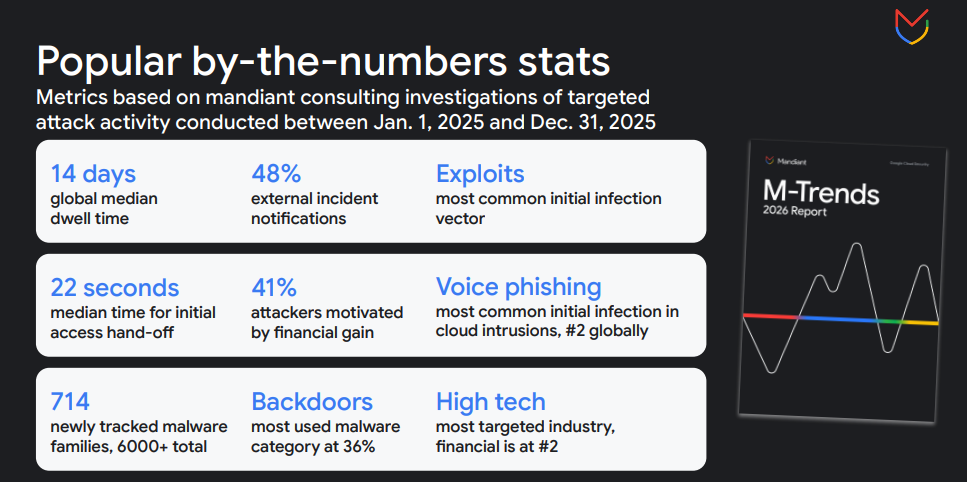
“That tells me that the large majority, or the increasing majority, of attacks have some sort of AI component on the back end that’s powering that automation of the attack life cycle,” Bushar said. “How can we get the advantage back into the defenders hands? … The only way we’re going to do that is through AI.”
By adopting AI, organizations reclaim competitive advantage by trading traditionally labor intensive, manual processes for much faster automated capabilities. This is already yielding results in the field: Shane Dwyer, CISO for the State of Iowa, noted that his system processes about 60 billion logs per month. Through digital transformation and the implementation of a full SIEM/SOAR solution, about 93% of those 60 billion logs are funneled out upfront.
“That means that my staff are only looking at about 7%. That's where I want them, looking at those critical places,” Dwyer said. “We went from having to manually go and look at logs to now addressing the issues before they become issues and intervening before an attacker can get a foothold in our environments.”
This drive toward proactive intervention is echoed by Gene Meltser, CISO for the State of Connecticut. Recognizing that a fragmented, reactive security model was unsustainable, Meltser partnered with Google to transition toward a unified, AI-driven Security Operations Center (SOC). This “Agentic SOC” approach enables Connecticut to anticipate threats before they reach production and neutralize risks across multicloud environments in near real-time. For Meltser, consolidating siloed systems and increasing velocity through AI are critical strategies for future-proofing state infrastructure against increasingly automated adversaries.
“My view of security is rapidly evolving, because we have to, given what we’re observing in industry and where AI is going, especially around automating defenses and offenses,” Meltser said. “For us, at a state level, [AI] is going to be a feature of speed and our ability to retool what we do to meet rising demand and to withstand some of the attacks we’re going to be seeing.”
Agentic privacy, compliance and risk management
Much like combing through security logs, privacy, compliance and risk management have traditionally been associated with significant manual toil. Jeanette Manfra, Vice President and Head of Risk and Compliance at Google Cloud, described how her team has approached experimenting with agentic AI in this space with Google itself as “customer zero.”
By implementing automation, privacy chatbots and agentic controls “that in all of our analyses are actually proving better at finding privacy issues than the humans were,” Manfra’s team is saving thousands of hours. “We're delivering better privacy with less toil on multiple teams, and it’s freeing people up to do the more innovative, creative work that is delivering better, trusted outcomes.”
Manfra is quick to emphasize, however, that people remain essential in this agentic era. AI agents can replace tasks, but humans are critical to designing agents, checking and validating what they produce, and using that information to engage in the type of higher-level thinking and creating that drives innovation.
Even straightforward administrative hurdles, such as informing users about new security standards, can be simplified by AI. Lester Godsey, CISO at Arizona State University (ASU), recounted how his team turned to AI to answer questions and spread awareness about ASU’s updated standards.
“Instead of expecting our users to read those 19 new standards, we consolidated them and all of the security-related existing standards and policies for the university, and created a bot that you could query and ask any question,” Godsey said. “That got a lot more gratitude and attention than I thought it would.”
.jpg)
The key to reaping the benefits of AI in public sector cybersecurity is a willingness to experiment. Adversaries and threat actors are actively using AI, seeking new ways to leverage it for exploitation. In such a rapidly evolving risk environment, integrating AI is not optional, even if it brings new risks.
“Have an open mind — cybersecurity isn't black and white, it’s really about risk management and expectation setting,” said Adarryl Roberts, CIO of the Defense Logistics Agency (DLA). “This is forcing us, from a cyber perspective, from a CIO perspective, to rethink how we're actually implementing cybersecurity as well. As you're looking to implement [AI], to go faster, you have to take risks as a CIO. Just understand what that risk is.”
Cybersecurity education to meet the agentic era
Such a systemic evolution in the field of cybersecurity inevitably trickles down to education. As the role of the cybersecurity professional changes, so must the curriculum designed to prepare the next generation of security leaders. To meet this need, ASU will initiate a student-led SOC in the fall.
“The yearlong program that we’ve developed is not only the basics of being a security analyst,” Godsey said, “but in the latter half of our program, we're going to expose, hands-on, our students to automation, orchestration and agentic AI.”
By utilizing both Google technology and ASU’s internally developed CreateAI Platform, which has its own security, privacy and ethics guardrails, the program will expose students to the value of automation and AI to prepare them for effective careers.
“We need to fundamentally shift the way that we educate our students, such that instead of trying to ignore, or push away AI, or explain why AI doesn’t have value in in the educational process,” Godsey said, “how can we embrace it and then better position our students to be successful, whether it’s employment, future research or anything in between?”
Education and training, whether at university or in the workplace, are the foundation for a workforce that views AI as a force multiplier rather than a threat to job security. As Roberts emphasized, the most important commodity at DLA is its people. AI is not competition but a tool that empowers them.
“We’re training our workforce to where prompting, understanding automation, business process engineering [are] part of our tenets for our workforce,” Roberts said. “Technology, typically in the government, they feel it happens to them, not with them. That’s [why we’re] trying to democratize at the same time we're deploying.”
Download the 2026 Mandiant M-Trends report for exclusive insights into the AI-powered attack lifecycle and the latest frontline metrics for public sector defenders.
This content is made possible by our sponsor Google Public Sector; it is not written by and does not necessarily reflect the views of GovExec's editorial staff.
NEXT STORY: Maximus Podcast Episode 1: Data Readiness for Mission Resilience