

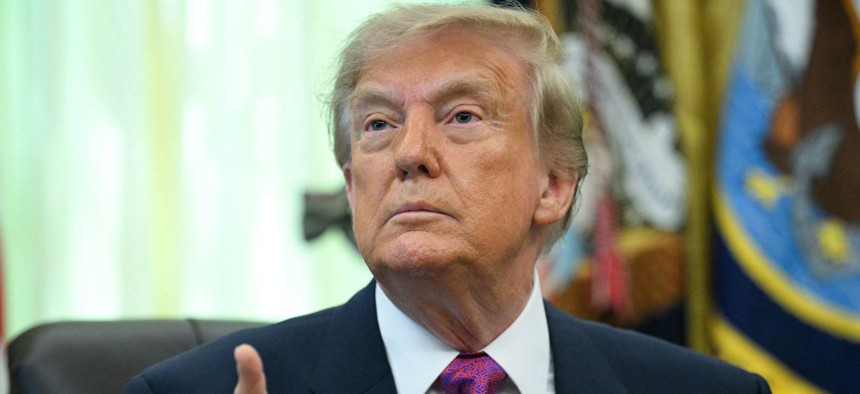
Federal employee groups said Monday that President Trump's plan to freeze most federal workers' pay at 2026 levels next year will be an effective pay cut that will exacerbate federal agencies' recruitment and retention troubles. Jim WATSON / AFP via Getty Images




Trump’s 2027 pay freeze has unions warning of recruitment, retention problems
Critics of President Trump’s plan to keep most federal employees’, save for federal law enforcement officers and military service members, pay at 2026 levels say it picks winners and losers.

Organizations representing federal employees and their allies in Congress in recent days have decried President Trump’s plan to freeze most federal workers’ pay while directing sizeable raises for federal law enforcement and members of the military.
Last week, Trump issued an alternative pay plan formalizing the call from his fiscal 2027 budget proposal to freeze most federal workers pay at 2026 levels next year. He also announced that he would direct the Office of Personnel Management to authorize a 3.8% increase in basic pay for federal law enforcement officers, to go along with a between 5 and 7% raise for military service members, depending upon their rank.
But unions and professional associations warned denying most feds a raise next year could exacerbate recruitment and retention crises at several agencies. Following the Trump administration’s push to cut down on federal headcounts last year, including through mass firings and encouraging early retirement and buyout programs, the non-postal federal civilian workforce fell below 2 million employees this year for the first time since the 1960s, per June data from the Office of Personnel Management.
“This is a slap in the face to the dedicated civil servants who keep our nation running and will make it harder for federal agencies to recruit and retain essential employees,” said Everett Kelley, national president of the American Federation of Government Employees. “For years, wages for federal employees haven’t kept pace with rising costs for housing, food, utilities and other essentials. Private-sector workers currently earn 27% more on average than federal employees doing the same job. To add insult to injury, the administration is asking for special approval to pay hundreds of employees ‘requiring an extremely high level of expertise’ up to $400,000 a year—equal to the president’s base salary—even as it denies workers a basic cost-of-living raise.”
Kelley referred to recently finalized regulations granting OPM greater authority to OK critical position pay that could allow up to 400 positions to earn more than double the current General Schedule pay cap of $197,200 per year.
William Shackelford, national president of the National Active and Retired Federal Employees Association, said that when coupled with inflation and a likely increase to health insurance premiums through the Federal Employees Health Benefits Program next year, a pay freeze is effectively a pay cut.
“This ‘more work for less pay’ policy will only drive the most valuable employees out of federal service, costing Americans in degraded services—from care to veterans to law enforcement and support for our military, wasteful spending due to inadequate management of government contracts and grants, less reliable information and more,” he said. “[Pay] decisions do not only affect current employees—they reach into retirement, too. Annuities are based on high-3 average salary, so a freeze affects the value of future retirement pay as well as today’s paychecks.”
And Dave Spero, national president of the Professional Aviation Safety Specialists, a union representing Federal Aviation Administration workers who install and maintain air traffic control and other aviation safety equipment, said a pay freeze could jeopardize agency efforts to hire hundreds of new technicians.
“The FAA’s workforce plan to hire an additional 750 technicians just became that much more difficult,” he said. “Aviation safety inspectors and other critical employees will begin to retire and the recruitment of these aviation safety professionals will suffer . . . These employees maintain and oversee the largest, safest and most complex air traffic control system in the world. Dismantling it by destroying the morale of the employees is heartbreaking.”
Rep. Steny Hoyer, D-Md., accused the administration of trying to “drive hardworking public servants out” of agencies, and vowed to fight for Congress to override the president’s plan.
“Last week’s announcement that civilian federal workers will not be receiving an annual cost-of-living adjustment for 2027—even while military and law enforcement personnel are given as high as a 7% raise—will only further reduce morale and retention at agencies and make it harder to recruit the best and brightest to serve,” he said. “I’m proud to represent more than 75,000 civilian federal employees in Maryland’s Fifth District, and I will continue to fight this administration’s efforts to denigrate them and deny them the pay and benefits they are due.”
If you have a tip that can contribute to our reporting, Erich Wagner can be securely contacted at ewagner.47 on Signal.
NEXT STORY: Trump formally proposes pay freeze for most federal workers, 3.8% increase for law enforcement