

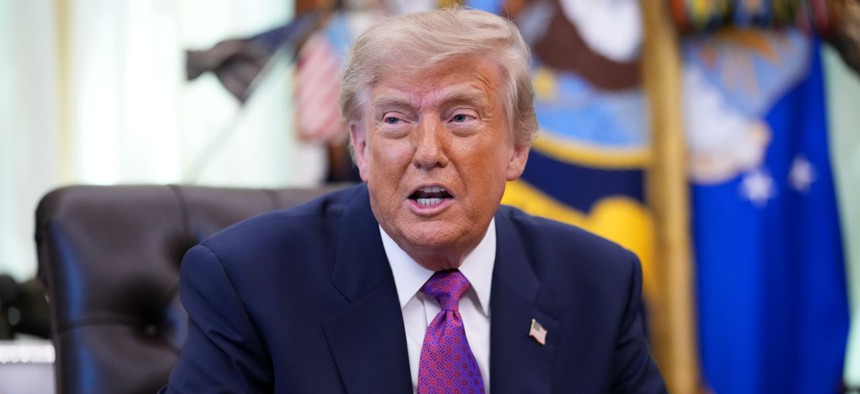
President Trump this week formalized his plan to freeze most federal workers' pay at 2026 levels next January. Exempt are federal law enforcement officers, who are in line to receive a 3.8% pay increase again next year. Andrew Harnik/Getty Images




Trump formally proposes pay freeze for most federal workers, 3.8% increase for law enforcement
In a letter to House Speaker Mike Johnson, the president claimed that denying the federal workforce a pay raise will not hurt agency recruitment and retention efforts.

Most federal employees would see their pay frozen at 2026 levels next year under an alternative pay plan issued by President Trump this week, though for the second straight year, federal law enforcement officers would receive a 3.8% increase.
Trump first proposed the pay freeze as part of his fiscal 2027 budget proposal. Though the document was silent on federal employee compensation, officials with the Office of Management and Budget quickly clarified that its omission equated to a planned freeze for 2027.
In a letter to House Speaker Mike Johnson, dated Thursday, Trump said increasing most federal employees’ pay would be “unacceptable and unfair” given the inflation that occurred under the Biden administration. Inflation actually has risen from 2.8% when former President Biden left office to 3.3% as of last month.
“I have therefore decided to set at zero the pay adjustment to be made for the 2027 pay year,” Trump wrote. “This decision will maintain fiscal responsibility without harming the government’s ability to recruit and retain well qualified employees.”
But in the next paragraph, Trump said that for the second straight year, he instructed the Office of Personnel Management to issue a 3.8% increase in basic pay to federal law enforcement personnel next year, “to increase recruitment and retention” in those roles.
The issuance of a pay freeze would mark a departure from last year, however. While Trump proposed a pay freeze as part of his fiscal 2026 budget, ultimately he elected to institute a 1% across-the-board raise for non-law enforcement federal workers last August.
Alternative pay plans have been a routine exercise across Democratic and Republican administrations. Presidents have until the end of August to issue those proposals, else much larger increases to locality pay would automatically take effect, due to the 1990 Federal Employees Pay Comparability Act.
Congress may override the president’s proposal, typically as part of appropriations legislation. Though the House’s spending bills are silent on federal employee compensation—effectively endorsing Trump’s plan—the Senate has yet to unveil its draft of the spending package that typically serves as the vehicle for pay raises.
In early 2019, the newly Democratically controlled Congress successfully overrode Trump’s plan to freeze federal worker pay that year, ultimately instituting a 1.9% average pay raise retroactive to the beginning of that year.
If you have a tip that can contribute to our reporting, Erich Wagner can be securely contacted at ewagner.47 on Signal.
NEXT STORY: Want to retire at the end of 2026? Start planning now