

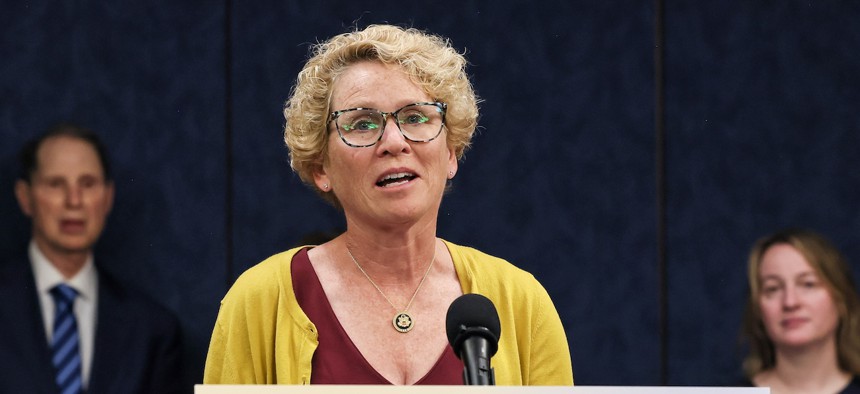
Rep. Chrissy Houlahan, D-Pa., speaks during a rally for Paid Leave for All at the U.S. Capitol on July 10, 2024. Houlahan joined Reps. Don Beyer, D-Va., Brian Fitzpatrick, R-Pa., on Thursday to reintroduce the bill expanding paid family leave for feds. Jemal Countess/Getty Images for Paid Leave for All Action




Expanding paid leave for federal workers is back on the table
Bipartisan legislation would grant civilian federal employees up to 12 weeks of paid family and medical leave per year.

A bipartisan trio of House lawmakers on Thursday reintroduced legislation aimed at expanding federal workers’ access to paid leave to handle illnesses and other circumstances not included in the 2019 law granting feds paid parental leave.
The Comprehensive Paid Leave for Federal Employees Act, introduced by Reps. Don Beyer, D-Va., Brian Fitzpatrick, R-Pa., and Chrissy Houlahan, D-Pa., would grant federal employees up to 12 weeks of paid family leave each year to attend to a serious health condition or to care for a spouse, child or parent. The measure would also cover absences needed to help a family member who is the survivor of domestic violence, sexual assault or stalking, as well as to attend to a family member’s deployment into active duty military service.
When Congress passed the 2020 National Defense Authorization Act, the House’s version included a provision providing 12 weeks of paid parental and family leave to feds. But during negotiations with the Senate, the measure was stripped down to remove the family leave portions, and feds became eligible for paid parental leave in October 2020.
The lawmakers’ bill was first introduced in 2021 by then-Rep. Carolyn Maloney, D-N.Y., who previously had spearheaded the campaign for paid parental leave. In a statement, the lawmakers argued that feds’ current access to unpaid family leave is unrealistic given today’s cost of living.
“Unpaid leave may protect a job on paper, but for too many working families, it is not leave they can actually afford to take," Fitzpatrick said. “When a federal employee faces a serious illness or needs to care for a loved one, the choice should not be between earning a paycheck and being present for their family. Without paid leave, workers can be pushed out of careers they have spent years building, agencies lose experienced public servants, and taxpayers lose operational expertise that cannot be easily replaced.”
“We’ve already made meaningful progress by securing paid parental leave for federal employees and expanding paid leave for service members who transition to the federal workforce,” Beyer said. “The next step is expanding family and medical leave to all federal workers, because every American deserves the peace of mind that comes from being able to take time off to care for their health or a loved one without losing a paycheck.”
If you have a tip that can contribute to our reporting, Erich Wagner can be securely contacted at ewagner.47 on Signal.
NEXT STORY: Why Social Security’s funding gap matters to federal retirement