

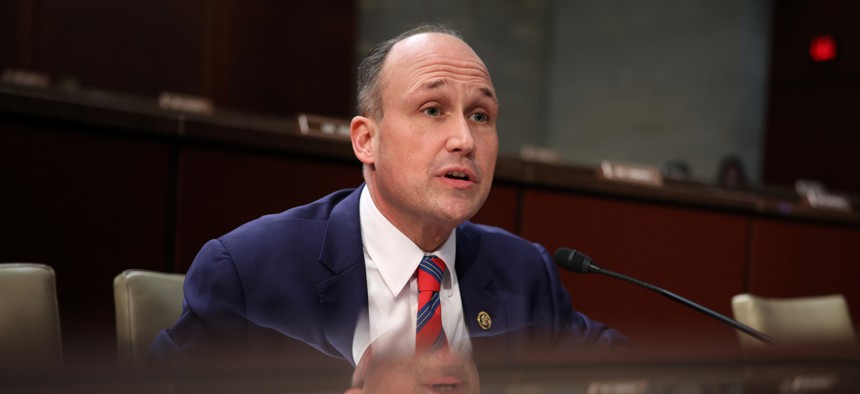
Rep. Nick Langworthy's, R-N.Y., Federal Workforce Early Separation Incentives Act will now head to the House floor for a vote. Kayla Bartkowski / Getty Images





House panel advances bill to update federal worker buyout caps
Voluntary Separation Incentive Payments offered to federal workers during agency downsizings, have been capped at $25,000 since the 1990s. Newly advanced legislation would tie maximum payouts to half of an employee’s annual salary.

The House Oversight and Reform Committee on Wednesday unanimously advanced legislation aimed at updating the federal government’s buyout programs to encourage employees to leave.
Voluntary Separation Incentive Payments are one of the government’s main tools for reducing agency headcounts, alongside Voluntary Early Retirement Authority and reductions in force. But VSIP offerings max out at $25,000, where the cap has sat since the 1990s.
The Federal Workforce Early Separation Incentives Act (H.R. 7256), introduced by Rep. Nick Langworthy, R-N.Y., would remove the $25,000 hard cap on VSIP payments and replace it with a maximum of six months of a federal worker’s salary, subject to agency head approval. The new model is based off how federal agencies already calculate severance pay for laid-off feds.
Langworthy said an update to the federal government’s buyout program was long-overdue, and that the changes will allow agencies to move more agilely—and humanely—in workforce planning.
“This outdated cap has limited agencies’ ability to offer competitive, voluntary offramps,” he said. “As a result, the federal government often misses opportunities to reduce payroll costs early and instead turns to more expensive and disruptive alternatives such as involuntary separations, extended administrative leave, or simply paying for positions that no longer align with few options.”
Rep. James Walkinshaw, D-Va., said he and other committee Democrats supported the measure, noting the three decades since the buyout cap was last examined. But Chairman James Comer, R-Ky., placed the bill in the context of President Trump’s seismic reorganization of government. Hundreds of thousands of federal workers left government last year, through a combination of reductions in force, purges of newly hired or promoted employees and an at-times coercive campaign to encourage voluntary exits via buyouts, early retirements and deferred resignations.
“The American people elected President Trump to take control of the federal workforce, which has become bloated at the expense of efficiency and accountability to the taxpayer,” Comer said. “But President Trump has been hamstrung by outdated federal law that provides only limited tools to downsize agency employment rolls.”
The measure advanced by a 43-0 vote. It now heads to the House floor for consideration.
Share your news tips with us: Erich Wagner: ewagner@govexec.com; Signal: ewagner.47
NEXT STORY: OPM expands job roles receiving 3.8% law enforcement pay raise