

The Conference Board's Leading Economic Index showed continued declines between March and September 2025, signaling a possible economic slowdown. OlekStock / Getty Images




Signals of a slowdown: What federal employees should do with their TSP right now
If the U.S. is headed for a recession, federal employees need not panic about their investments, but instead strategically assess what their financial goals are.
With some economic signs raising the caution flag, now is a key moment for federal employees to take a calm, strategic look at how their Thrift Savings Plan portfolio is positioned. The goal is not to panic, but to respond intelligently.
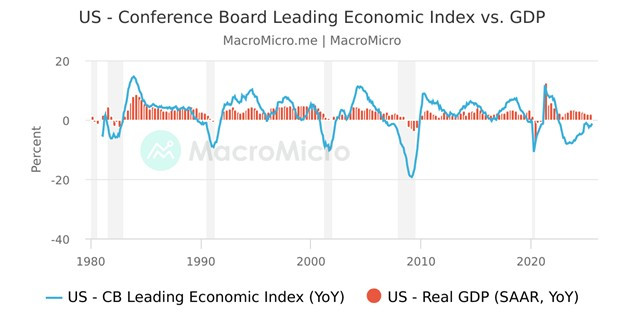
The Conference Board, which is a global, nonprofit business organization that provides data, research and insights to understand economic patterns, offered up some data on the state of the economy per the chart below. Their Leading Economic Index shows signs of a slowdown, with momentum heading down across several components. And while a recession is not guaranteed, the signal is clear: growth is slowing.
Understand what the economic signals are telling us
The LEI is a combination of 10 forward-looking indicators (such as building permits, new orders, initial claims for unemployment insurance, stock prices and consumer expectations) and is designed to anticipate turning points in the economy.
- In March 2025 the LEI dipped 0.7 % to 100.5 (2016 = 100).
- In June it fell as much as 1.0 % to 98.8.
- In September it declined another 0.3 % to 98.3, with six-month declines deepening.
The main point is that people are feeling less confident, businesses are ordering fewer goods, fewer homes are being built and more people are filing for unemployment. This doesn’t mean a recession is happening now, but these warning signs suggest we should be careful. Even Moody’s Chief Economist, Mark Zandi discussed the probability of a recession to an “uncomfortably high” level, now at 48%. He also shared that there’s been a reduction in the amount of residential building permits, similar to pandemic levels.1
Why it matters for TSP investors
For federal workers with the TSP, where asset allocation, retirement timelines and stability often matter more than an uncertain upside, it’s an opportunity to be proactive. This is the time to revisit your strategy, remind yourself of your goals and adjust in ways that align with a slower growth, more unpredictable environment.
It’s important to note that when growth slows:
- Riskier assets (e.g., large equity exposure) may underperform or remain volatile.
- Safe assets might become more important, as to not chase yield, but to preserve capital and liquidity.
- You cannot afford to be “ahead of your skis” on positioning. In other words: don’t try to time a deep downturn, and don’t react so early that you miss out on recovery. Your objective is long-term retirement readiness, not short-term tactical swings.
- You might reconsider the balance between growth (equities) and safety (bonds, stable value, short-term) in the TSP’s portfolio lineup.
The “Bucket Strategy”: Growth meets safety
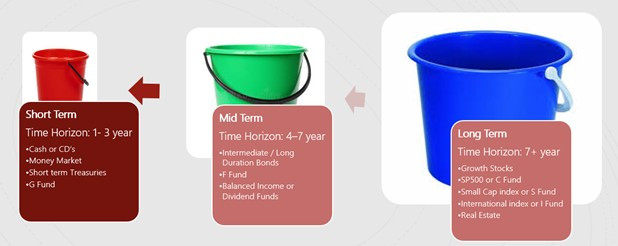
One smart method for federally employed TSP investors is adopting a bucket strategy where you split savings into portions that serve different roles: one for growth, one for transition/later, one for safety. The idea is to keep your long-term retirement horizon invested in growth while making sure you have a more stable fallback in a slower growth environment.
Here’s how you might adapt this to your TSP:
- Growth bucket: Long-horizon portion (seven-plus years from retirement). Heavily invested in equities (e.g., TSP C, S, I funds). Accept volatility, aim for upside.
- Transition/Income-preparation bucket: Mid-term (four to seven years). Moderate growth / moderate safety—blend equities and bonds (e.g., TSP F, L Income funds) depending on risk tolerance.
- Safety bucket: Short-term (–zero to three years until retirement or major distribution). Focus on capital preservation, liquidity—TSP G Fund, short-term TSP options, possibly even deferring major equity rebalancing.
Practical TSP steps for federal employees
Here are practical steps you can take this week and this quarter:
- Review your current allocation: How much is in equities vs. bonds vs. stable value? Are you comfortable with experiencing some volatility in a slowing economy?
- Check your rebalancing schedule: Many TSP participants rebalance annually or when allocations deviate by a set tolerance. With slower momentum, it may make sense to tighten your rebalance band (-/+ 5 % rather than ±10 %), so you don’t drift into too much equity or too little safety.
- Consider future contributions: Instead of automatic contributions always going into the hottest equity pursuit, you might split going forward: e.g., 60% to growth bucket, 30% to transition bucket, 10% to safety bucket (or some similar ratio based on your horizon).
- Avoid emotional adjustments: If you hear a recession is coming or see big headlines, don’t let fear push you into rash allocation decisions. Remember: you’re a long-term investor. Your strategy should reflect your retirement goals, not headlines.
- Track the economic indicators: Keep an eye on the LEI and similar metrics. If the index continues to fall steeply and breadth of decline deepens, you may choose to tilt more conservatively. Conversely, if momentum stabilizes or turns up, you may shift back toward growth.
- Re-visit your timeline and required income in retirement: Slower growth may mean your TSP needs to work a little harder (or you work a little longer) if you plan to maintain certain account balances. Use any slowdown signal as a prompt to update your retirement model.
Time for preparation, not panic
We know it’s tempting to worry when you see negative economic signals, but here’s why you don’t jump ship:
- The LEI is a warning not a guarantee. Slowing growth is more likely than freefall.
- As a federal employee with pension/benefits plus TSP, your risk profile is different from someone who is 100% equity financed.
- Having a plan and sticking to it often beats trying to time the top or bottom of the market.
- If you overreact and move entirely to safety, you may lose long-term growth that matters for retirement.
Therefore: you adjust, you prepare, you align, but you do not panic.
The long-term strategy aligned with your federal retirement goals
Your ultimate retirement goal as a federal employee most likely serves different purposes: achieve a secure income stream (perhaps via the pension), ensure your TSP portfolio grows sufficiently, preserve capital for distribution, maintain flexibility and retire on your terms.
With slowing economic momentum, your TSP strategy becomes more about resilience than chasing high returns. The bucket strategy ties directly into this: growth for the long term, but safety for the nearer term.
Key reminders for TSP investors
Though the momentum in the economy may be slowing, TSP investors shouldn’t abandon their plans. Instead, use this time to review and refine your strategy with a financial professional. Focus on preparation, not panic.
Working with a certified financial planner can help you to be proactive by focusing on action, rather than worrying. With the bucket strategy, we can help you prioritize growth if you have time and add safety as you near retirement. We can walk you through how to adjust contributions and allocations based on your risk tolerance and timeline, letting data, not news headlines, drive your decisions.
- Markets.com, Moody’s Economist Warns: Recession Risk Climbs to ‘Uncomfortably High’ Level, September, 2025
Content in this material is for general information only and not intended to provide specific advice or recommendations for any individual. All investing involves risk including loss of principal. No strategy assures success or protects against loss. Stock investing includes risks, including fluctuating prices and loss of principal. Bonds are subject to market and interest rate risk if sold prior to maturity. Bond values will decline as interest rates rise and bonds are subject to availability and change in price. Asset allocation does not ensure a profit or protect against a loss. Rebalancing a portfolio may cause investors to incur tax liabilities and/or transaction costs and does not assure a profit or protect against a loss. The economic forecasts set forth in this material may not develop as predicted and there can be no guarantee that strategies promoted will be successful.
Watch Our YouTube Video on This Topic
Neil Cain is a certified financial planner with Capital Financial Planners. To discuss your investments, including your TSP, register for a complimentary Retirement Readiness Meeting. For topics covered in even greater depth, see our YouTube Channel.