

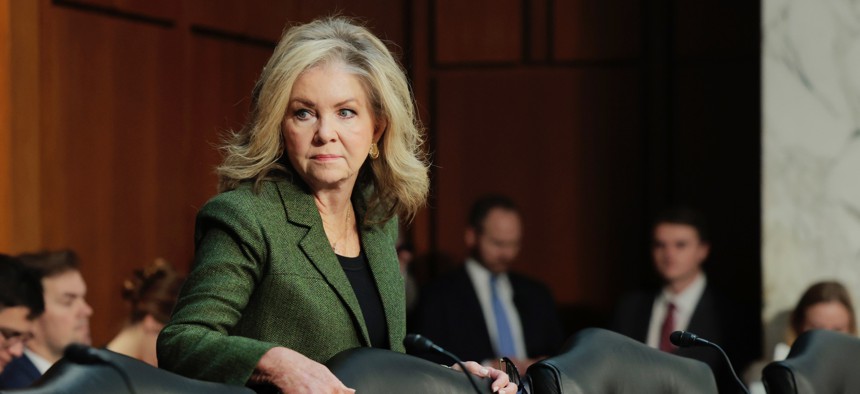
Sen. Marsha Blackburn's, R-Tenn., legislation would allow the FAA to deploy air traffic controllers older than the maximum retirement age, pending medical certification. Anna Moneymaker / Getty Images





To fix air traffic controller shortage, Congress proposes changing retirement limits
The Control Tower Continuity Act would help address the ongoing staff shortfall of 3,000 positions by exempting personnel from mandatory retirement at age 61.

To help fill a 3,000-person gap in the air traffic control workforce, Sen. Marsha Blackburn, R-Tenn., is pushing a bill to bring retired controllers back on the job.
The Control Tower Continuity Act (S. 2263) proposes to lift mandatory retirement requirements applied to certain air traffic controllers at the age of 61, potentially allowing for the return of experienced personnel at a time when they are in high-demand.
“Healthy and skilled air traffic controllers should not be forced to retire at age 61,” said Blackburn, in a statement. “As the United [States] faces a shortage of air traffic controllers, Americans are forced to endure delays, cancellations, and safety concerns. The Control Tower Continuity Act would empower healthy and experienced air traffic controllers to work beyond the current mandatory retirement age to address air traffic controller shortages.”
Current statutes require air traffic controllers to retire at the age of 56 unless exempted by the Transportation Secretary for “having exceptional skills and abilities as a controller,” in which case, they could continue working until the age of 61.
The retirement rules date back to a 1971 amendment to FAA regulations that emerged from concerns that the job’s cumulative stress and ATC’s shift work would lead to burnout, based on House hearing testimony from officials like then- Air Traffic Control Association Executive Director Donald Francke citing the need to phase out older controllers who were not able to make accurate decisions quickly.
As a result of the new law, air traffic controllers hired May 16, 1972, would be required to retire at age 56 — offering roughly 25 years of service after the maximum age of ATC recruitment of 30 — or they could apply for a waiver from the Transportation Department to work until 61.
However, a 2005 FAA research report examining operational errors made by controllers between fiscal 1997 and 2003 did “not support the hypothesis that older controllers are at greater risk of involvement in an OE” and called for the reexamination of the retirement criteria.
Efforts to increase the number of air traffic controllers have been a priority of the last two presidential administrations, but they were punctuated by the Jan. 29 mid-air collision of a commercial airliner and an Army Black Hawk helicopter near Washington, D.C., that killed 67 people.
Transportation Secretary Sean Duffy detailed new incentives and training reforms in February to accelerate the process for deploying newly minted air traffic controllers into service. In May, Duffy said he planned to utilize retirement exemptions to allow controllers to work beyond the age of 56 and until at least 61 and offer 20% bonuses to retain them.
Transportation efforts to hire 2,000 controllers come alongside personnel losses elsewhere in the FAA, where 2,700 employees expressed interest in the “deferred resignation program,” that allows staff to go on paid leave through September before leaving government.
Blackburn’s bill would also require controllers over the age of 61 to update their medical certifications every six months to continue to serve.
The bill has been referred to the Senate Homeland Security and Governmental Affairs Committee. Officials from the Air Traffic Control Association and the National Air Traffic Controllers Association were not available for comment about the legislation.
Share your Pay & Benefits Watch-related questions with us:
Carten Cordell: ccordell@govexec.com, Signal: cartencordell.29
NEXT STORY: Trump’s hiring freeze has jeopardized postal workers’ health care, IG says