
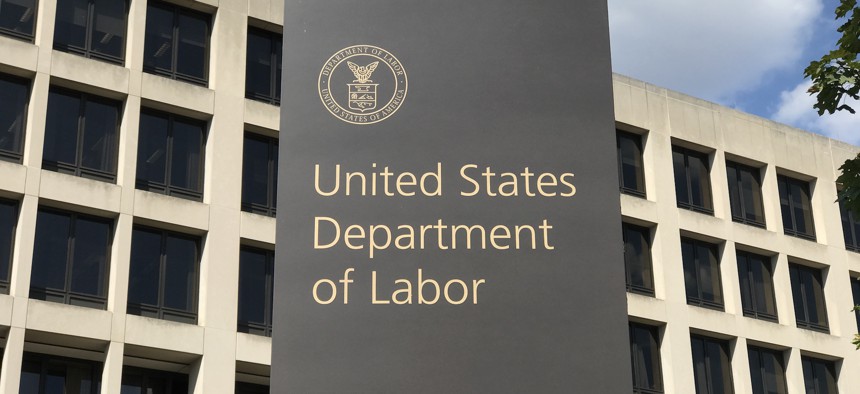
The Office of Federal Contract Compliance Programs is an agency within the Labor Department. Westy72 / Getty Images




Labor has mostly stopped checking whether federal contractors are following disability rules
A watchdog found that the Office of Federal Contract Compliance Programs has no plans to restart routine audits, leaving less oversight of protections for workers with disabilities.

As the Trump administration slashed a Labor Department agency’s workforce and jurisdiction, the office’s enforcement of certain anti-disability discrimination rules that are still on the books was nevertheless weakened by the overhauls, according to a new watchdog report.
Prior to the start of the president’s second term, the Office of Federal Contract Compliance Programs enforced equal opportunity requirements for federal contractors and subcontractors, including Executive Order 11246 (a 1965 anti-discrimination directive), Section 503 of the Rehabilitation Act (anti-disability discrimination law) and the Vietnam Era Veterans’ Readjustment Assistance Act (veterans employment law).
Agencies in fiscal 2025 spent roughly $793 billion on federal contracts that support the employment of more than one million U.S. workers.
OFCCP used to generally conduct audits to assess contractor compliance with all three measures’ requirements concurrently, but Trump repealed the executive order as part of a broader anti-diversity push. As a result, the agency paused, with respect to anti-disability discrimination requirements, the annual certification of affirmative action programs and associated auditing.
The Government Accountability Office found that this has caused confusion among federal contractors about what rules are still being enforced and could hurt federal contractors with disabilities.
“In the absence of audits related to Section 503, DOL lacks a mechanism for regularly monitoring contractors’ implementation of the policies and practices described in their required affirmative action programs,” auditors wrote. “In turn, OFCCP has less assurance that contractors are complying with Section 503 and supporting the employment of people with disabilities.”
An OFCCP employee told Government Executive in 2025 that possible employee settlements under Section 503 and VEVRAA were being held up by the enforcement pause.
In August, DOL also updated regulations so that contractors no longer have to set a goal of employing 7% of their workforce with people with disabilities or track such progress by requiring employees and applicants to self-identify as having a disability or not.
GAO reported that OFCCP conducted nearly 9,000 contractor audits between fiscal years 2017 and 2025, of which 15.7% uncovered at least one violation of agency regulations.
Following the repeal of EO 11246, OFCCP also downsized its workforce. GAO found that the agency went from nearly 500 full-time employees at the start of fiscal 2025 to fewer than 80 by fiscal 2026 and reduced the number of its field offices from 50 to six.
Additionally, auditors criticized agency officials for not conducting workforce planning to ensure that the retained staffers had the skills needed to perform remaining enforcement activities.
GAO recommended that OFCCP resume certifying contractor affirmative action programs and Section 503 audits. The agency’s director, Kenneth J. Wolfe, wrote in a letter attached to the report that officials do not have plans to restart either “at this time” due to the August regulation updates. He noted, however, that the agency is investigating contractor complaints alleging disability discrimination.
The agency did agree with a recommendation to conduct strategic workforce planning as well as several suggestions to provide more information to contractors about current compliance requirements.
Earlier this month, new Labor Secretary Keith Sonderling was sworn in after his predecessor, Lori Chavez-DeRemer, resigned following a series of scandals.
Civil servants with disabilities have recently accused several agencies, including the departments of Veterans Affairs, Health and Human Services and Labor, of unreasonably denying and delaying decisions on reasonable accommodations requests, particularly for telework.
If you have a tip that can contribute to our reporting, Sean Michael Newhouse can be reached securely at seanthenewsboy.45 on Signal.
NEXT STORY: Watchdog to examine summertime hack of DHS information network, other incidents