

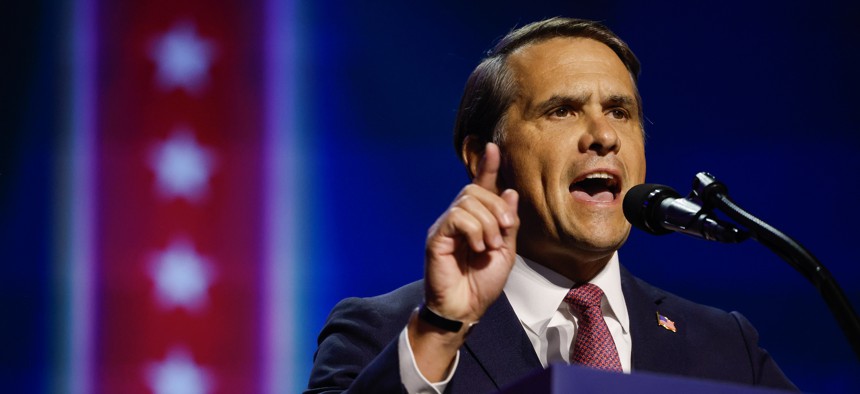
Attorney General Todd Blanche speaks on Sept. 9 at the 2026 Republican National Convention in Dallas, Texas. House Judiciary Democrats argued that the speech violated the Hatch Act. Justin Sullivan / Getty Images



Hatch Act complaints against Trump officials continue to pile up as investigations go on for nearly a year
Attorney General Todd Blanche and Transportation Secretary Sean Duffy are the latest administration officials to be accused of breaking the ethics law.

Last week, congressional Democrats and good government groups accused multiple Trump officials of violating the Hatch Act, a law that limits the political activities of government officials.
While such organizations have filed several complaints since the start of the president’s second term, the agency that enforces the ethics law does not appear to have issued any findings yet concerning the potentially prohibited activities of senior administration appointees.
Attorney General Todd Blanche
House Judiciary Democrats on social media criticized Blanche ahead of his speech before the GOP’s midterm convention.
“The nation’s chief law enforcement officer will be violating federal law on national TV in front of the entire country,” according to the post. “It’s dumbfounding and unprecedented.”
An X account for the Justice Department replied that Blanche’s appearance did not run afoul of the Hatch Act because it was in his personal, rather than official, capacity and had been approved by ethics officials. While the law generally prohibits civil servants from engaging in political activities if they’re doing so in an official capacity (e.g. their government title is used), most federal employees can engage in such activities outside of work hours.
Still, the nonprofit Public Citizen previously argued that Blanche broke the Hatch Act over a speech that he gave at an August campaign rally because his position is subject to stricter rules. Further restricted employees — generally those at intelligence and enforcement agencies – are not permitted to participate in partisan political campaigns.
A DOJ spokesperson at the time said that Public Citizen’s complaint was “baseless.”
Transportation Secretary Sean Duffy
On Sept. 10, Democracy Defenders Fund, a legal organization that is focused on countering the Trump administration, filed a Hatch Act complaint against Duffy over an August speech he gave at a super PAC event supporting GOP candidates in Michigan in which he discussed department business and urged attendees to vote for Republican candidates.
“Although Secretary Duffy is not prohibited from engaging in political activity in his personal capacity, he cannot use his official authority to influence an election,” the organization officials wrote. “That is, however, exactly what Secretary Duffy did when he spoke extensively about official government matters during a political speech in a way that utilized his position ‘to strengthen the impact’ of his political activity.”
The Office of Special Counsel, which enforces the Hatch Act, previously found that officials during the Biden administration, including Navy Secretary Carlos Del Toro and Social Security Commissioner Martin O’Malley, violated the law when they criticized Donald Trump ahead of the 2024 presidential election during media interviews that were primarily about their government work.
A DOT spokesperson characterized the complaint as “another baseless political attack.”
"The secretary’s participation was in his personal capacity and consistent with longstanding practice for presidential appointees,” they said in a statement to Government Executive.
Duffy has been the subject of several ethics complaints, including with respect to a deleted post on his department social media account promoting his wife’s book and a web travel series featuring his family that was funded by companies regulated by DOT. The department said that the post was "inadvertently retweeted” by a staffer, and the secretary asserted that ethics officials cleared his participation in the show.
Grant Terminations
Citizens for Responsibility and Ethics in Washington, a nonprofit, on Sept. 9 filed a Hatch Act complaint after administration officials said in court documents that they canceled $7.6 billion in clean energy grants “based solely on the political identity of the grant recipient’s state.”
“Any agency officials involved in making these decisions based on the political identity of the recipient likely violated the Hatch Act, because they are conditioning funding on a recipient’s support or opposition to a particular political candidate or party,” wrote CREW President and CEO Donald Sherman.
Neither the Office of Management and Budget or the Energy Department responded to a request for comment.
While the Hatch Act is typically associated with election-related activity, it also can apply to how government programs are implemented. For example, OSC in 2025 determined that a Federal Emergency Management Agency supervisor violated the law for directing workers responding to Hurricane Milton in Florida to skip over homes with signs supporting Trump.
Last month, CREW sent a letter to OSC criticizing the length of time it is taking to complete Hatch Act investigations into six senior administration officials, five of which have been pending for more than 10 months. In response, the agency said that it “doesn’t comment on open cases.”
With respect to the Duffy and grant termination Hatch Act complaints, an OSC spokesperson confirmed to Government Executive that the agency received them but did not otherwise have a comment.
The Senate in August confirmed Charles Baldis, a former GOP Senate staffer, as special counsel, though he’s been leading OSC since spring 2025 as the designee of the former acting chief. In 2025, the president removed the former special counsel — Hampton Dellinger, who was appointed by President Joe Biden — before the end of his five-year term.
Penalties for violating the Hatch Act can include removal from federal service, grade reduction, debarment from government employment for up to five years, suspension or a civil penalty of up to $1,000.
If you have a tip that can contribute to our reporting, Sean Michael Newhouse can be reached securely at seanthenewsboy.45 on Signal.
NEXT STORY: Musk should testify about overstated savings from DHS contract cancellations, Democrats argue