

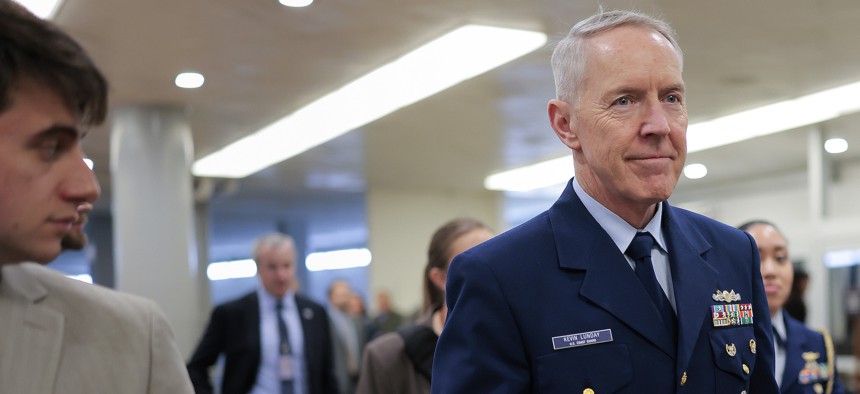
Kevin Lunday walks through the U.S. Capitol on Dec. 11, 2025. He was recently confirmed as the new Coast Guard commandant. Heather Diehl / Getty Images




Missed deadlines, unclear leadership, neglected requirements: Watchdog flags shortcomings in Coast Guard’s efforts to improve sexual misconduct policy following scandal
Coast Guard officials said that President Donald Trump’s orders to eliminate diversity, equity and inclusion programs in the federal government interrupted some reform efforts.

Updated at 11:45 a.m. ET Jan. 15
The Government Accountability Office on Wednesday issued two reports assessing the Coast Guard’s efforts to combat sexual assault and harassment in the wake of Operation Fouled Anchor — an internal review of mishandled sexual assault allegations at the service's Academy from the late 1980s to 2006 that officials did not inform Congress about.
While acknowledging that the service branch has made some progress, investigators made recommendations on how the Coast Guard could enact unimplemented reforms and improve oversight reporting.
In one report, GAO said that the Coast Guard has implemented about two-thirds of 49 reform actions that it promised to take addressing sexual misconduct. Investigators, however, warned that continued success could be hampered by lagging processes:
- Officials said they do not have timelines for completing several actions, some of which were initially supposed to have been enacted by October 2024.
- The Coast Guard’s executive steering committee for sexual misconduct overhaul efforts has not met since November 2024, leading investigators to conclude that the service “does not have an active team to guide reform implementation.”
- Many officials, including at the Academy, said that leadership has not asked for feedback on reform efforts since they’ve been implemented.
GAO also noted that, while the Coast Guard is planning to use fiscal 2026 to add 59 full-time positions to support sexual assault prevention, victim services and independent investigations, it has not “fully assessed and quantified its workforce capacity — including the skills, competencies and resources it needs to fully implement the sexual misconduct reforms.”
Investigators recommended that the Coast Guard establish two-way communications to enable sharing feedback about such reforms and ensure there is an active implementation team. Officials agreed with both, saying they’d complete them by June 30.
The Coast Guard argued that it has already complied with a third recommendation to develop an updated implementation plan, but GAO said that the service’s plan lacked new target dates for completion and other metrics to gauge success.
In a second report, GAO criticized the Coast Guard over its most recent report to Congress on sexual misconduct in the service, flagging that it lacked certain required information and was submitted a year late.
The Coast Guard said that in fiscal 2022 there were 226 reported incidents of sexual assault and 88 of sexual harassment. But officials neglected to submit other information, including the number of times that assault victims were accused of misconduct or crimes collateral to the assault investigation as well as disciplinary actions in cases that were not tried by a court martial.
Additionally, as of December 2025, the service is now late in submitting reports covering fiscal years 2023 and 2024. Investigators did note, however, that officials are revising the 2023 report in light of GAO flagging that the 2022 one lacked certain required information.
Investigators recommended that the Coast Guard ensure annual sexual misconduct reports address all mandated elements and are completed on time, both of which the service concurred with.
Officials interviewed for both reports also said that President Donald Trump’s anti-diversity, equity and inclusion executive orders delayed progress on some sexual assault and sexual harassment reform efforts, as the Coast Guard needed to ensure they were in compliance with the new directives.
In December, the Senate, by voice vote, confirmed Kevin Lunday as the new Coast Guard commandant. He had been leading the service in an acting capacity since January 2025 when the Trump administration removed Linda Fagan, who was the first woman to lead a U.S. military branch, in part for an “excessive focus on diversity, equity and inclusion policies” and her handling of Operation Fouled Anchor.
The Coast Guard in a statement to Government Executive said that: "We are committed to transparency and accountability of the circumstances surrounding Operation Fouled Anchor. We cooperated fully with the Government Accountability Office audit and are taking actions to address their recommendations while continuing to implement reforms to address sexual misconduct.”
This story has been updated with a statement from the Coast Guard.