

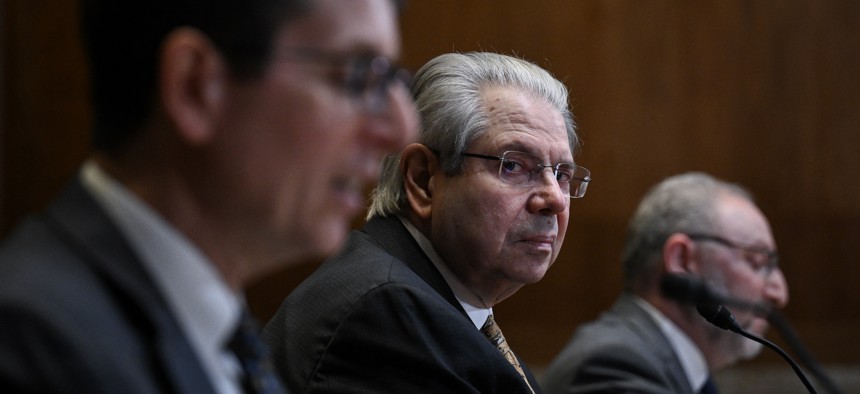
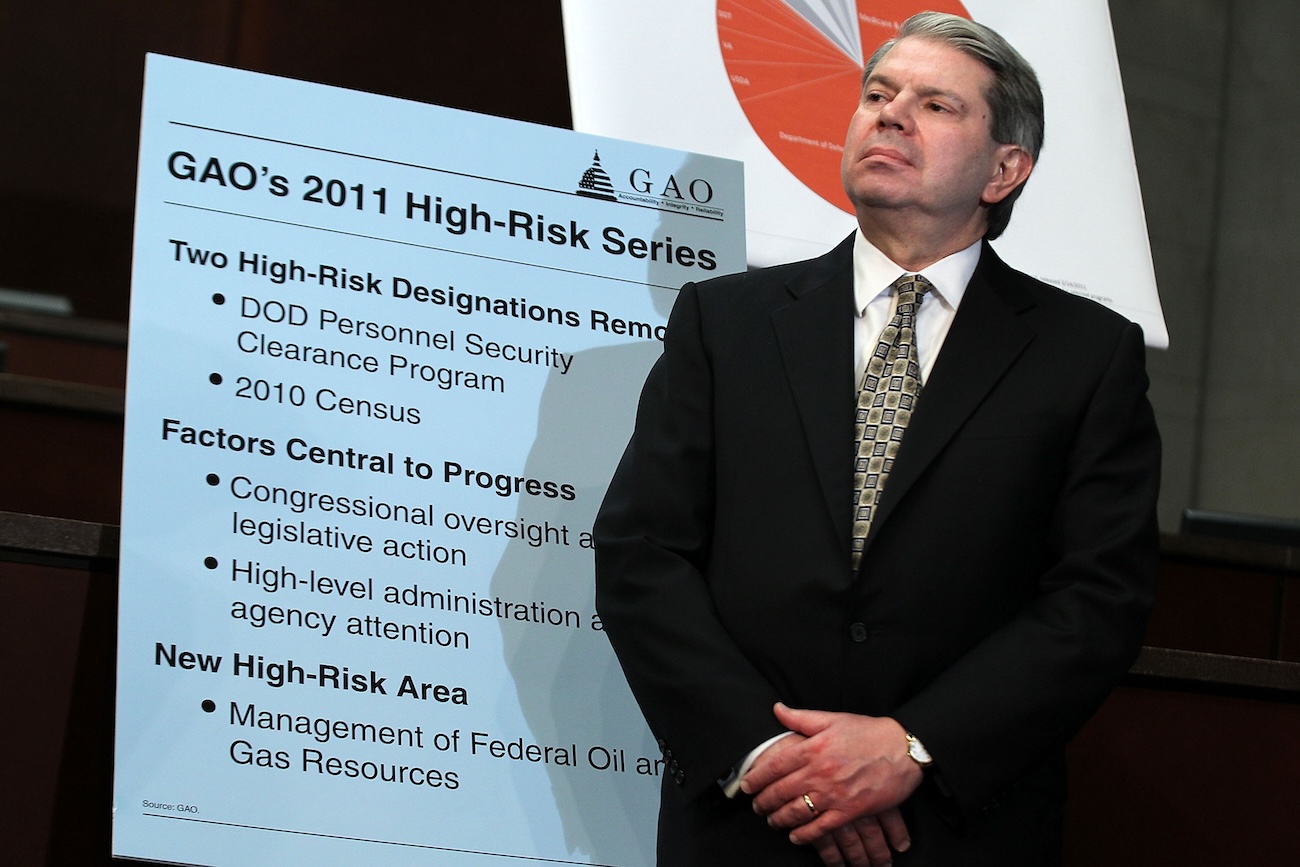
Comptroller General Gene Dodaro testifies during a hearing at the U.S. Capitol on April 29. His term expires at the end of the month. DREW ANGERER / Getty Images




Exit interview: GAO’s Gene Dodaro talks impoundments, tenure and retirement priorities
The outgoing comptroller general reflects on leading the agency through national crises, building a skilled workforce and guiding federal oversight before his term ends Dec. 29.

One of an agency leader’s worst fears is getting put on the high risk list of federal programs that are especially vulnerable to waste, fraud, abuse, mismanagement or are in need of transformation.
That list is compiled at the start of each new Congress by the Government Accountability Office, an agency within the legislative branch that issues reports on the performance of federal programs and makes suggestions on how agencies can improve their effectiveness and efficiency.
Gene Dodaro has led GAO since 2008, first as acting comptroller general for two years before being confirmed in 2010 for a 15-year term. After he retires at the end of the month, Congress will establish a bipartisan, bicameral commission to recommend replacements to the president, who will then nominate a candidate subject to Senate confirmation.
Sarah Kaczmarek, managing director of GAO’s Office of Public Affairs, has confirmed that the agency will be led in the interim by Chief Operating Officer Orice Williams Brown.
Over his more than 50 years at GAO, Dodaro has influenced the federal government’s response to the 2008 financial crisis and COVID-19 pandemic as well as numerous security challenges. Earlier this year, Government Executive inducted him into its Government Hall of Fame.
In this exit interview, Dodaro discusses what it’s like to lead a workforce of “trained critics,” how to build relationships with an array of political figures and GAO’s future, particularly as it runs into conflict with the Trump administration over impoundments, which is when the executive branch delays or withholds congressionally approved funding.
Editor’s note: The following interview has been lightly edited for clarity and length.
What motivated you to join GAO as an entry-level auditor back in 1973?
GAO actually came to my campus. The comptroller general at the time was Elmer Staats, and his wife, Margie, her family were benefactors of the university. So it was sort of happenstance that because the comptroller general's wife at the time was a graduate of the school that I went to, and her family was supportive of the university, that GAO came on campus.
They talked to me because I was an accounting major. But they told me if I went to GAO, I didn't have to do accounting all the time. GAO was engaged in a wide range of activities. And I also was interested in doing public service. My grandfather, my namesake, was an immigrant from Italy, and I saw what this country could do for somebody coming from a poor region and providing opportunities for our family. So I thought it was a good fit for me and my interests, which were much broader than accounting. And GAO gave me an opportunity to do public service, to give back to the country and try to help our government provide the best services possible to the American people.
Because you ended up at GAO as a result of an agency campus visit, during your leadership tenure, have you prioritized or have you been able to go to college campuses to talk about the agency's work?
I think it's essential. I've prioritized making sure we have a very robust internship program here at GAO. We usually bring in about 200 interns every year. It's one of our main pipelines for future development of the GAO workforce.
I've been out on campuses. I've given commencement addresses. The University of Georgia, for example, I was just there. I was asked to kick off their ethics week. We have an Educators Advisory Panel here at GAO made up of deans of schools of public policy, public administration, information technology and accounting.
We have over 50 colleges and universities in our national recruiting program. So I've visited as many campuses as I can across the country. And I enjoy it. I enjoy engaging with students, helping them understand the importance of public service, the big changes that you can accomplish as an individual and the improvements that you can make. And students have a vested interest in shaping the environment in which the federal government is operating to deal with a wide range of domestic and international challenges.
I do it at every opportunity I can. There's also a number of schools that send people to GAO as part of their Washington visits, and so I always make time to meet with them when they're in town here as well. So it's a big priority for me. It's important that we attract the talent that we need to the federal government to deal with all these challenges that are facing us. Bringing in people at the entry level to establish a talented pipeline, it's very, very important.
Of the 38 areas on GAO’s high risk list, for example, at least 22 are on there, in part, because of skill gaps and shortages. It's not just more people; we need the people with the right skills, talents and abilities. I think because of our effort on recruiting and internships that our retention rate is 96% here at GAO. So people come and they stay, particularly if they've been here three years or more.
(GAO’s retention rate in 2024 was 95% with retirements and 97% without retirements.)
But also people go on to try other things, and they come back to GAO. I encourage that because I don't want anybody to ever feel they didn't pursue whatever they wanted to pursue. Then when they come back, they have additional skills, abilities and perspectives.
One reason that we've been ranked as one of the best places to work in the federal government all 17 years of my tenure — the last five years, we've been ranked number one among midsize agencies — it's because these activities create a network. They talk to their friends, they say they have good experiences. The professors know us. They know what work we do. So you have this network of support for young people to be able to consider a career here at the GAO.
I also explain to them that we have continuing professional education here at GAO. We have a learning center. So if you're interested in working with very smart, talented people, most of our people have advanced degrees. If you're interested in working for an organization that people listen to, we have an impact. And when they're interns here at GAO, we put them right to work. So they get an idea what it's like to be an analyst on an engagement audit with GAO, and we get a chance to see how they do. So if we're happy, they're happy and when they come then you're already in a very good position to be able to retain people.
In your more than 50 years at GAO, what have you done that you think has had the greatest impact on the American people?
I’ll give you a couple categories.
One is helping the country when there's a national emergency. I became acting comptroller general in March 2008. We were on the precipice of a potential depression. The chairman of the Federal Reserve, Ben Bernanke, and Treasury Secretary Hank Paulson had gone to Congress and asked for $700 billion. The credit markets were frozen. Banks weren't lending to banks. It was a very tenuous time for our country.
I recommended that they have more accountability over the money. There was like a two- or three-page bill, and it didn't have a lot of accountability in it. They were motivated by saving the country, and I understood that. But we also need to have transparency and accountability, particularly over that amount of money. Congress took my suggestions and added additional requirements, so GAO had to be on site at the Treasury Department the day the law was passed in October 2008 and also report publicly every 60 days.
I first testified on this in December 2008. We had 10 recommendations to Treasury, including better reporting about what the banks were doing with the money that was infused to help them increase lending, open up credit to people and ease the strain on the financial markets and systems. I also testified on the auto companies; General Motors, Chrysler, Ford, they were looking for loans. They were concerned about potential bankruptcies, and I testified on how those loans could be strengthened to protect the American taxpayers.
Of the $700 billion program, only about $400 billion was actually spent, but the net result of that activity was $31 billion. Banks all repaid the money with interest and loans. The automakers paid most of it back, not all of it. Most of the net cost was a part of the program to help pay people's mortgages, so they could stay in their homes. The emergency funding measure wasn't popular because it was viewed as bailing out Wall Street, but it helped stave off a really serious situation. It helped a lot of people, and GAO was a key player in making sure that it was done efficiently, effectively and protected the taxpayers’ interest. And I think, ultimately, it was a bargain at $31 billion net cost of that program.
We've done the same thing during the Great Recession where we were looking at the $800 billion stimulus package. We were reporting on what state and local governments were doing with the money every 60 days. So we were doing real-time auditing, and Congress has a reliable partner in GAO when we have these extraordinary events.
Same thing with the pandemic. We tracked all $4.6 trillion, the largest American rescue package ever, and we provided monthly briefings to congressional committees and bimonthly reports. We had over 200 reports, over 400 some recommendations. (It was 484 recommendations, specifically.) So bringing real-time auditing to major national efforts that have extraordinary circumstances is a hallmark of GAO.
Secondly, is to bring about focus on the highest risks across the federal government. Our high risk list has been going on since 1990. I've continued it. We've expanded it. We've worked to make improvements. One of my priorities was not only to identify these risks, but to work with the Congress and the agencies to get areas off the list.
One of the areas that we got off the list was that the government wasn't planning to put in more modern weather satellites. The satellites that were in place, both the polar orbiting satellites and the geostationary satellites, were aging, and the government didn't have a good plan to replace them or have contingency plans. This is both for the National Oceanic and Atmospheric Administration and for the Air Force. As a result of our work, Congress provided additional funds. The agencies got plans in place, so we have more modern weather satellites now. It’s particularly important as the severe weather events have become more frequent and more severe over time, so it protects life, property and helps people, the economy and individuals recover more quickly if they can limit the damage by being prepared ahead of time.
I've also created, with the support of the Congress, an expanded role for GAO in science, technology and engineering areas. This has helped GAO to provide great support to the Congress on evolving artificial intelligence areas — to be able to regulate that technology — and also oversee federal investments in quantum computing, regenerative medicine, computer-brain interfaces, etc. Science and technology is evolving faster than any time in human history, so that will help Congress deal with these issues, and the American people will be the beneficiaries of that involvement.
We also have done a lot of work at the Defense Department on military readiness, national security and homeland security issues. Following 9/11, we identified the lack of good information sharing among intelligence agencies to protect us from terrorist attacks. Eventually, we took that area off the high risk list. Congress created an information-sharing environment. We worked with the director of National Intelligence and other communities, so we now have a robust system of sharing information to help protect the country.
In 1997, I raised computer security as an important vulnerability across the entire federal government. In 2003, I identified critical infrastructure protection as a vulnerability — electricity grid, the financial markets, telecommunications, our water infrastructure system. All these things are very vulnerable, and I think our work has led Congress and the private sector to take these issues more seriously.
We're still not, as a country, acting at a pace commensurate with the evolving grave threat to these issues. We really need to continue to do that. But I think because of GAO’s early identification of these issues and encouragement of laws and information sharing between the public and private sectors, we’re better prepared than we were before. We're not as prepared as we need to be. So there's still work to be done.
Those are a few areas that come to mind. I know we have a limited amount of time. I could go on, but I won't.
Looking to the future, what qualities and experiences do you think the next comptroller general should have?
First and foremost, you have to have the trust and confidence of both parties of Congress and both chambers. You have to operate in a nonpartisan, independent manner. You are there to provide support to the entire institution of the Congress for a 15-year period of time. It's a long period of time. So the person has to be able to have trusted relationships with a wide range of people throughout the Congress.
You also have to have the ability to engage and work in a constructive manner with the executive branch and the agencies that you audit and review. Thirdly, I would say you need to have someone who can manage a multidisciplinary organization. We have over 3,000 highly trained professionals of virtually all disciplines. Financial auditing is only about 10% of what we do. The rest of it is performance audits. We need economists. We need subject area experts in defense, healthcare, transportation, etc. We have actuaries. We have scientists. We have computer security experts, acquisition experts, so we have a wide range of subject area technical experts.
We do work that supports over 90% of the standing committees of the Congress. There's a wide footprint, so you have to have somebody who can manage a multidisciplinary workforce on a portfolio of work that transcends across the federal government's activities. They have to be a person that can work with these highly trained people at GAO.
I leave behind me a very strong workforce. The GAO workforce is among the best in the world. I have total confidence in them, but you need somebody who can come in and understand how they carry out their activities to make continuous improvement, as I've tried to do over my time.
You have to stay up to date. One of GAO’s strengths is evolving to meet the needs of the Congress and to meet the needs of the country. We've changed greatly in our over 100 years of existence.
We're in the auditing business, but we're also in the relationship business, so you have to be able to do that. GAO has about 3,500 people currently. They're all trained critics. They don’t just critique others, they're always critiquing whoever's leading the agency as well. So you have to have somebody that can gain their trust and confidence within GAO as well as with Congress and the executive branch. Those are a few of the key qualities that I think are the most important.
As far as relationship building goes, how did you manage to form successful relationships with members of both parties, in both chambers as well as federal agency leaders?
You have to be proactive. I try to meet with all the chairs and ranking members of committees as much as I can, and it's difficult. They have intense schedules. But I try to do that to talk about and find out about their priorities, to encourage them to implement some of our open recommendations and to just have a general dialogue. I go and I meet with as many members of Congress as I can. And I meet with both the chair and ranking members — always.
I'm always meeting with both sides. And it makes a difference when you go meet with somebody when they’re in the minority, and you don't just show up when they're in the majority. To me, it's important to always send a signal that we're nonpartisan. We are here to support you whether you're in the majority or minority. And whoever asks us a question, they get the same answer. So we need to be consistent.
I also go and I meet with the leadership of each executive branch agency, once people are confirmed and in place. I've met with the Secretary of Veterans Affairs Doug Collins. I’ve talked to his deputy, Paul Lawrence. I met with Education Secretary Linda McMahon. I've met with the secretaries of the Army and the Air Force and just met yesterday with the deputy Agriculture secretary. So I go across the range of the federal government to explain how we interact with the agencies, how our processes work to make sure we're transparent, fair and professional and how agencies get to comment on our draft reports and have their comments included.
I'm also encouraging them to implement our recommendations. About 77% of our recommendations are implemented, and most of that's voluntary by the executive branch agencies. We have no enforcement authority. Congress is our enforcement authority. Sometimes Congress will direct the agencies to implement recommendations, perhaps faster than the agencies would have implemented them on their own or necessarily at all.
Being proactive is the key. Then, you’ve got to act with consistency and trust. When you're in the business that we're in, people aren't always going to be happy with your results if you're truly independent. Sometimes people think that there's one type of outcome they're going to get from asking us to look at a certain area, and they get a different outcome because the facts don't support what some of the theories are. So we go through those facts, and you have to communicate effectively.
Some things are inevitably not going to be always in sync with some of the political objectives that people are pursuing. But we need to operate in the political environment. We're not political. We’re going to tell people the truth. We're going to give people the facts. We're giving people constructive recommendations, not just critiques of what might have gone wrong or what could be going wrong.
One of the most difficult parts of the job is to convince Congress and the executive branch agencies to take action before there's a crisis. I mean, that's difficult. Probably the biggest success I've had in that area was during the Y2K computing crisis. I was able to convince Congress to set up special committees, both in the Senate and House, to focus on that. The president created a Y2K Conversion Council, and I was an observer there. We were able to successfully avoid any calamities that could have occurred because action was taken ahead of time.
While their effort was not successful, House Republicans proposed halving GAO’s funding and limiting the agency's authority to sue over impoundments. Considering that, are you worried about the future of GAO?
Well, no, I'm not.
First of all, the outcome of the budget decisions by Congress this year was flat funding for GAO, no reduction in funding. Obviously, you have to absorb additional costs with the same level of funding, but it's a far cry from what was proposed by the House Appropriations Committee. I think that truly reflects strong bipartisan support across the Congress for GAO.
Now, you need to continue to earn that confidence and trust. I'm confident GAO will be able to do it. GAO is valued highly by a wide variety of people in the Congress, but we need to continue to communicate that effectively. We need to make sure that we're fair in how we treat the executive branch.
For example, our reviews looking at potential impoundment issues have been evenhanded. In half of our reports we found problems, and the other half no problems. So we approach everything on a facts and circumstances basis and what's in the law.
We're continuing to get a wide range of requests from the Congress. In fact, we're getting as many, if not more, requests for our work, which signifies to me that there's a wide range of people who trust GAO to continue to ask us to review some of the most highly sensitive and complex areas in the federal government. They know we have the capabilities, and we're going to produce good, objective, fact based, nonpartisan work that they can use to then help build consensus in the Congress about making some changes.
I've never been one to be overconfident, but you have to be optimistic. You have to believe in yourself. If you don't believe in yourself and the organization, other people aren't going to believe in you, and I believe in GAO. I believe we're a positive force for change in the government. I believe we're the taxpayers’ best friends. I believe we're the most reliable source in producing savings in the federal government. During my tenure, it's been over $1.2 trillion in savings. That has been done on a reliable, consistent basis and without hurting people or having undue negative impacts. These are savings that occurred because agencies are eliminating overlap, duplication, reducing risks and making wiser investments.
I know the people here at GAO. They're true professionals. They are dedicated to public service. They're dedicated to supporting the Congress. They're dedicated to working constructively with the executive branch, and when all those things come together that will continue to provide good, broadbased support for GAO into the future.
What are you doing on the first day of your retirement?
If I can, I'm going to be hugging all my nine grandchildren and spending more time with my wife. My family has — as all public servants do, families of our military as well as our civilian people — made sacrifices in order to have people serve the country. I owe my family a lot, and I will continue to spend as much time as I can with them. Love carries you a long way, so we'll see what the future holds for me beyond that. But that's my priority.
Share your news tips with us: Sean Michael Newhouse: snewhouse@govexec.com, Signal: seanthenewsboy.45
NEXT STORY: Why America needs the GAO: DOGE done right