

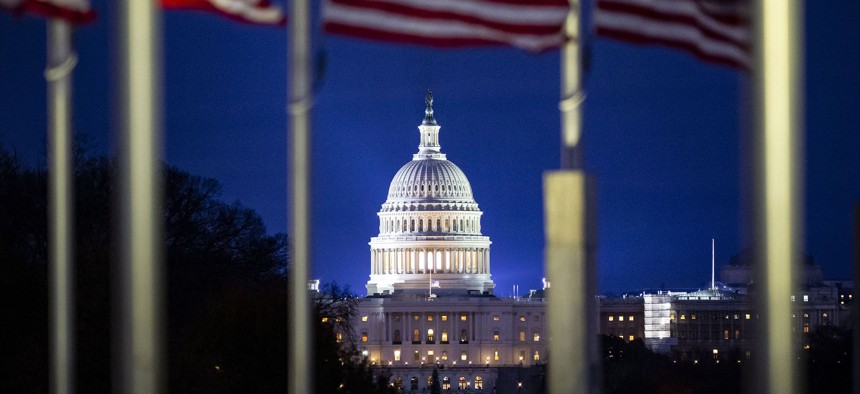
Several federal employees who were pushed out of their jobs last year ran for Congress. Al Drago / Bloomberg / Getty Images




They left federal service and ran for Congress. Even in defeat, they found a new way to serve
At least two former feds will be members of the House next year.

Around a dozen former federal employees ran for Congress in this month’s midterm elections, and at least two won their races. Even those who won’t be heading to Capitol Hill next year, however, said that being political candidates enabled them to continue public service despite leaving their agencies.
“The world is wide open for me, and I will be looking for a job and considering whether I'll be running for office again in the future. But first and foremost, I’ll be looking for a job,” said Democrat Lauren Reinhold, who lost her race to represent Kansas’ 1st District. “Any headhunters who want to come my way, I would be glad to talk to them. But I will say, I don't have a real specific, clear sense of what I want to do next, but I know that it will be focused on public service and good government.”
Reinhold, who served in several different roles at the Social Security Administration and National Labor Relations Board before leaving government following objections to the Trump administration’s federal workforce policies, said that her experience as a nonpartisan civil servant helped her to persuade voters in a GOP-leaning district.
“It helped me zero in on the issues and frame them in a nonpartisan way, which we had to do in this race,” she said. “There's no way I would have moved the needle about 10 points if I hadn't done that because I had to stand in front of people of unknown political persuasion and give them my platform in a way that everyone, in an honest way, could buy.”
While Reinhold said that people were “very rarely overtly rude” to her, she also said that some voters, after hearing about her agency experience, would “find an ‘aw shucks’ way to say ‘I really think the government is too big.’”
Chris Backemeyer, a Democrat who ran in Nebraska’s 1st District, said that his decades of experience at the State Department was “appreciated for the most part” by voters, especially after the war in Iran broke out, as he previously participated in nuclear negotiations with Iran. But he also said that some people’s lack of understanding that the civil service serves across administrations hurt him.
“The biggest criticism from my opponent was that I worked for Kamala Harris and Joe Biden to drive up prices, supposedly,” he said. “I also worked for Donald Trump, and I also worked for George Bush and I also worked for Barack Obama.”
Trina Swanson — the Democratic nominee in Minnesota’s 8th District who previously held senior roles at U.S. Citizenship and Immigration Services — said that she was surprised by how many technical immigration questions she got from voters, such as about the green card process and refugee vetting. She attributes this to the increased immigration enforcement that recently occurred around Minneapolis.
“I came away from those where people trusted me and what I could bring to the table, and that I actually could push comprehensive immigration reform in Congress and be that voice of reason in the room that would not just use immigration as a way to score political points,” she said.
Swanson urged the new Democratic majorities in the House and Senate to pass legislation prohibiting Immigration and Customs Enforcement agents from wearing masks, requiring them to wear body cameras and obtain judicial warrants before entering homes. She also urged lawmakers to conduct oversight into ICE’s hiring surge.
“[ICE] has an important function to play, but we can't be in a situation again where that agency is allowed to be weaponized against the people of this country,” she said.
While most of the former feds who ran for Congress lost their races, Democrat Zach Dembo, a former federal prosecutor who resigned due to the Trump administration’s overhauls at the Justice Department, won his election to represent Kentucky’s 6th District. And Democrat Sam Forstag, a Forest Service smokejumper and union official who said that he was motivated to run to oppose Department of Government Efficiency cuts, will represent Montana’s 1st District in the new Congress.
But even those who didn’t win said that running as a political candidate was a rewarding experience.
“It was refreshing to be able to decide my own policy platform and my priorities and focus on the issues that I felt were the most important, which you don't always get to do when you're working in the federal government,” Backemeyer said.
Swanson expressed a similar sentiment.
“When you're a public servant, you're just used to implementing other people's laws and policies and positions, and you aren't out there pushing your own agenda or selling yourself,” she said. “So for all of us to take something really negative in our lives and turn it into something positive, and want to continue that public service, I think is honorable.”
If you have a tip that can contribute to our reporting, Sean Michael Newhouse can be reached securely at seanthenewsboy.45 on Signal.
NEXT STORY: Trump taps OMB deputy to lead GAO amid rushed selection process