

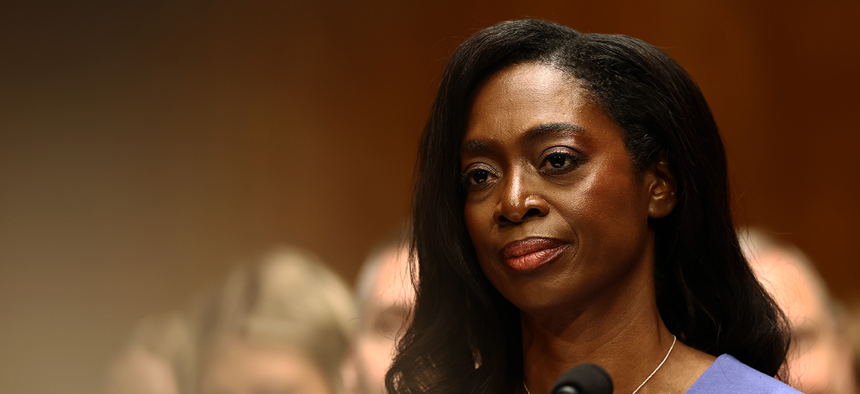
CDC Director Dr. Erica Schwartz told the audience at a healthcare conference that the agency’s workforce morale is at an “all-time low.” Finn Gomez/Getty Images



CDC director acknowledges employee trust is at an ‘all-time low’
Dr. Erica Schwartz is trying to rebuild trust with a workforce still reeling from staffing cuts and leadership upheaval. But her remarks Thursday included another misidentification of the officer killed at CDC headquarters last year.
For the second time in recent months, a top leader at the Centers for Disease Control and Prevention has invoked the name of the police officer who died in a shooting at the agency’s headquarters – only to get his name wrong.
CDC Director Dr. Erica Schwartz told an audience at a healthcare conference Thursday that employee morale is at an “all-time low” as the agency works to rebuild trust with its workforce and a skeptical public.
Schwartz, who took over as the agency's permanent director in August, said the CDC is developing plans to win back trust internally and externally. The agency also expects to carry out a hiring plan next year to replenish its ranks after major staffing cuts last year.
But CDC employees say the agency still has a long way to go.
In August 2025, a gunman opposed to the COVID-19 vaccine opened fire on the CDC headquarters in Atlanta, killing a responding police officer, David Rose.
HHS Secretary Robert F. Kennedy Jr. commemorated the first anniversary of the attack by visiting CDC headquarters on Aug. 7, 2026, where he met with Rose's family.
During a fireside chat at the Milken Institute Future of Health Summit, Schwartz referred to an “Officer Stone” who died in last year’s campus shooting.
“The psychological safety, you’ve heard me say, within the CDC is at an all-time low. There’s just multiple things – with the shooting that happened with Officer Stone last year, almost a year and a half ago, with the fact that there have been so many changes within the CDC. We have certainly lost trust. I have lost trust with them, and I’m trying to earn that trust every day,” Schwartz said.
In July, ahead of the one-year anniversary, National Institutes of Health Director Dr. Jay Bhattacharya, who was also serving as interim CDC director at the time, told agency employees that the agency would honor Rose for his sacrifice in the line of duty — but got his first name wrong.
“As everyone knows, there was last year the tragic event of a shooting at the CDC, and that led to the death of a young officer, Derek Rose,” Bhattacharya said. “On Aug. 8, we’re going to celebrate his life. We’re going to have a rechristening of the street leading into the CDC in honor of him, and we’ll celebrate the CDC.”
A CDC employee told Government Executive on Thursday that that staff “are pretty upset.”
“If they can't give him the respect of getting it right, they shouldn't even say his name,” the CDC employee said.
A second CDC employee described the mixup as “certainly disgusting.” The CDC did not immediately respond to a request for comment.
Rebuilding the workforce
Schwartz said the CDC has created a hiring plan that “should hopefully be going into action in 2027.” CDC officials have told employees at least since March 2026 that hiring plans have been in the works, but have not yet materialized.
The CDC cut its workforce by about 25% under the second Trump administration. Kennedy told lawmakers in April that the department will make about 12,000 new hires. Despite Kennedy's announced hiring surge, the CDC so far hasn’t done much hiring, and has relied on temporary details to address some of its staffing shortages.
Schwartz told employees in late October that the agency has selected four permanent center directors, although several are still going through the security and ethics clearance process. She said another five candidates to lead CDC centers are still in the interview process. Former CDC officials told reporters in June that over 80% of CDC center director positions lacked permanent leaders, and were being run by acting officials.
Rebuilding public trust
Schwartz also said the agency is working to restore public confidence in its scientific work.
“In terms of addressing external trust, it's all about making sure the American public understands how we are going with the science. Wherever the science leads us, we're going to go. Looking at being as transparent as we can, and then really leading with humility," she said.
Schwartz acknowledged that the CDC and other public health institutions lost public confidence during the COVID-19 pandemic by failing to engage Americans in meaningful conversations about public health measures.
"I do think during the COVID pandemic, there was an arrogance that came from institutions like the CDC, telling Americans that 'You will do this, you shall do this,' and really not having a conversation with the American public. And I want to be a CDC director that really has a conversation with the American public."
HHS has pursued a vaccine-skeptical agenda under Kennedy’s leadership. Former CDC Director Dr. Susan Monarez told a Senate panel in September 2025 she was fired for resisting his orders regarding vaccines.
The U.S. is also experiencing the largest measles resurgence since 1991, and the Pan American Health Organization, a branch of the World Health Organization, is deliberating over whether to remove the country's measles-elimination status.
Schwartz said that she and Kennedy agree that the measles-mumps-rubella (MMR) vaccine “is the number-one way to prevent measles.” But on other matters of public health, Schwartz said “I disagree all the time” with the HHS secretary.
“What I love about the secretary is that he listens to those disagreements. He's not someone who just says, 'No, I don't have room for that.' He really does value differing opinions. And I what I appreciate about having these conversations with him is that he brings in other people who again have different opinions," she said.
In her first remarks to CDC’s workforce in August, Schwartz said she will “speak truth to power,” and ensure staff can offer candid feedback on policy matters without fear of retaliation.
Schwartz said one of her goals is to create a “21st-century CDC” focused on innovations in public health, and that she is “excited to work on both sides of the aisle” with a new Congress next year.
“I know that we may not agree on every issue, but I do think there are common grounds where we there's a common ground where we can actually focus on really trying to make Americans healthy again," she said.
If you have a tip that can contribute to our reporting, Jory Heckman can be securely contacted at jheckman.29 on Signal.
NEXT STORY: VA staffing losses are disrupting critical services at multiple hospitals