

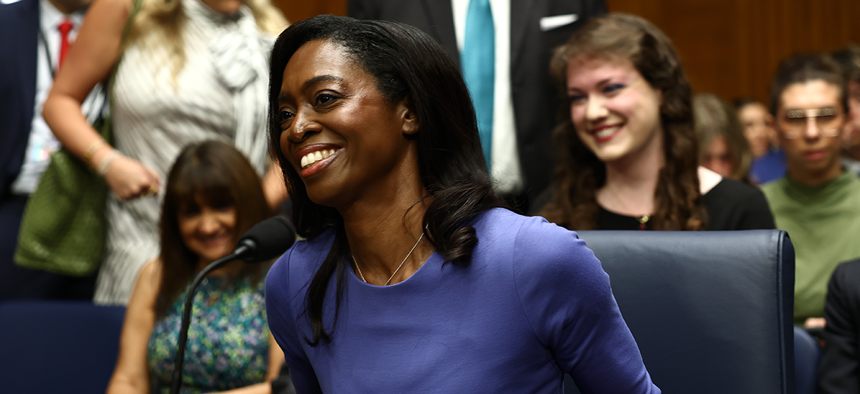
CDC Director Dr. Erica Schwartz told employees at a town hall Thursday that the agency is in the process of filling center-level leadership vacancies. Finn Gomez/Getty Images




CDC hiring plan and more permanent leadership coming soon, director tells staff
CDC leaders say they're close to finishing a hiring plan that would replenish the agency’s ranks after deep staffing cuts last year, but employees have heard similar messages since March 2026.

The Centers for Disease Control and Prevention is shoring up vacancies in its leadership ranks and telling employees that a hiring plan to mitigate the agency’s deep staffing cuts is coming into focus.
CDC Director Dr. Erica Schwartz told employees at a town hall Thursday that the agency has selected four permanent center directors, although several are still going through the security and ethics clearance process. She said another five candidates to lead CDC centers are still in the interview process.
Schwartz said she’s hopeful that by the agency’s next all-hands meeting, “we will be able to announce that all nine positions have been filled.” Schwartz told employees in August, shortly after her Senate confirmation, that she would focus on rebuilding trust in a workforce that has been fearful of retaliation, and would hold listening sessions with employees.
“Folks were saying they want stability. They’ve been through so much instability that there is a need for stability. And so the one thing that I would like to let all of you know, as a result of those listening sessions, is that we have been working very hard to actually put permanency in our leadership positions," Schwartz said, according to a recording obtained by Government Executive.
Former CDC officials told reporters in June that over 80% of CDC center director positions lacked permanent leaders, and were being run by acting officials. The CDC did not immediately respond to a request for comment.
Sean Slovenski, CDC's principal deputy director and chief operating officer, previously told employees in a town hall this summer that he had “never seen such a plethora of acting roles in my life,” and that acting leaders typically don’t feel empowered to make decisions with a lasting impact.
Slovenski said Thursday CDC leadership is close to finishing a hiring plan that would replenish the agency’s ranks. CDC officials have told employees at least since March 2026 that hiring plans have been in the works, but have not yet materialized. CDC cut its workforce by about 25% under the second Trump administration.
“I know a lot of people have been asking, ‘Where are we in the hiring plan?’ We are pretty far down the road. Going into the beginning of the year, we're going to be able to move on a lot of that,” Slovenski said. “I think you're going to start to see things move a heck of a lot quicker than they have this past year or so.”
HHS Secretary Robert F. Kennedy, Jr. told lawmakers in April that the department will make about 12,000 new hires.
“We will have made up all the employees that we lost, and we’ve replaced them with a better group of people who are actually going to address chronic health,” Kennedy said.
Despite Kennedy's announced hiring surge, CDC hasn’t done much hiring, and is relying on temporary details to address some of its staffing shortages. According to the latest federal workforce data from the Office of Personnel Management, CDC has made 243 hires since the start of the second Trump administration – but has seen a net decrease of 3,389 employees.
“We've made great progress on getting through the initial approvals. Obviously, there's process at the HHS level, we're working through that, but so far we've gotten good affirmation on the requests that we've had for 2027,” Slovenksi said.
CDC this year responded to outbreaks of Ebola and hantavirus abroad, as well as cyclospora and measles outbreaks in the United States.
Dr. Henry Walke, director of CDC’s Office of Readiness and Response, told employees the Ebola outbreak in remote areas of the Democratic Republic of the Congo, is the DRC’s largest outbreak and the “second-largest outbreak ever.”
“We have around 60 cases a day and about 30 deaths every day,” Walke said, adding that “it’s growing more quickly than previous outbreaks.”
The CDC estimates that there’s been 9,735 cases and 4,690 deaths linked to this current outbreak.
“We're rapidly approaching 10,000 cases. We'll probably reach that milestone in the next week, and 5,000 deaths,” Walke said.
Two Americans were previously diagnosed with Ebola and were successfully treated overseas. But to date, no cases of the disease have been confirmed in the United States in connection with the current outbreak.
“We anticipate this response will remain activated until well into the new year. And so, we will need all of CDC to stand up and be engaged,” Walke said.
“This year has placed significant demands on CDC's emergency response capabilities, and I want to thank the many staff across our agency who've stepped forward to support these efforts,” Schwartz said. “With our ongoing Ebola response and other public health emergencies, we will continue to need expertise from across CDC in the months ahead.”
To monitor more common illnesses in the United States, Schwartz said the CDC’s Center for Forecasting and Outbreak Analytics has released an “enhanced surveillance tool” that will allow Americans to track COVID-19, influenza and RSV in their communities.
“Why I think that's so innovative and so great is because now you're basically giving them better information,” Schwartz said. “They're going to be able to make more informed decisions faster, because they're getting this data [in] almost-real time. It's not real-time specifically, but much faster than traditional surveillances.”
NBC News reported in September that the CDC recently raised its benchmark for levels of COVID-19 in wastewater, adjusting a key metric such that a level that would previously have been classified as high transmission may now register as moderate instead. The Associated Press reported in May 2025 that a dozen data-gathering programs that track deaths and disease at CDC had been eliminated in the early days of the Trump administration.
If you have a tip that can contribute to our reporting, Jory Heckman can be securely contacted at jheckman.29 on Signal.
NEXT STORY: HHS telework rollback challenge upheld by FLRA