

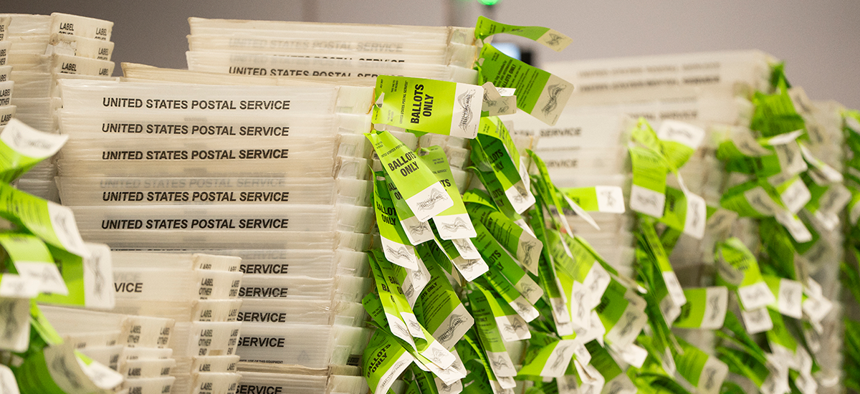
The Supreme Court's order states the government “is unlikely to succeed on the merits of its challenge” to a lower court's preliminary injunction. Photo by Rebecca Noble/Getty Images



Supreme Court keeps USPS from carrying out mail-in voting changes in midterm elections
Postmaster General David Steiner previously told Government Executive that USPS would comply if the courts decided to block these changes.

The Supreme Court is keeping the Trump administration from imposing new rules for mail-in ballots in the lead-up to the midterm elections this November.
President Donald Trump signed an executive order in March imposing new rules on mail-in voting. The Postal Service released a final rule in August to implement the executive order.
The court’s tersely worded and unsigned order issued Monday evening states that the government “is unlikely to succeed on the merits of its challenge” to a lower court's preliminary injunction that barred USPS from taking further steps to carry out its final rule.
The final rule would have required states planning to send mail-in or absentee ballots to provide USPS with a list of participating voters. The final rule also established new barcode and envelope-formatting requirements.
USPS previously provided nonbinding guidance to states on envelopes and barcodes in previous elections, but its final rule would have allowed the agency to reject ballots that didn’t meet its standards. USPS was also tasked under the executive order with launching a Federal Mail Ballot Portal for states to upload their voter lists.
Justice Brett Kavanaugh wrote in his concurring opinion that "there is at least a fair prospect that the final rule falls within the Postal Service’s statutory authority," but that applying the final rule to this year’s elections would be “arbitrary and capricious” under the Administrative Procedures Act, “because state and local election officials do not have sufficient time to reasonably implement the rule before the elections.”
Justices Samuel Alito and Clarence Thomas, in their dissent, wrote that the “Postal Service has broad authority to regulate the mail,” and that without a stay of the lower court’s ruling, the government “will suffer irreparable harm." The USPS final rule, they argued, would have increased the visibility of ballots in transit and would have helped “better detect election fraud.”
Postmaster General David Steiner told Government Executive in an exclusive interview last month that USPS “is not a political organization,” and would comply if the courts decided to permanently block the executive order's implementation.
“We deliver the mail. Someone else makes the rules. We deliver the mail, and so we deliver the mail under the rules that are put on us, and that's exactly what we'll do. People can fight over whether the rules are valid or not. Once that fight is finished, we'll do whatever the courts say we can do. That's not our decision,” Steiner said.
The American Postal Workers Union, which represents the frontline USPS employees most directly impacted by the final rule, warned that its employees hadn’t received training on changes outlined in the executive order or USPS final rule.
In an amicus curiae brief, the union warned that the final rule would “likely cause catastrophic wholesale non-delivery of mail to hundreds of thousands of voters,” because postal clerks “cannot realistically be trained" on these changes ahead of the November elections.
APWU represents the frontline Business Mail Entry Unit (BMEU) clerks who accept large batches of mail-in ballots to be delivered to voters. Under the final rule, postal clerks would have scanned a sample of each batch of ballots to confirm the voter information on individual ballots matches the information states submitted to the online portal.
A USPS whistleblower claimed that if clerks identified any errors in the sample, USPS would have refused to accept the entire batch - in many cases, tens of thousands of ballots - until election officials resolved the errors.
APWU also represents the IT workers tasked with creating that online portal. The USPS whistleblower also claimed that the agency has rushed to complete work on the portal, and hasn’t followed “standard principles of testing and debugging new software before launch.”
If you have a tip that can contribute to our reporting, Jory Heckman can be securely contacted at jheckman.29 on Signal.
NEXT STORY: DHS secretary defends smaller FEMA workforce after judge challenges 50% staffing cut plans